-
The weekend in review
Read Full Post: The weekend in reviewIt was a busy old weekend. Our class pretty much split into two: half of us spent the weekend in Pollenzo, checking out the other campus of our uni and attending a meeting of the Slow Food offices, while the other half larked about at Carnivale in Venice. I couldn’t tell you who had more fun!?
The group I joined got a grand tour of our big brother campus. Our campus at Colorno is the small and newer half of the university which began in Piedmont, in the village of Pollenzo, about ten minutes from Bra where the headquarters for Slow Food has its offices. Amazing things have been done to transform Pollenzo’s campus – the Agenzia di Pollenzo, a neo–gothic estate built in 1833 as a model farm by King Carlo Alberto of Savoy – into a sparkly new facility that can hold up to 180 students enrolled in cohorts of 60 in a three-year program that takes them on field trips literally around the world: they’ve had stages in the UK, Japan, Australia, India and Africa. Pollenzo’s much smaller (pop. 800) than Colorno (8,000); and Bra (pop. 28,000) where most of the students live is much smaller than Parma (pop. 177,000) where most of us do.
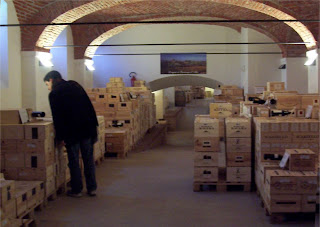
One of the interesting features of the Pollenzo campus is the Wine Bank, in the historic wine cellars of the Agenzia di Pollenzo, where producers can lodge their products in a centre for oenological teaching and present – for study or tasting (but not, alas, by us this time) – a selection of specially selected Italian wines of many vintages.Back in the meeting room, I enjoyed the business discussions, and the mealtime schmoozing that went on with the 50-odd Slow Foodies from Italy, Germany, France, Switzerland, the US, the UK, Australia, Ireland, Argentina, Canada and the Netherlands. We enjoyed good and interesting foods at lunchtimes: cured meats, varied cheeses, salads; there were of course some Presidia and local food products… including wonderful gelato.
Meanwhile, news from home today made me sad: I hear that Fanny Bay Oysters – locally owned for 22 years, described as the largest oyster farm on Vancouver Island, and one of the largest shellfish producers on the B.C. Coast, has just been sold to a U.S. (Washington state) company. Of course the public promise is that all will remain as it was as far as the running of the company goes, but there was also an uneasy paragraph in the news story I read that mentioned the U.S. firm’s interest had stemmed in part from its lack of a processing plant in B.C. Which suggests that change is inevitable, and that the change will involve some kind of increased processing activity. Anyway, it’s always a sad thing to see business ownership leave the neighbourhood, particularly one where there isn’t a lot of steady employment. However you cut it, it’s local cash leaving the local area, and in this case the country.
-
A year ago already
Read Full Post: A year ago alreadySo, it’s been a year since the Iambic Cafe revealed itself – and my evolving involvement with the staples of life: food and poetry. What can I say: the journey continues.
One of those present at the writers retreat where it all began was Barbara Klar, whose Ideas radio program Swine Before Pearls is about to hit the airwaves (February 19, 9:05 pm, CBC Radio 1 – or however that translates for internet transmission in time zones other than Canadian ones: I think we’ll have to be tuning in during the wee hours of the 20th here in Europe). She’s going to explore the connection between our food animals and our own mortality, as we tip over into the Chinese Year of the Pig. It sounds promising.
Me, I’m also impatient to see Barbara’s new poetry collection which is due out from Brick Books — next year? Having heard a few of the poems as they wended their way onto the page, I know it will be more than noteworthy. So the conjunction of food and poetry is present everywhere, not just in my life. And speaking of Brick, another book I’ve been waiting for seems to be busting over the horizon: Lorri Neilsen Glenn‘s Combustion.
Here’s some food I’ve been enjoying now, mid-winter, when fresh vegetables and inspiration might seem at their lowest:
Celery and Apple Soup
(about 4 servings)
1 tbsp butter or oil
2 medium onions, peeled and diced
4-5 stalks fresh celery, including leaves, diced
1 medium potato, peeled and diced
2 large cooking apples, cored and chopped
4 cups vegetable stock
Salt and pepper
1 tsp brown sugar
1/4 cup fresh chopped parsley
1/4 cup Greek (or full-fat plain) yogurt or 1/4 cup heavy cream
Crumbled stilton or gorgonzola; or grated fresh parmigiano-reggiano; or freshly made croutons; or toasted almonds, to finish- In a large saucepan sweat the diced onion in the butter until transparent. Add the celery and potato to the onion and continue on a low heat for about 5 minutes.
- Add the apple and heat through, another 5-10 minutes.
- Add the stock, seasoning and sugar.
- Bring to the boil, then simmer, covered, for 30 minutes. Stir in the parsley.
- Allow to cool a little before liquidising thoroughly, and then pass it through a sieve.
- Check seasoning and consistency, adding a little milk or broth if needed. Stir in about yogurt or cream, and crumble or grate one of the cheeses into the soup, or top with croutons or toasted almonds.
-
Painting with light and tasting with wine
Read Full Post: Painting with light and tasting with wineOne of this week’s visiting lecturers was Alberto Cocchi, a Parma photographer who works out of his studio in Bologna. His American accent threw us at first – he spent some years in the US studying and working – but he was all Italian when it came to style and attitude to food – his photos were inventive and gorgeous. He revealed that the very etymology of “photography” comes from Greek roots, and means painting with light, before walking us through the technical stuff, the f-stops and the ISO settings, the digital vs film debate.
Depth of field, he said, is where it all begins when you’re talking about food. Or talking, more specifically, about food porn (a term last year’s students had taught him and which, since we’re getting technical here, I feel obliged to reveal was originally gastroporn, discussed in print as long ago as 1984, in The Official Foodie’s Handbook). He showed us some examples of his work with depth of field: selectively using focus to group objects, and using light to create interest and even a bit of mystery. We had a quick preview of his recent shoot in Scotland where he photographed whiskey, oysters and Black Angus (on and off the hoof).
Yesterday we had a photo shoot in the classroom where he worked magic on a couple of dishes, showing us the difference between natural light, side lighting, fill-in techniques (using plastic mirrors or even cosmetic mirrors) and more complicated stuff with softboxes, umbrellas and flashes. We got to watch the photos evolve on the screen. We’re looking forward to seeing him on one of our field trips later this year, when he’ll take us out and let us test what he showed us.
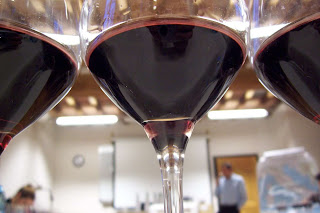
And we had an informal wine tasting. Some Barolo, Brunello di Montalcino, Amarone, Nero D’Avola, Cabernet and Pinot Nero passed beneath our noses and across our palates in quick succession, and then we had to run for the last bus home and – those of us attending – get ready for our Valentine’s Day dinner. It was red and white food, which included radishes & salt, cream cheese with red pepper jelly, pasta, roasted baby red potatoes, rice pudding and strawberries (in chocolate!). Oh, and red and white wine I guess. The Valentine’s cocktail was prosecco with pomegranate seeds, very pretty.


Latest Posts
- Sublime
- Good weather for reading
- The world, the world
- Sublime launch!
- Planet Earth Poetry – Readings by Volunteers, Victoria 2026
- Poetry at the Goldfinch
Aldeburgh Poetry Festival Barny Haughton BBC BC poets Berkswell blackberries Black Stilt Bologna book launch Borough Market Carlo Petrini Catalonia Cyrus Todiwala dairy Daunt's Books Dijon Edinburgh Fanny Bay Feast of Fields Food and Morality food history food journalism Jenna Butler lardo Malahat Review Michael Pollan Okanagan olive oil tasting olive trees Omnivore's Dilemma Our Food Our Future Oxford Parmigiano-Reggiano Planet Earth Poetry poetry poetry readings Poetry videos prosciutto salumi Sean O'Brien Suffolk ticks Wendy Morton Wired Writing Yvonne Blomer
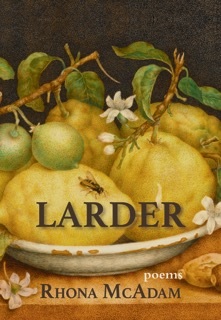
In her latest collection, Rhona McAdam navigates the dark places of human movement through the earth and the exquisite intricacies lingering in backyard gardens and farmlands populated by insects and pollinators, all the while returning to the body, to the tune of staccato beats and the newly discovered symmetries within the human heart.
“…A beautiful, filling collection, Larder is a set of poems to read at the change of the seasons, to appreciate alongside a good meal, and to remind yourself of the beauty in everything, even the things you may not appreciate before opening McAdam’s collection….”
Rhona McAdam is a writer, poet, editor, and Registered Holistic Nutritionist with a Master’s in Food Culture from Italy and a deep-rooted passion for ecology and urban agriculture. Her work spans corporate and technical writing to poetry and creative nonfiction, often exploring the vital links between what we eat and how we live. Based in Victoria, BC, and available via Zoom, Rhona is always open to new writing commissions, readings, or workshops on nutrition and the culinary arts.