-
Spring on the wing
Read Full Post: Spring on the wing Spring is erupting in all directions. The Anna’s Hummingbird (Calypte anna) nest that graces my fence has very recently produced three newborns and I’m looking forward to watching their progress (and seeing how they all squeeze into a space that’s probably two inches across at most). It’s still damp and chilly here so the mother is spend
 ing a good deal of time warming their hairless, featherless bodies. I knew they were big on nectar – hence their value as pollinators – but hadn’t realized they also chow on insects. I’ve hung a feeder nearby that should (for now) be safe from the ants who overran it last time I hung it out. I’ll have to make an ant moat if they become a problem again.
Speaking of moats, I’m intrigued by the idea of a chicken moat. Not a chicken keeper myself, but I’m working on a group project around chickens for the Permaculture Design course I’m taking.
Other airborne creatures have been in the news lately. Meli sent me notice of the headline item that bees are being adversely affected by pesticides. I am not quite certain why it has suddenly become headline news that if pesticides kill insects, and bees are insects, then bees are going to be harmed by pesticide use, but I suppose it does not hurt to belabour this important point. To which should be added the related point that pesticides will also harm beneficial insects besides bees, as well as the higher life forms (hummingbirds, for example?) that feed on those – whether by poisoning them or by removing a food source.
Let us all (who are within geographical reach) celebrate our wisdom in these matters by heading off this Saturday to enjoy a pesticide-free work party at Haliburton Community Organic Farm.
-
Seedy weekend
Read Full Post: Seedy weekend What has come to feel like a rare weekend of glorious (if not warm) sunshine brought out the seedies at Duncan’s Seedy Saturday. I’d been to one other at this venue, in 2010, and it’s grown hugely in popularity since then.
It takes place at the Mercury Theatre, which is getting a little small to contain the interest. Upstairs was mobbed; downstairs was quieter, and featured my friends from Haliburton Community Organic Farm.


RogerFoucher Meanwhile outside there was some action: food vendors, plus fruit and nut trees and bushes, and a display of edible weeds from the highly knowledgeable wild foods educator Roger Foucher, who will be offering a workshop on wild & cultivated perennials in Victoria on April 1).
I got away with only five packages of seeds, and a shiny new blackcurrant bush. With luck I’ll be growing part of my own Christmas cake this year.
-
Permaculture & poetry
Read Full Post: Permaculture & poetry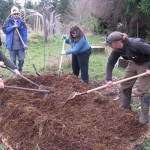 The last couple of weeks have swung past in a mainly permacultural haze.
The first screening at a new permaculture film night series was Anima Mundi, a bit of a collective disappointment for the 20-odd souls who crowded into the Community Microlending Society office, but a cheery networking session, lively discussion and helpful information share ensued.
I went for my second round of Permaculture Design classes last weekend, in which we built a hot compost bed in a classically low-maintenance permacultural manner (meaning: let nature do its thing). We prepared the ground by sheet-mulching with layers of cardboard; built a hollowed shell from horse manure; filled it with weeds and seriously rotten kitchen waste; and then covered it with more horse manure. Rats apparently don’t care to dig through manure to get to rotten food. You can then plant squash on top, which keeps the weeds down and thrives on the nitrogenous waste beneath. And harvest fresh soil in a year’s time, when the hill will have sunk to about ground level. Or leave it in place and plant something else there.


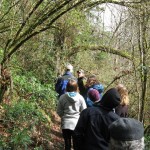
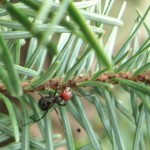
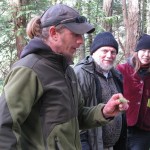
Later we went for a forest walk with Brandon Bauer in order to test our powers of observation and taste a few ants. Very tasty indeed. A sharp organoleptic explosion that Brandon likened to tamarind or vinegar; I’d say a very acerbic sorrel.
There’s a nice-sounding workshop I won’t make it to this weekend, An Introduction to Home-Scale Permaculture with Elaine Codling; and the Duncan Seedy Saturday takes place that day as well.
And finally, back to poetry. I read with Ruth Pierson and Ted Blodgett at Vancouver Public Library last night and a good time was had by all, I’d say. I read food poems to one of the most responsive and delightful audiences ever, and sold lots of books, including the last few copies of Sunday Dinners. If you have one, you can now officially treasure it as a rare book.
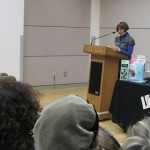
Ruth Roach Pierson 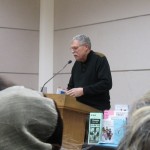
E.D. Blodgett
Latest Posts
- Writers at Word!
- Sublime and Twisted Readings coming up!
- Sublime
- Good weather for reading
- The world, the world
- Sublime launch!
Aldeburgh Poetry Festival Barny Haughton BBC BC poets Berkswell blackberries Black Stilt Bologna book launch Borough Market Carlo Petrini Catalonia Cyrus Todiwala dairy Daunt's Books Dijon Edinburgh Fanny Bay Feast of Fields Food and Morality food history food journalism Jenna Butler lardo Malahat Review Michael Pollan Okanagan olive oil tasting olive trees Omnivore's Dilemma Our Food Our Future Oxford Parmigiano-Reggiano Planet Earth Poetry poetry poetry readings Poetry videos prosciutto salumi Sean O'Brien Suffolk ticks Wendy Morton Wired Writing Yvonne Blomer
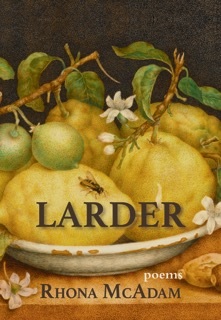
In her latest collection, Rhona McAdam navigates the dark places of human movement through the earth and the exquisite intricacies lingering in backyard gardens and farmlands populated by insects and pollinators, all the while returning to the body, to the tune of staccato beats and the newly discovered symmetries within the human heart.
“…A beautiful, filling collection, Larder is a set of poems to read at the change of the seasons, to appreciate alongside a good meal, and to remind yourself of the beauty in everything, even the things you may not appreciate before opening McAdam’s collection….”
Rhona McAdam is a writer, poet, editor, and Registered Holistic Nutritionist with a Master’s in Food Culture from Italy and a deep-rooted passion for ecology and urban agriculture. Her work spans corporate and technical writing to poetry and creative nonfiction, often exploring the vital links between what we eat and how we live. Based in Victoria, BC, and available via Zoom, Rhona is always open to new writing commissions, readings, or workshops on nutrition and the culinary arts.