-
Exam shazaam & Vinitaly
Read Full Post: Exam shazaam & VinitalyI read somewhere that on this day in 1755, Jean-Anthelme Brillat-Savarin was born in France. He wrote The Physiology of Taste, about the pleasures of food, published in 1825 when he was just 69. I should like to add that a couple of centuries later, on this day in 1955, my dear departed parents were married; it was their enduring joke on the world to elope on April Fool’s day. The last anniversary they celebrated was their 46th, shortly after my return to Canada in 2001.
We wrote our much anticipated food technology exam on Friday which got me thinking, as I perused my notes in the lead-up, about how learning really takes place, particularly in an aging and over-full human brain. The information actually retained probably had more to do with affection for the instructor than interest in the subject. For example I’m not sure, having supposedly completed the course, that I even know what is meant by the term sensory analysis; my understanding of the term is all tangled up in my enduring incomprehension about statistical methods which appear to have been the main topic under discussion (for many reasons it was hard to know really what in that class was being discussed). On the other hand, I feel sound in my understanding of olive oil technology which included harvesting and milling operations as well as chemical make-up and regulatory issues around extra-virgin olive oil. Reading my notes again brought the pleasures of the class back to mind in a way that doesn’t normally happen, I think.
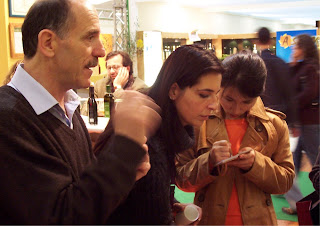
Our much-loved instructor in that class, Sandro Bosticco, who had also led us gently, kindly and knowledgeably through a couple of wine tasting classes last week (one of which I wretchedly had to miss, felled by another short-lived stomach bug), reappeared to lead us through the terrifying expanse of the Vinitaly show yesterday, which also features an olive oil exhibition, Sol. He took us through an oil tasting at a producer who was promoting a high quality blend of extra-virgin olive oils, called Gemini, which successfully combined the punch of Tuscan with the flavours of Sicilian. He then led us back into the Tuscan wine pavilion where we sampled some Vino Nobile di Montepulciano. Which of course is not to be confused with wine from the Montepulciano grape, as earlier explained by our Montepulciano-growing friends in Le Marche).The rest of the day was an exhausting but pleasurable tour of a few select producers under the wing of our campus director, Carlo Catani, no slouch in the wine area himself, particularly when paired with another distinguished varietal, the university’s director Vittorio Manganelli. We lunched in the Puglian pavilion and saw again our old friends orecchiette and agnello, but the best thing on my plate was the starter, a lovely little timbale of melanzane bathing in a pool of fresh tomato sauce and jauntily garnished with shreds of cheese and a chapeau of basil leaf.
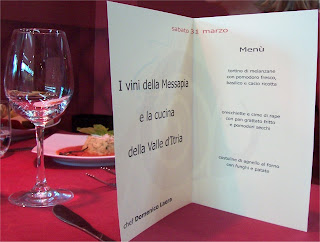
Would you go to a wine tasting in this pavilion?
-
And now a word from M.F.K. Fisher
Read Full Post: And now a word from M.F.K. Fisher..who speaks of her time in Dijon, that started in 1929:
It was there that I learned it is blessed to receive, as well as that every human being, no matter how base, is worthy of my respect and even my envy because he knows something that I many never be old or wise or kind or tender enough to know.
from Long Ago in France.
She speaks tellingly about her fierce and frugal landlady, Madame Ollangnier, who scours the markets and badgers the food sellers into handing over the lamest and haltest of edible foodstuffs which she then transforms into excellent meals for M.F.K. and her other lodgers.
So having read that last night I was delighted by the coincidence of this morning’s speaker, Andrea Segre of the University of Bologna, who told us a fabulous tale about his students’ food economics project that has blossomed into a many-fingered enterprise: Last Minute Market began as a way to turn the horrific waste of supermarket surpluses – those imperfect, unwrapped or dented items the ordinary consumer won’t touch with a ten foot euro – into nutritious meals for the local needy.
More food economy in the afternoon with Riccardo Vecchio who walked us through the ins and outs of PDO (Protected Denomination of Origin) and PGI (Protected Geographical Indication) marks on foods, from a marketing and economic point of view. They’re not just in Italy, not just in Europe or the UK, but potentially all over the place now. And he gave us a briefing on farmers’ markets, which are new to Italy (being gradually brought back in after they died out here around 1900, that is). There are plenty of food markets in Italy, it’s true, but the stall-holders are typically not farmers or food producers selling their own wares.
And now, back to my books. Food technology exam tomorrow. More later.
-
Arrivederci Apulia
Read Full Post: Arrivederci ApuliaSea urchin (“UNI!!” shrieked the sushi-eaters), part of Friday’s lunch.
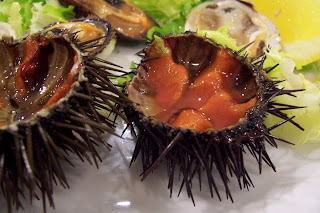
One of our speakers said he’d prefer to refer to the place we’ve been calling Puglia by its alternate and more ancient name, Apulia. We were rich in speakers this week.
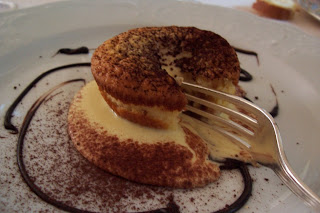
Thursday we kicked off with a talk by eminent enologist Severino Garofano, about viticulture in the Mediterranean, as well as an overview of the Puglian grapes which we’d been encountering in liquid and nascent form all week. Negroamaro, primitivo, aleatico and susumaniello had all figured in our glasses, and we had a few more drops to sample the range of Garofano’s Azienda Monaci, over a lunch at our excellent hotel. It began with a clever little bundle of shellfish and ended with a triumph of torta: a warm, perfectly-sized almond souffle-ish marvel, melting with cream and a flourish of chocolate.
We took a chilly stroll through the vinyards of Tenute Rubino which are interlaced with fields of artichokes; a combination that works for me. The owners wanted us to get a sense of the land our evening wine would come from, and we certainly experienced the salt winds that flavour the grapes.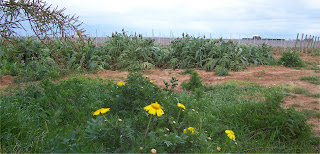
We travelled to Cisternino, a Slow City, where we enjoyed a meal of meat with our wine, in Rosticceria Antico Borgo Di Menga Piero, a fornello, a butcher shop where you can buy meat by day as in a regular butcher’s, but by night, when you approach the display cases as a steady stream of locals were doing, you choose your cut of meat much as North Americans might do with lobster. The offerings included involtini di trippa soffocati (tripe rolls), capretto (young goat), and costata di asino (donkey in a red sauce).
On Friday, there was another talk on fishing in the region which included discussion of garum, a Roman seasoning which lives on in the Vietnamese fish sauce nuoc mam, yet another food whose sustainability and provenance is under question (covered during the week in the (thanks Ruth) Christian Science Monitor).
We heard a lot about the different nets and traps used to catch seafood, including the technique of octopus-fishing requiring nothing more complicated than a chicken leg and a fishing line. Of course once you have your octopus you have to kill it, and then you have to beat it with a stick in order to tenderise it enough to eat.

We were given the opportunity to taste it raw, an opportunity that I do not think I will need to seek out again. It made me think how nice is octopus simmered in red wine. Or cooked in anything, really. Ditto the cuttlefish.After lunch we headed out to see where the meal had come from, to the docks at Brindisi. We were on the brink of turning back, as it was windy and it seemed the fishermen may not have gone out, when a boat returned and its cargo was swiftly unloaded for a speedy fish auction.
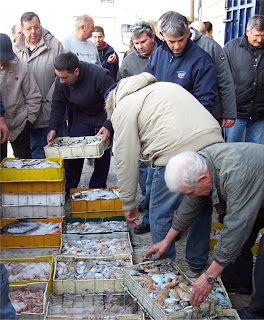
One last supper – at the stylish Menhir – where we dined on fish of many faces including some local clams with broad beans and orecchiette.

We had some beautiful wines from Candido, including a mind-blowing Aleatico dessert wine. Then, clutching our tums and our lovely Maglio easter eggs, we stumbled off to bed to ready ourselves for the flight back to Milan early the next morning. Enough eight course suppers to fell an ox, more wines than we could count on two hands, and more enlightenment about the variety of local food products in this area than we would have believed possible. Next stop Vinitaly, in Verona this weekend, where we’ll certainly be seeing several of the wine-makers we’ve already encountered on our travels in Le Marche and Puglia.


Latest Posts
- Writers at Word!
- Sublime and Twisted Readings coming up!
- Sublime
- Good weather for reading
- The world, the world
- Sublime launch!
Aldeburgh Poetry Festival Barny Haughton BBC BC poets Berkswell blackberries Black Stilt Bologna book launch Borough Market Carlo Petrini Catalonia Cyrus Todiwala dairy Daunt's Books Dijon Edinburgh Fanny Bay Feast of Fields Food and Morality food history food journalism Jenna Butler lardo Malahat Review Michael Pollan Okanagan olive oil tasting olive trees Omnivore's Dilemma Our Food Our Future Oxford Parmigiano-Reggiano Planet Earth Poetry poetry poetry readings Poetry videos prosciutto salumi Sean O'Brien Suffolk ticks Wendy Morton Wired Writing Yvonne Blomer
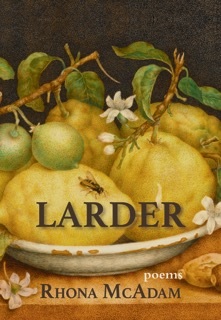
In her latest collection, Rhona McAdam navigates the dark places of human movement through the earth and the exquisite intricacies lingering in backyard gardens and farmlands populated by insects and pollinators, all the while returning to the body, to the tune of staccato beats and the newly discovered symmetries within the human heart.
“…A beautiful, filling collection, Larder is a set of poems to read at the change of the seasons, to appreciate alongside a good meal, and to remind yourself of the beauty in everything, even the things you may not appreciate before opening McAdam’s collection….”
Rhona McAdam is a writer, poet, editor, and Registered Holistic Nutritionist with a Master’s in Food Culture from Italy and a deep-rooted passion for ecology and urban agriculture. Her work spans corporate and technical writing to poetry and creative nonfiction, often exploring the vital links between what we eat and how we live. Based in Victoria, BC, and available via Zoom, Rhona is always open to new writing commissions, readings, or workshops on nutrition and the culinary arts.