-
Spain 3: bread and sausage
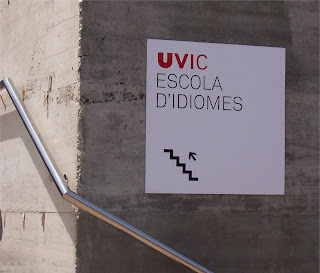
Read Full Post: Spain 3: bread and sausageOn our second day in Spain, we headed to the University of Vic, also known as UVic (- and I guess, fair enough, they have more claim to the name than Victoria, which lacks a school of idioms).
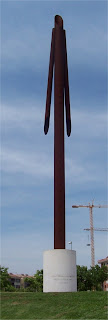
On our way across campus, we passed a steely statue commemorating Catalonian poet, the letters of whose name had been picked off the base, so I can’t tell you who it was. But perhaps we can assume a towering intellect?
We had a presentation by a nouveau baker called Francesco Daviva who runs Forn de Pa Altarriba, where for 25 years he has been trying to radicalise bread. He talked about the shape of bread (there are only three: round, baguette, loaf/square), its presentation on restaurant tables, and the various ways of making it divisible for diners. Mediterranean tables seldom have bread plates, so there are issues about crumbs and cutting that quite naturally have to be considered: the sorts of things I suppose bakers used to instinctively incorporate into their work instead of giving a stand-up lecture. Although we passed a few rolls around to look at shape and colour and aroma, we were not offered anything material to chew on, and wandered off for an hour or so before reconvening for lunch in a campus cafeteria. (The bread at lunch was, well, unremarkable.)
It was blistering hot when we followed the leader to our next destination, Casa Riera Ordeix, to see some more sausage-making. Curious emblem over the door…

Fuet, (Salchichon de Vic) the sausage of Vic , has been made for about 150 years in the centre of Vic, run to this day as a family business. This was high quality meat: nothing but prime cuts of pork (well trimmed legs and pork belly for fat). They produce 3000 kg of sausage per week from January to July and then double the volume between September and Christmas, as it’s a product traditionally eaten at Christmas. They have a strictly scheduled week: Mondays they fill the casings; Tuesdays through Thursdays they trim the meat, as we saw:

Fridays they grind and season the meat, which is left to macerate over the weekend. The sausages are hung from nails in aging rooms where the temperature and humidity – much like prosciutto di parma – are regulated by opening and closing windows; the local flora of course play a part in the curing.
The sausages are brushed and re-hung periodically until they have done their two to three months’ stint. The product was absolutely delicious: spicy and peppery, firm and chewy. They sell the sausages everywhere in the world — except Canada and the US whose hygiene regulations exclude these and a great many artisanal products. (Hey y’all: the Europeans eat this stuff every day and are still standing…!)
(Except for the one who fell ill during the tour; perhaps heat, perhaps an early symptom of the flu that would catch up with her later.)
We packed our bags and headed to our next destination in Calafell, where we checked into the weird and somewhat horrible Hotel Solimar, a massive complex where we got to witness European-style mass tourism close up. Luckily our university escorts reviewed the offerings at the hotel buffet we were supposed to eat from that evening and realised it was in fact an inedible wasteland of fried and processed foods, prefixed by stacks of badly washed plates, and so we got to choose our meal in the somewhat better offerings along the seafront.
-
Spain 2: cured meat and wine
Read Full Post: Spain 2: cured meat and wineOur first day we left behind three casualties: two recovering from queasiness from the previous night’s tapas feed, and one sore throat.
We drove through the wooded hills – a surprise to many of us, expecting a parched, desert-like landscape – to sausage-maker Fussimanya, which has been operating for 35 years. It started life as a restaurant serving Catalan specialties, and, as we had a chance to discover, is still hugely popular (it was pretty much full on a Monday lunchtime when we left). They began by making sausages for the restaurant but now produce a full range of products which are sold through their own shops on the site and in Vic.
Here we watched the production of brisba, a hefty boiled sausage which comes in white (made from a lot of things you might not wish to see listed here) or black (made from blood, fat and meat).
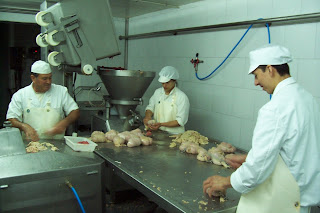
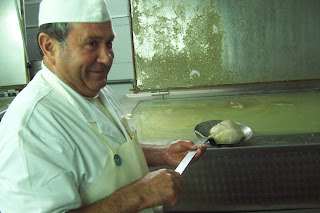
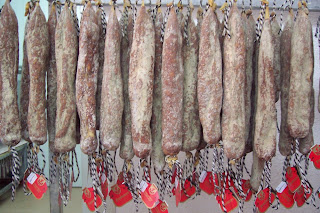
They also make five varieties of cured sausage: longaniza, churizada, chorizo, fuet and sumaya. This one, fuet, uses 3 grams of pepper per kilo of meat: whole peppercorns inside and ground pepper outside; it’s a firm, dry sausage, very moreish as we discovered in a tasting.
We also got to see how the traditional wine vessels are used:
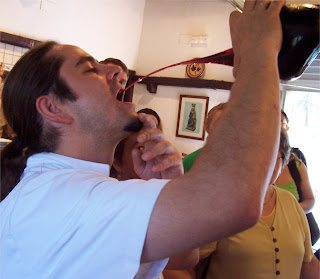
No wine was spilled, but one knee was grazed, ironically right after negotiating oh so carefully the slippery floor of the factory.
Afterwards we were taken for a look at Vall de Sau Collsacabra – a valley whose centre is a drowned village, its church steeple showing in times of drought – as now – from the middle of the lake. This was part of Franco’s legacy, the translator told us; he wanted to bring water to the country and created a series of artificial lakes through damming rivers and walling in valleys, and drowned more than one village in the process. I’m not sure what the villagers must have thought of it all, but such areas are now rich playgrounds, studded with posh hotels like the one we were standing in front of. Nearby was a former Benedictine monastery (Sant Pere de Casserres) which had been founded in 1005 but abandoned after the 14th century; it was restored in 1998 and is a popular attraction– but we didn’t get to see it.
Instead we headed back to Fussimanya for a long and excessive lunch:
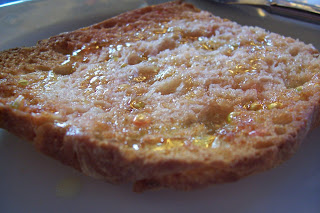
More pan con tomate..
Cold roasted vegetables:
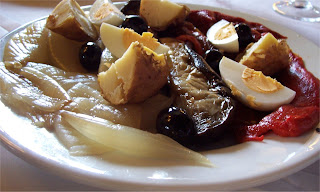
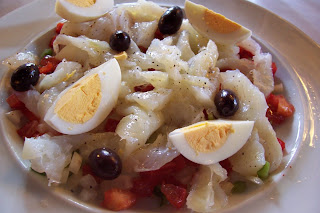
A platter of raw cod:
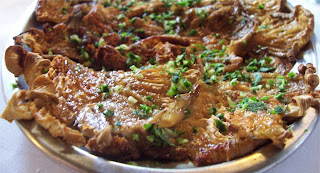
Some fried mushrooms:
The ever present aoli, called allioli in Catalonia:
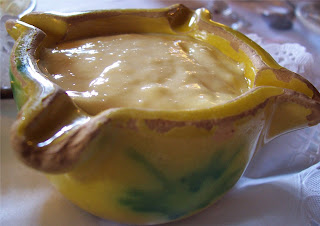
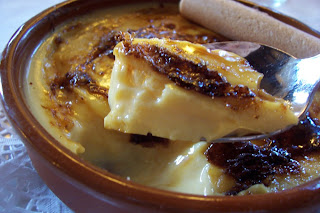
Crema Catalana: is it so different from Crème Brûlée? We thought maybe it was not as dense a custard. And served in this characteristic bowl, with the wafer.
After lunch we drove to Santa Maria d’Horta d’Avinyo to visit the winery Bodegues Masia d’Avinyo, home of the Roqueta family, wine producers since the 12th century.

Most of the old bits and pieces from this history of winemaking are now part of a museum. We saw the sunken wine vats, over which were suspended ropes for the grape-treaders; a system of drains then allowed the juice to drain out by gravity. The vats had to be cleaned by hand, but it was very dangerous work, because there could be a lethal build-up of carbon dioxide, and so in a twist on the canary in a mineshaft idea, the winemakers suspended cats inside first; if they died, it wasn’t safe to go in. Lucky for the local felines, they later realised that candles worked just as well.
Here’s an olde worlde kind of way to put corks in your wine bottles:

We had a small lesson in historical market economics as we finished the museum tour. This was always a big wine producing area, and became even more so at the end of the nineteenth century, when phylloxera had devastated the vines of France and stepped up demand for Spanish wine. Many of the French workers moved to Spain. Once the French restored their industry (by grafting their vines onto phylloxera-resistant American root stock), and when phylloxera reached Spain in the 1890s, Spanish wine production dropped still further; with the arrival of the industrial revolution, the winemaking families turned to more reliable factory work, so it became difficult to convince workers to return to the vineyards. But the winery is now producing some 476,000 bottles a year, under the supervision of youthful oenologist Joan Soler.
They produce two labels (Roqueta and Avadal) and we enjoyed a tasting of some of Avadal’s offerings. Here’s the elegant tasting room, lined with barrels that have been autographed by visiting celebrities, including Ferran Adria who we’d be meeting just a few days later.
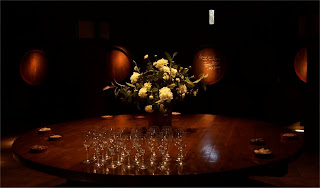
The wines included Picapoll – a local grape named for a Catalan word meaning how chickens peck. Quite an acidic one. Then a very nice Chardonnay, a couple of Merlots and a Cabernet Franc/Cabernet Sauvignon/Syrah blend.
And then back to Vic, where thanks to a free dinner, and a possible bad reaction to some gazpacho, two more of our classmates would fall to stomach ailments.
-
Canada Day, and the pain in Spain
Read Full Post: Canada Day, and the pain in SpainJust got back from nine days in northern Spain: a record breaker for the university, I think, as being the sickest stage ever. We racked up the following ailments which affected, if I counted right, 18 out of 24 of us (some people had more than one thing) requiring 4 hospital visits:
3 respiratory tract infections/bronchitis
1 attack of vertigo
1 sinus infection
1 jellyfish sting
1 grazed knee
1 dicky hip
1 stiff neck
7 nausea/vomiting
1 incapacitating hangover
1 sore throat (that stopped there)
5 or 6 colds
1 scary allergic reactionWe arrived in Vic on Canada Day and celebrated with some contemporary tapas (outcome: two sick stomachs). Novelties included a salad with a frozen yogurt dressing:

Delicious cheese flowers: a taste similar to high quality gruyere, and oh so pretty:

Some sausage and the omnipresent Pan con Tomate (tomato bread):

Bacon-wrapped dates:

Not sure why anyone would do this to perfectly nice asparagus, but it looks impressive:


Latest Posts
- Writers at Word!
- Sublime and Twisted Readings coming up!
- Sublime
- Good weather for reading
- The world, the world
- Sublime launch!
Aldeburgh Poetry Festival Barny Haughton BBC BC poets Berkswell blackberries Black Stilt Bologna book launch Borough Market Carlo Petrini Catalonia Cyrus Todiwala dairy Daunt's Books Dijon Edinburgh Fanny Bay Feast of Fields Food and Morality food history food journalism Jenna Butler lardo Malahat Review Michael Pollan Okanagan olive oil tasting olive trees Omnivore's Dilemma Our Food Our Future Oxford Parmigiano-Reggiano Planet Earth Poetry poetry poetry readings Poetry videos prosciutto salumi Sean O'Brien Suffolk ticks Wendy Morton Wired Writing Yvonne Blomer
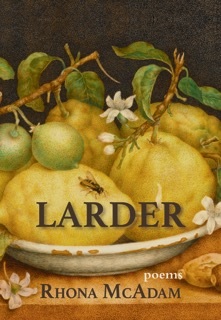
In her latest collection, Rhona McAdam navigates the dark places of human movement through the earth and the exquisite intricacies lingering in backyard gardens and farmlands populated by insects and pollinators, all the while returning to the body, to the tune of staccato beats and the newly discovered symmetries within the human heart.
“…A beautiful, filling collection, Larder is a set of poems to read at the change of the seasons, to appreciate alongside a good meal, and to remind yourself of the beauty in everything, even the things you may not appreciate before opening McAdam’s collection….”
Rhona McAdam is a writer, poet, editor, and Registered Holistic Nutritionist with a Master’s in Food Culture from Italy and a deep-rooted passion for ecology and urban agriculture. Her work spans corporate and technical writing to poetry and creative nonfiction, often exploring the vital links between what we eat and how we live. Based in Victoria, BC, and available via Zoom, Rhona is always open to new writing commissions, readings, or workshops on nutrition and the culinary arts.