-
Been such a long, long time…
Read Full Post: Been such a long, long time……since I had a minute to blog, it really has. Which reminds me of one of my favourite songs:
But back to reality, whoever has time for that.
Tracking backwards, I was so so so so very lucky to join in a collective event to belatedly celebrate Nancy’s birthday on Saturday afternoon: she had the great wisdom to suggest that those of us who wished could come to the Barbican and watch a play in her esteemed company, and the play she chose was, honestly, one of the best I’ve seen. The company was the inescapably and reliably brilliant Theatre Complicite, and their new production, A Disappearing Number, featuring the wonderful Saskia Reeves, was intricate and funny and incredibly moving. It is odd, isn’t it, that when you see something moving, you can’t actually move for a while, and so in a way we enjoyed sitting stunned in our seats long after the last hurrah.
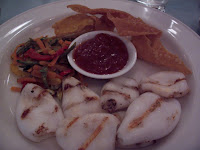
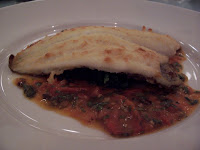
We eventually did get up and wandered outside for fortifying cups of tea in the rain, watching the London rats race by with their rucksacks and flapping maps, and then went for a very nice meal at Fish Central (pour moi, grilled squid, brill and sticky toffee pudding).

Friday I went back to my old (work) stomping grounds and was whisked away by one of the head hunters in a taxi and a train and a car all the way to darkest Henley where I met the lovely Belinda, who runs Stirring Stuff. We had an informal demonstration by two members of her Big Boys’ Cookery Club, who prepared a substantial and delicious meal of veal kidneys with peas, broad beans, roasted shallots and fried bread (it sounds nicer in French but I don’t recall all the words) and talked Slow Food until bedtime, the distant sounds of one of the resident teens and her thousand friends somewhere above our heads, and returned to London in the morning.
Thursday I reached farther back into the past and met up for a drink and catch-up in a pub near Victoria Station with Graham, another former Spencerian; Wednesday I had a most delicious supper with Tina, a return visit to The Fish Hook in Turnham Green for some spicy fish soup and a bowl of mussels in cream.
Tuesday was a poetry reading – a big one – at Oxfam Marylebone, a quarterly event organised and hosted by expat Canadian poet Todd Swift. It was an impressive lineup (though missing one – most unfortunately, David Morley couldn’t make it) and the readings moved at a cracking pace, so was not as wearing as the length of the list might have suggested. We heard Fleur Adcock, Chris Beckett, Julia Bird, Giles Goodland, Chris McCabe & Mario Petrucci, a good and invigorating mix for a rainy night.

Before the reading, Tammy and I enjoyed a terrific late in the day dim sum from what we think is (another) chain restaurant, Ping Pong. Everything was good. Very good.

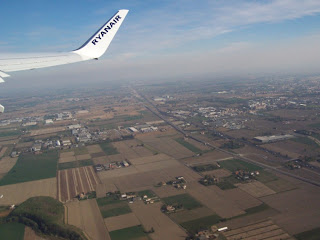
And before that, I flew back from Parma. Only last Monday.
-
Plastic world
Read Full Post: Plastic worldI got a monster killer migraine yesterday afternoon, which went some way to explaining why fate didn’t want me travelling this weekend.
Before it hit, I did a bit of reading on the subject of plastic, which I wandered into through a story on the banning of plastic shopping bags. It made a nice change from the latest grim news for English farmers who are already struggling with the latest round of foot and mouth.
But it’s not a much more uplifting story, although the banning of plastic bags – something not unknown in Canada – is a good thing. Spending, as I have been lately, quite a bit of time Thameside in London, I’ve often noticed them floating in the water. The Thames is a tidal river, draining into the English Channel, so as my recent reading has been telling me, those plastic bags will ultimately end up as plastic fragments perhaps even flowing past my house on the Gorge in Victoria.
The interesting – if tiny – preview of a longer film called Synthetic Sea, produced by the Long Beach CA Algalita Marine Research Foundation, explains that plastic, as we should all know by now, is non biodegradable: which means that although it breaks down in time, it doesn’t disappear, it simply disassembles under sunlight – a process called photodegradation – into tiny plastic fragments which then wash around in the ocean, for centuries. Algalita believes that every piece of plastic ever created still exists.
In the the centre of the Pacific, Algalita took a random sample of sea water which showed there were six times as many plastic particles as there was plankton in the water. This means, of course, that plastic is competing with plankton as a food source for filter-feeding sea life (at the bottom of the food chain). The plastic becomes embedded in cell tissue of lower life forms like salps and is then ingested by larger sea life – on and on up to the fish on our dinner plate: I wonder if there is any way to find out how much plastic ends up in a salmon steak?
Not only does it threaten our food sources, plastic is also killing wildlife. Sea birds like albatross will eat larger plastic items like bottle caps and disposable lighters that fill and block their digestive system and kill them through starvation; others confuse tan coloured plastic fragments with krill or may eat nurdles – the pellets used by manufacturers to ship plastic for manufacture – thinking they are fish eggs. The problem here is that birds regurgitate their food for their young, many of whom die through malnutrition and the poisoning from the toxins that plastics carry. Whales and other sea animals are often found to have massive quantities of plastic – including balloons – in their digestive systems, and may also sustain injury or die when becoming trapped or tangled in discarded plastic.
So banning plastic bags is a good first step, but it’s not the end of the story. Plastic is lurking in all parts of our lives. I found a 2004 article in Science magazine that adds a caution about where else it’s hiding:
Many “biodegradable” plastics are composites with materials such as starch that biodegrade, leaving behind numerous, nondegradable, plastic fragments. Some cleaning agents also contain abrasive plastic fragments.
Like Algalita, the researchers found lots and lots of plastic fragments of all sizes; they found theirs in estuarine and subtidal sediments around Plymouth, and to check whether it was really something that all kinds of animal life would ingest, they kept “amphipods (detritivores), lugworms (deposit feeders), and barnacles (filter feeders) in aquaria with small quantities of microscopic plastics. All three species ingested plastics within a few days.” They couldn’t say what the long term effects of eating plastics might be on these or larger animals, but they do warn that “There is the potential for plastics to adsorb, release, and transport chemicals.”
A few statistics that are circulating on the web:
- The world uses over 1.2 trillion plastic bags a year. That averages about 300 bags for each adult on the planet. That comes out to over one million bags being used per minute.
- On average we use each plastic bag for approximately 12 minutes before disposing. It then lasts in the environment for decades.
- Not all litter is deliberate. 47% of wind borne litter escaping from landfills is plastic. Much of this is plastic bags. In the marine environment plastic bag litter is lethal, killing at least 100,000 birds, whales, seals and turtles every year. After an animal is killed by plastic bags, its body decomposes and the plastic is released back into the environment where it can kill again.
- In June 2006 United Nations Environmental Program report estimated that there are an average of 46,000 pieces of plastic debris floating on or near the surface of every square mile of ocean.
-
Still Cheeselessly in Parma
Read Full Post: Still Cheeselessly in ParmaIf you’re a believer in signs, when you read my tale you will perhaps understand why I gave up my attempts to get to Cheese this morning.
First, the friend who was going to come with me had pulled out before I left London. Next, I found out on Thursday that the plans to visit a winery Friday morning with another classmate had changed – the rental car wasn’t rented after all and there was no way for me to get there without leaving on Thursday and staying an extra night — somewhere. I was busy to-ing and fro-ing with packages to the post office and various other errands and just couldn’t manage it, so decided to go on Saturday. Then arose the possibility of getting a ride with someone else to Bra on Saturday morning, but that fell through on Friday. So I went to the train station Friday night and bought a ticket for a train leaving at 5.53 this morning, which would have got me to Bra at around 10.
Got up 4.30, walked to the train station and arrived I guess at about 5.51 – with just enough time to reach the platform and watch my train pull out, in the full knowledge that the next train wouldn’t get me there until an hour after the start time of the talk I most wanted to hear.
I took all this to mean the cosmos was indicating my presence was not required at Cheese this year, so I turned around and walked back home, since it was still too early for the buses to be running. Well at least I got my exercise. And was spared a three-stage, four hour train trip each way. The way things were going, chances are excellent that I would have missed one of those connections and ended up late anyway.
I don’t know how many of you out there have tried to plan trips using Trenitalia‘s rather good website, but it does have one major flaw, which is that it doesn’t tell you the ultimate destination of the train you will be catching/connecting with or the platform you’ll need, which means you have to figure that out on the fly by checking the departure list posted on the platform, and then find the platform listed, and hope it hasn’t changed. A lot to manage in a strange station with sometimes only three or four minutes between trains.
Think I’ll go out and buy myself some… cheese.


Latest Posts
- Writers at Word!
- Sublime and Twisted Readings coming up!
- Sublime
- Good weather for reading
- The world, the world
- Sublime launch!
Aldeburgh Poetry Festival Barny Haughton BBC BC poets Berkswell blackberries Black Stilt Bologna book launch Borough Market Carlo Petrini Catalonia Cyrus Todiwala dairy Daunt's Books Dijon Edinburgh Fanny Bay Feast of Fields Food and Morality food history food journalism Jenna Butler lardo Malahat Review Michael Pollan Okanagan olive oil tasting olive trees Omnivore's Dilemma Our Food Our Future Oxford Parmigiano-Reggiano Planet Earth Poetry poetry poetry readings Poetry videos prosciutto salumi Sean O'Brien Suffolk ticks Wendy Morton Wired Writing Yvonne Blomer
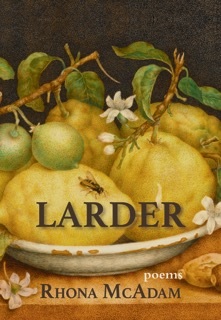
In her latest collection, Rhona McAdam navigates the dark places of human movement through the earth and the exquisite intricacies lingering in backyard gardens and farmlands populated by insects and pollinators, all the while returning to the body, to the tune of staccato beats and the newly discovered symmetries within the human heart.
“…A beautiful, filling collection, Larder is a set of poems to read at the change of the seasons, to appreciate alongside a good meal, and to remind yourself of the beauty in everything, even the things you may not appreciate before opening McAdam’s collection….”
Rhona McAdam is a writer, poet, editor, and Registered Holistic Nutritionist with a Master’s in Food Culture from Italy and a deep-rooted passion for ecology and urban agriculture. Her work spans corporate and technical writing to poetry and creative nonfiction, often exploring the vital links between what we eat and how we live. Based in Victoria, BC, and available via Zoom, Rhona is always open to new writing commissions, readings, or workshops on nutrition and the culinary arts.