-
Going, Going…. Here!! Leah’s Lovely Launch
Read Full Post: Going, Going…. Here!! Leah’s Lovely LaunchWednesday night was a long-awaited moment for the amazing Leah Fritz and her many friends and fans, when she launched her first collection for 8 years. Going, Going saw its debut in the company of loyal followers at the Barbican‘s very smart library
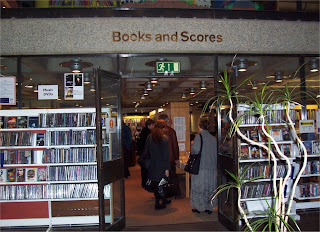
(we are a public library so come and use it! said librarian John Lake during his introduction). Fighting my way past the paparazzi,
…I enjoyed a glass of wine and a few crisps with a passel of poets (including at least one with a forthcoming collection!) before taking my place in a comfortably full reading space.
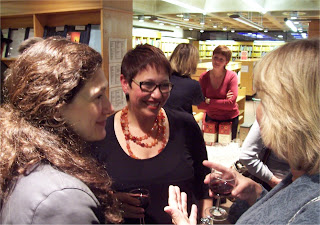
The publisher was there selling copies of this beautiful hardcover,
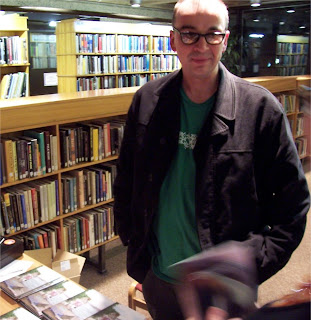
and after a reading by Allan Brownjohn and one by Leah herself,
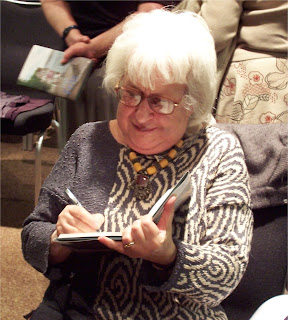
there were books to be signed and wine to be drunk. As for me, I had an early morning date with destiny, or at least a mini-cab, so I slunk off right away so I could catch my 39 winks.
-
Orford Ness & Game for Everything
Read Full Post: Orford Ness & Game for EverythingAlways an auspicious sign, the snail.

This one was living free on Orford Ness, in Suffolk, a blasted landscape in many senses, being a former military testing site and now a valuable nature preserve. A group of poets made a visit there on the weekend in search of inspiration.
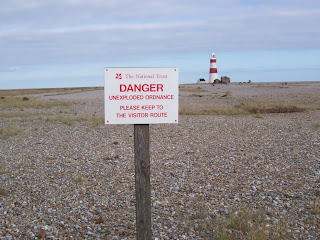
It’s made up of 10 miles of seaward-exposed shingle, which we were told comprises 15% of the world’s habitat for coastal vegetative shingle (another 15% is at Dungeness). There are many signs pointing to its military past…
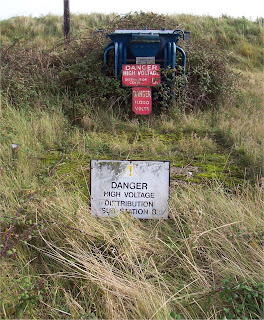
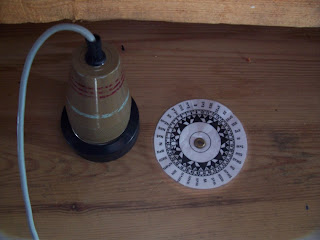

The National Trust man who showed us round told us the bomb disposal squad is still called out to deal with unexploded bombs some 15 to 20 times a year.
After our walk we returned to little Blaxhall
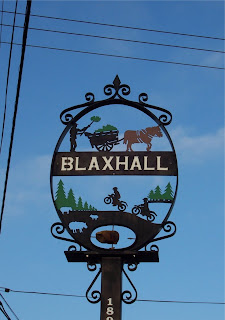
for some tea, and then made our way back to Orford for supper at the Butley Oysterage, where I dined handsomely on griddled squid

and grilled Dover Sole. A poetry workshop followed, accompanied by a very fine smoked salmon terrine with potatoes and leeks, and some of Orford’s best smoked chicken.
Then before I could turn around it was Tuesday, and time to join some of London’s Slow Foodies for a night of wild food from Mark Gilchrist, who shoots, butchers, dresses and cooks all his own game.
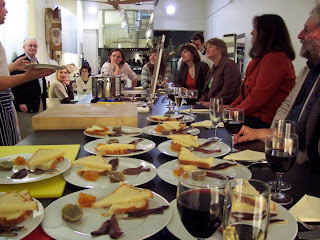
He started us off with a plate of assorted duck appetisers: Teal liver pate; Pintail confit; air-dried Pintail; salted, cured and smoked Widgeon, served with fresh brioche and kumquat jam.
Then a pan-fried fillet of Roe deer…

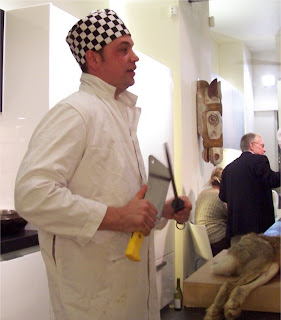
And then he put on his butcher’s coat and demonstrated how to skin and joint a hare, and told us how to make a ragout of hare like the one he was about to serve on freshly-made tagliatelli.
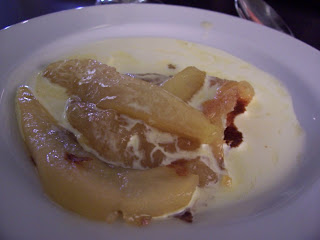
The ultimate dish was Conference pear tarte tatin…
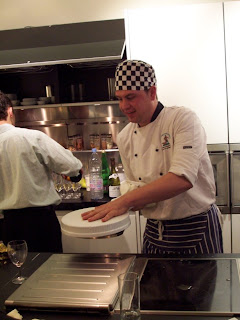
which, containing molten caramel, must be turned onto its pastry base with care…
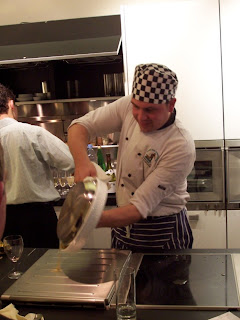
And of course it must be served with a drop of cream.
-
Food Food Poetry Poetry
Read Full Post: Food Food Poetry PoetryI braved the pelting rain to get to the Restaurant Show at Earl’s Court last Tuesday, where I saw lots of stands – including some small food producers I’d been learning about while working on our food producers’ database (which launched on Wednesday, yay!). It was lovely to meet the people and taste the food I’d been writing about. I then sat myself down at The Stage and watched some cooking demonstrations. The first was from Barny Haughton,
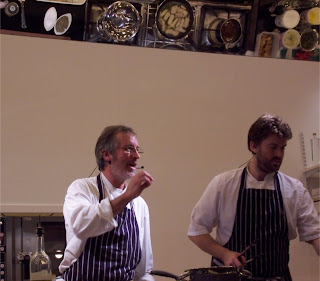
who talked about sustainability in the commercial kitchen: inviting people to use less popular, cheaper cuts of meat – if we’re going to be carnivores it’s more responsible to use the entire animal, which is a theme I’ve been hearing for some time – and sustainable fish varieties. He was followed by like-minded Cyrus Todiwala,
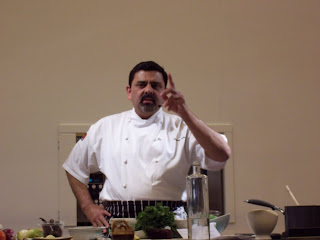
who was speaking on behalf of the Greener Food project. He’d been sent a big box of locally-raised, seasonal vegetables and told to make something of them. His beetroot with coconut salad was terrific, as was everything else he made. We were as heartbroken as he that he didn’t have time to make us his pigeon curry…
Then Ian Pengelley, another London chef, took the stage – by this time things were running very late and it got a bit chaotic. His aim was to show us how nicely champagne went with Asian foods, so we got to try a bit with some Thai beef salad, some sushi rolls and some seared scallops. And sure, we agreed! All very nice.
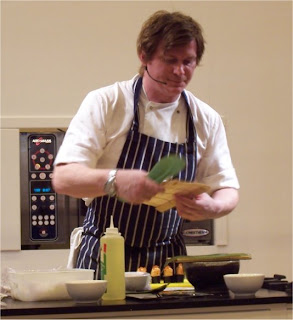
His sommelier was very entertaining – giving us a finale show where he decapitated the last bottle by strategic use of the base of a champagne glass. Definitely not one to try at home.
Then I had a couple of evenings to catch my breath before Friday’s Les Murray reading at Senate House – certainly one building that can accurately be described as neo-brutalist. This grey edifice loomed ahead of me in the dying light, and I sensed trouble ahead as I sought the room which my note to self said was “3rd floor Senate North”.
I entered from a sort of westerly door, I thought, so turned left, looking for north. I found a lift just around the corner, with a notice posted about talks and lectures — including the one I was after, so without anything more to go on, I entered and ascended to the 2nd floor, which was as far as this one went.
On the second floor there was another lift that went up to the 4th floor, but there was a 3rd floor button as well, so I pressed that and pushed my way out through a crowd of students to find myself on a near-deserted floor, where the only open door was to some special library – ancient civilisations or something, with an ominous No Exit sign on the entry.
Not a soul around, so I lugged myself and the bag I was escorting up to the fourth floor, where I found the crowd of students from the lift forming a lengthy queue for library card renewal. Beyond the security gates (only passable by library card holders of course) I spotted and hailed a friendly looking woman in a name badge who told me I wanted room N336. She told me to get back in the lift and go to the ground floor, along the hallway to a different set of lifts.
So back I got in the lift and descended to the ground floor where I found myself facing another set of card-operated barricades and a silver-haired defender of.. of.. whatever it was he was defending seated behind what I’m sure must have been a bullet-proof glass window. He told me I shouldn’t have come to the ground floor in this lift and that I should go back to the third floor as he presumed I was a member of the society for ancient civilisations or whoever it is who lives up there. No, I said, I was looking for the poetry reading in room N336. He said he knew nothing about a poetry reading or any such room, and couldn’t tell me whether I was actually in the north tower or not. After admonishing me again for coming down in that particular lift, and reinforcing his point that this was not an exit, he let me exit through the gate and I was back in the main hallway ready to search out the next set of lifts.
Which I found and ascended to find a big classroom with two doors (one marked 336 and the other 336A) but no other indication there was a reading there. I entered and found a bookseller setting up and three others sitting in wait, which seemed a bit sparse since it was only ten minutes to the reading, but down I sat. The room did in fact fill up nicely by the start time, and Les Murray started his reading. For the next hour, we were entertained by his poems and by the periodic rattling of the door knob closest to the reader (on the door labelled 336, in fact) followed by the covert entry of latecomers through the other door. There followed a wine reception and then it was time to slink off into the night.
I made a nerdy list of the poems he read, and here they are; rather unkindly he read from the Australian edition of his collected poems, so those who rushed the book table afterwards were not always able to find their favourites, but he sold quite a bit and did a little friendly book signing. I was happy he started us off with a food poem, and I liked (and remembered from past readings, I think), his cow poem, which he introduced by saying it was one of his favourite animals, and that he thought he was one of the few real Hindus of Australia. It was a poem from the point of view of the cow, which he observed is a ‘collective creature’ and thus difficult to find a pronoun for.
Beanstock Sermon; Glass Louvres; Words of the Glass Blowers; On Removing Spiderweb; Arial; Cows on Killing Day; Cell DNA; Contested Landscape at Forsayth; The Shield Scales of Heraldray; the Moon Man; Judged Worth Evacuating; Clothing as Dwelling as as Shouldered Boat; Visitor; Jellyfish; Reclaim the Sites; To One Outside the Culture; Melbourne Pavement Coffee; On the North Coastline; Me & Je Reviens; Japanese Sword Blades in the British Museum; The Mare Out on the Road; Birthplace; Sunday on a Country River; and then he finished with a few new poems.


Latest Posts
- Writers at Word!
- Sublime and Twisted Readings coming up!
- Sublime
- Good weather for reading
- The world, the world
- Sublime launch!
Aldeburgh Poetry Festival Barny Haughton BBC BC poets Berkswell blackberries Black Stilt Bologna book launch Borough Market Carlo Petrini Catalonia Cyrus Todiwala dairy Daunt's Books Dijon Edinburgh Fanny Bay Feast of Fields Food and Morality food history food journalism Jenna Butler lardo Malahat Review Michael Pollan Okanagan olive oil tasting olive trees Omnivore's Dilemma Our Food Our Future Oxford Parmigiano-Reggiano Planet Earth Poetry poetry poetry readings Poetry videos prosciutto salumi Sean O'Brien Suffolk ticks Wendy Morton Wired Writing Yvonne Blomer
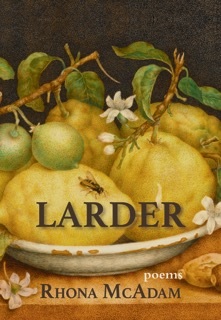
In her latest collection, Rhona McAdam navigates the dark places of human movement through the earth and the exquisite intricacies lingering in backyard gardens and farmlands populated by insects and pollinators, all the while returning to the body, to the tune of staccato beats and the newly discovered symmetries within the human heart.
“…A beautiful, filling collection, Larder is a set of poems to read at the change of the seasons, to appreciate alongside a good meal, and to remind yourself of the beauty in everything, even the things you may not appreciate before opening McAdam’s collection….”
Rhona McAdam is a writer, poet, editor, and Registered Holistic Nutritionist with a Master’s in Food Culture from Italy and a deep-rooted passion for ecology and urban agriculture. Her work spans corporate and technical writing to poetry and creative nonfiction, often exploring the vital links between what we eat and how we live. Based in Victoria, BC, and available via Zoom, Rhona is always open to new writing commissions, readings, or workshops on nutrition and the culinary arts.