-
Food & migraines
In my many years as a migraine sufferer, I have more than once been subjected to tedious, if well-intentioned lectures on the general theme that, contrary to what I might know about my own body, my migraines are entirely due to food allergies.
So I was pleased to read in a back issue of The Skeptic a piece called Unconventional Migraine Treatments, about the widespread misapplication of research into migraines and food allergies. The author, Peter Adamson, unpacks the research in a widely quoted but monumentally inapplicable study called “Is Migraine Food Allergy?” (a sampling of only 88 children – and no adults) which misappropriators use
to ‘prove’ that allergies trigger or cause migraine. (The ambiguous use of allergy in the title permits… use [of] the traditional broad definition, namely ‘unusual sensitivity’, which allows them to include food intolerance.)… None mentioned that the children studied had ‘severe and frequent migraine’, that almost half of them also ‘had behaviour disturbance (mostly hyperkinetic)’, that over a third had rhinitis and 16% had epilepsy.
Not one mentioned the authors’ caution:
However, we cannot securely extrapolate to other groups of patients, such as those with infrequent mild migraine or adults.Nor did they mention the authors’ warning:
Diets are dangerous and socially disruptive, so such treatment should be adopted only when the symptoms are severe and only under experienced medical and dietetic supervision.AACHs having cited this ‘proof’ that migraine is caused/triggered by allergies, then prescribe their favourite, often very restrictive, diets to migraineurs of any age.
(AACHs = alternative and complementary healing systems and their practitioners).
That line about diets being socially disruptive is hugely under-discussed, I feel. Food allergies and intolerances are endemic in our neurotic and chemicalized culture, and many of the resulting diets – paralysing in their restrictions, and making dinner party pariahs of their followers – are, IMHO, the work of quacks who manipulate the anxiety and desperation of people struggling to stay afloat in this anxious and desperate world.
This is not to dispute that there are very real allergies and intolerances to foods out there, but I think the terms are over-used, and, as explained above, inappropriately used, at worst by some “practioners” to make money from vulnerable people. I also believe writers like Felicity Lawrence who propose that allergies and intolerances may be caused by eating processed foods, not by the pure form of the food; she made this argument memorably about commercial bread in her book Not on the Label. You’ll hear the same argument from Red Fife Wheat growers. I think the toxins present in chemical fire retardants or plastic cookware or fast foods deserve a wide berth, instead of heaping blame on good quality, nourishing food.
To those who have suggested to me that I try cutting back on wheat or dairy or tomatoes or whatever the latest dietary demon is in order to see if it helps my migraines, my answer is and will always be that I would prefer to live a normal, sociable life, eating what I please. And what I please does not include most fast or processed foods. It does include wine, cheese, chocolate and coffee in varying amounts which I do not find cripple me consistently or even occasionally. Even if there actually is a food issue at the root (which I doubt) (I choose to blame my ancestral fellow-sufferer, name of Granny, and all the grannies before her) I am prepared to suffer a day or two a month for a mostly normal life. That’s maybe 25 days of discomfort against 340 days of enjoying my food; not a bad ratio.
And if I am to enjoy my food when eating out, I’d like to do it without being deafened by my neighbours or have conversation drowned in “ambient” dance music. And at last! Someone has pointed out the acoustical failings of contemporary restaurant design. Of particular value is this list of pointers if you want to make sure of a quieter dining experience:
- Sit in tables in alcoves, which provide a barricade against sound waves.
- Avoid sitting by the bar or kitchen.
- Avoid sitting near large parties, who tend to talk louder.
- Ask for additional light and look at your dining companion. Without realizing it, we read lips.
- Ask management to turn the music down, even if you get dirty looks. Not only does this reduce noise, but people will then talk more softly.
- Look at photos of the restaurant ahead of time. No carpet or tablecloths and boxy dimensions should raise red flags.
-
Okara, and GE-free shopping guides
It’s a byproduct, it’s a food, it’s a fertilizer..? Okara is all of these things. It’s made up of the solids left over from tofu and soy milk making, and resembles cottage cheese. It starts to sour and then rot fairly quickly so is perishable if you’re planning to eat it, as many Japanese do. It is rich in iron, low in fat, high in fiber, and also contains protein (not nearly as much as whole soybeans of course) as well as calcium and riboflavin.
Raw okara needs some preparation before using, both because it’s relatively flavourless on its own and because the proteins need cooking to become digestible. It should be steamed or baked or toasted for 25 to 45 minutes, or fried in oil for about 20 minutes until thoroughly cooked, and then cooled before using. It’s very light and crumbly once cooked, and still pretty flavourless.

You can add it to baking, use it as a substitute for nuts or ground beef; there are recipes around for okara falafel. I added it to some potato-vegetable pancakes last night, and it was good. There’s a useful-sounding blog out there, Okara Mountain, which has many more ideas.
Here’s a video on home tofu making, (and another one on making your own soya milk at home). The astute will notice that both tofu and soy milk begin the same way, and it is in these early steps that the okara is produced.
Okara is also a great soil enhancer if added to your garden or compost in the spring. If you leave it too long and it starts rotting in the bag, it will, as one of Haliburton‘s farmers put it to me, stink like a dead deer, though when spread over a garden and loosely raked under the leaf mulch, I haven’t noticed a smell. But that decompositional tang, certainly discernable to the canine nose, might explain why old Anton has developed quite a fondness for it, so I have to watch him closely until it rots down. I hope I am not attracting other four-legged browsers in the meantime.
And further to an earlier post which featured a Genetically-Engineered Foods Shoppers’ Guide from The Center for Food Safety, here’s one for Canadians, thanks to our friends at Greenpeace.
-
Sweet stuff
A recent article asks if maple syrup is the new sugar? A timely question with the Bigleaf Maple Syrup Festival seeping up on our horizon. The instigators of this festival go by the charming name of the Sapsuckers, and for a couple of years now, they’ve been promoting what is news to most of us: that even out here in the west, our local bigleaf maple trees (Acer macrophyllum, aka Oregon maple) can be tapped and the sap boiled down to make maple syrup.
The reason this isn’t more well known, or more frequently done, is that the more commonly known and aptly named sugar maple (Acer saccharum) – growing in Eastern Canada – has a higher sugar content. So although both need to be boiled down to acceptable levels of sweetness, the Eastern variety will take less sap and therefore less cooking time to reduce to a syrup.
Before you rush out to tap all your trees to see if there’s more sweet gold in them thar trees, the research has already been done: the only other tree you can tap for syrup is the birch, and its syrup has a distinctive flavour that not all will enjoy. Like the bigleaf maple, birch sap is lower in sugar than sugar maple sap, so will take much longer to boil down. But if you want to go for it, here’s how it’s done:
And if you’re looking for syrup recipes, here’s a good puddle of them. When I was in Nova Scotia a year or two ago I picked up a couple of interesting alternatives to syrup: maple sugar (sinzibukwud) and maple butter, both of which are produced by boiling past the syrup point.


Latest Posts
- Sublime
- Good weather for reading
- The world, the world
- Sublime launch!
- Planet Earth Poetry – Readings by Volunteers, Victoria 2026
- Poetry at the Goldfinch
Aldeburgh Poetry Festival Barny Haughton BBC BC poets Berkswell blackberries Black Stilt Bologna book launch Borough Market Caerphilly Carlo Petrini Catalonia culatello Cyrus Todiwala dairy Dijon Edinburgh Fanny Bay Feast of Fields ferries Food and Morality food journalism Michael Pollan olive oil tasting Omnivore's Dilemma Our Food Our Future Oxford Parmigiano-Reggiano persimmons Planet Earth Poetry poetry poetry readings Poetry videos prosciutto salumi Sean O'Brien sensory analysis Suffolk ticks tortelli di zucca Troubadour Wendell Berry Wendy Morton Yvonne Blomer
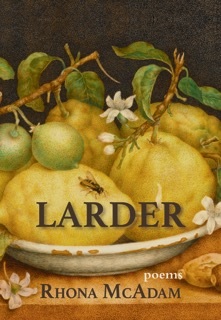
In her latest collection, Rhona McAdam navigates the dark places of human movement through the earth and the exquisite intricacies lingering in backyard gardens and farmlands populated by insects and pollinators, all the while returning to the body, to the tune of staccato beats and the newly discovered symmetries within the human heart.
“…A beautiful, filling collection, Larder is a set of poems to read at the change of the seasons, to appreciate alongside a good meal, and to remind yourself of the beauty in everything, even the things you may not appreciate before opening McAdam’s collection….”
Rhona McAdam is a writer, poet, editor, and Registered Holistic Nutritionist with a Master’s in Food Culture from Italy and a deep-rooted passion for ecology and urban agriculture. Her work spans corporate and technical writing to poetry and creative nonfiction, often exploring the vital links between what we eat and how we live. Based in Victoria, BC, and available via Zoom, Rhona is always open to new writing commissions, readings, or workshops on nutrition and the culinary arts.