-
Food and culture and deliberate misinterpretation
Read Full Post: Food and culture and deliberate misinterpretationI am something of a broken record on this subject, but it’s not my fault, it’s everywhere! The latest Food Programme (Feb 3) broadcast an interview with Michael Pollan about In Defence of Food, with discussion about nutritionism, with input from the term’s founder, Gyorgy Scrinis; Danish sociologist Soren Askegaard – who argued 11 years ago that focus on nutitional elements of food bypasses the equally important cultural aspects; and British physician Dennis Burkett (the father of fibre).
There is an interesting clip with Andrew Wadge, Chief Scientist at the Food Standards Agency who, like other food scientists I’ve heard interviewed about Pollan’s book, doggedly stick to a misinterpretation of Pollan’s advice that “you shouldn’t eat anything your great-grandmother would recognise as food” — instead trying to assert that Pollan is proposing you only eat what your grandmother would have eaten. Happily, interviewer Sheila Dillon pressed him on the point until it was clear he either hadn’t understood or was deliberately presenting a contrary position. While he continued to dodge the correction (even reasserting the misinterpretation on his blog), at least the attempt to mislead was made clear to listeners.
We need more such interviewers in Canada; after Anna Maria Tremonti’s interview with Pollan, the point was allowed to slide in a rebuttal interview with a food scientist, who again deliberately misconstrued Pollan’s advice, inaccurately paraphrasing it as ‘not to eat any foods that your grandmother wouldn’t recognise’ and lamely citing such things as exotic fruits that have been developed or popularised in the past century.
Which missed the point entirely. Pollan advises going to the wisdom of our ancestors – not literally to their diet – and using that to guide your food-buying, using highly processed yogurts in a tube as his benchmark for something great-granny would definitely not recognise as food, let alone know how to ingest.
Honestly. If food scientists can’t – or worse, won’t – get a simple concept like that right, it rather begs the question of why we should trust other advice they give?
-
Dog food to damned cold
Read Full Post: Dog food to damned coldOnly exciting food in recent days was a batch of dog food for the returning Anton, who is equally interested in food, walks and blue dinosaurs. His food was made of ground beef, beef hearts, oatmeal, brown rice, potatoes, whole eggs (including the shells, blitzed in the blender), spinach, shredded carrots, raw chopped garlic, red lentils and mixed (cooked) dried beans. And dissolved glucosamine tablets (he turns 13 this year).

Then I jumped on a plane, leaving this:
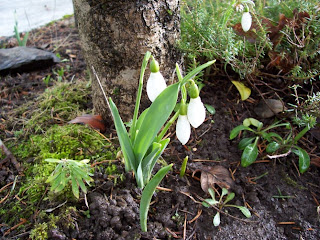
to come to this:

And here in Saskatoon it is a balmy -3c or so at the moment, except if you stand in a vicious wind. Yesterday was around -20c with a vicious wind.
-
Convenience, and the interesting arguments against microwaves
Read Full Post: Convenience, and the interesting arguments against microwavesIt strikes me that most of the ‘progress’ towards which the western world has worked itself to exhaustion has been the quest for greater convenience, a word that is starting to sound like a warning rather than a goal.
And working against it, as I re-learn basic skills like making my own mayonnaise and pasta, and switch as far as possible to local, perishable raw ingredients – awkward as they are to chase down – begins to feel damned virtuous. I’m grateful to have the time to indulge my fancies in this way.
But it seems to me that convenience is a selfish value. Rarely, it seems, is anything described as convenient of universal long-term benefit: the convenience of the car has contributed to what will be catastrophic effects on us all. Disposable anything, from diapers to juice boxes to syringes, creates more burden on landfills, usually involves a lot of plastic, and pushes out of production the more durable versions of itself (those that involve tedious washing or maintenance before re-using). Those notorious standby switches on electrical devices await our whim with the remote control; round-the clock hot water tanks are ready for random 3 am baths; city planning makes it impossible to live in much of this continent without driving: all of it needlessly draining energy for the sake of making our lives easier, which has been our single-minded and undisputed collective mission.
When it comes to food, it’s becoming clear that convenience can be dangerous to your health. As Michael Pollan points out, food that has a long shelf life has a long shelf life because even pests and microbes don’t find it’s worth eating; the perishable aspects of foods that are removed to keep a food from spoiling are usually what holds the nutritional value (wheat germ, for example, stripped out of white flour; the fragile antioxidants in fresh foods destroyed by heat processing). Long-lived food substances constructed in the lab are not comparable in any nutritional way to their traditional counterparts. As Pollan says, we co-evolved with the carrot for a reason, and it wasn’t so that we could extract beta-carotene and conclude that was the only reason for eating one. Eating badly and popping vitamin supplements turns out not to be the same as eating well over a lifetime either.
One convenience issue I’ve been mulling over as I re-heat my home-made meals using a microwave is whether microwaves are a bad or a good thing? While I am open to the idea they are a bad thing, I have not seen proof of that. And while I may be vaguely uncomfortable with blasting my meal for 3 minutes in the microwave, I like less the idea of heating it for half an hour in an otherwise empty gas oven or feeble toaster oven.
The main arguments against microwaves, that they damage the foods they heat, appear to be based on ‘scientific research’ done by a Swiss agronomist (though usually described as a scientist or a food scientist), Hans-Ulrich Hertel (often misspelled as Hans-Urich Hertel).
My willingness to have faith in Hertel’s findings is hampered by the fact they are only reported in blogs, alternative health sites of unknown credentials, and illiterate online ravings, all of which fail to mention they were based on a study of 8 people.
My nascent faith was further shaken by one item that named Hertel as the head of an anti-cell phone organisation called the ”World Foundation for Natural Science” (check out the website!) and another that says he was convicted in Swiss courts of making anti-semitic statements around the same time he won the right to publish his ‘research’ on freedom of speech grounds.
The Skeptic published an article about microwaves in 2003 that put things into perspective, and (Australian) ABC’s Dr Karl debunked Hertel’s evidence again in 2006. But I’m ready to hear about more credible studies that show the dangers of this particular form of convenience.


Latest Posts
- (no title)
- Sublime and Twisted Readings coming up!
- Sublime
- Good weather for reading
- The world, the world
- Sublime launch!
Aldeburgh Poetry Festival Barny Haughton BBC BC poets Berkswell blackberries Black Stilt Bologna book launch Borough Market Carlo Petrini Catalonia Cyrus Todiwala dairy Daunt's Books Dijon Edinburgh Fanny Bay Feast of Fields Food and Morality food history food journalism Jenna Butler lardo Malahat Review Michael Pollan Okanagan olive oil tasting olive trees Omnivore's Dilemma Our Food Our Future Oxford Parmigiano-Reggiano Planet Earth Poetry poetry poetry readings Poetry videos prosciutto salumi Sean O'Brien Suffolk ticks Wendy Morton Wired Writing Yvonne Blomer
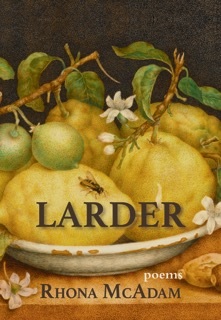
In her latest collection, Rhona McAdam navigates the dark places of human movement through the earth and the exquisite intricacies lingering in backyard gardens and farmlands populated by insects and pollinators, all the while returning to the body, to the tune of staccato beats and the newly discovered symmetries within the human heart.
“…A beautiful, filling collection, Larder is a set of poems to read at the change of the seasons, to appreciate alongside a good meal, and to remind yourself of the beauty in everything, even the things you may not appreciate before opening McAdam’s collection….”
Rhona McAdam is a writer, poet, editor, and Registered Holistic Nutritionist with a Master’s in Food Culture from Italy and a deep-rooted passion for ecology and urban agriculture. Her work spans corporate and technical writing to poetry and creative nonfiction, often exploring the vital links between what we eat and how we live. Based in Victoria, BC, and available via Zoom, Rhona is always open to new writing commissions, readings, or workshops on nutrition and the culinary arts.