-
Food, folk & farmers market
Read Full Post: Food, folk & farmers market
Albert Lee, mainstage, VIMF 2011 Last weekend’s Vancouver Island Music Fest was blessed with warm weather, peaceful crowds, some good food and great music.
It kicked off this year with Alison Krauss & Union Station playing a separate Thursday night concert. I’ve seen her a couple of times, so although I consider her to be both the bee’s knees and the cat’s meow, I took the more affordable option of skipping that, and waiting until the festival weekend pass kicked in on Friday.
Which gave us a chance to enjoy a leisurely Thursday night dinner of pasta dressed in garlic scape pesto, that was kindly included – courtesy of Farmer Derek – in the first Haliburton food basket. Which also included organic greens for the salad.

Red Horse, VIMF 2011 Friday night highlights were Red Horse (Eliza Gilkyson, John Gorka and my longtime favourite Lucy Kaplansky) followed by real Vegas magician Jeff McBride who provided some harmless fun. We left the next generation to enjoy Arrested Development so as to be fresh for the Saturday morning visit to the Comox Valley Farmers Market, which happily for us takes place right next door to the festival site.

Watermelon radish  Though the snackable carrots were long gone by the time we rolled up, the Willowvic Farm cinnamon buns were not, and nor were some particularly delectable spinach & feta croissants from Alderlane Farmhouse Bakery. And there was the watermelon radish which Big Buzz AcresFarm from Campbell River was selling to my great delight because I’ve just planted some myself.
Nathan Rogers, CVFM 2011 There were a lot of stands with some good looking foods and regular customers who bring their own shopping barrows, apparently. One
 surprise was to arrive and hear what sounded like a Stan Rogers cd playing, only to discover that it was in fact his son Nathan singing live, whose cross to bear is a voice very much like his dad’s, and perfectly suited to singing his father’s repertoire.
Celso Machado, VIMF 2011 
Celso Machado, VIMF 2011 On with the day. As usual, far too much to choose from, but I lucked into a workshop called The Magic of Music which introduced me to the wonderful Celso Machado, whose percussion antics so entranced his fellow performers they started filming him.

BettySoo+Rodney Crowell, VIMF workshop, 2011 
Mark Rubin+Silas Lowe, VIMF workshop, 2011 The Broken Hearted Song Circle followed, with a stellar lineup (Jon Anderson, Rodney Crowell, BettySoo, Leela Gilday and Gurf Morlix) and then it was on into the barn and Songs for Reason to discover some good ol’ boys – Atomic Duo – from Austin: highly entertaining all round.

Daniel Lapp, VIMF 2011 A Melancholic Frolic followed, featuring Lucy Kaplansky, JD Edwards, Eugene Smith, Morlove, Devon Sproule — and a rare treat for me to see Daniel Lapp again; I’d only seen him once and he was incredible, but at subsequent appearances I’ve caught, he’s given the stage over to his students – he’s a

JD Edwards much-admired teacher and mentor to young musicians.
“Don’t worry,” he told us, “it’s not broken” – as he detached and then slung the strings of his bow over the fiddle and proceeded to make some great sounds that left the others on stage gaping in delight. Edwards was good, if having a bit of trouble with his coiffure at times; always a pleasure to see Smith; but I was mostly there to see
Lucy Kaplansky Kaplansky who jammed with the others just like she oughta.I stayed for a few numbers by Steve
 Riley and the MamouPlayboys but the beer tent beckoned, and I also caught the unmistakeable sound of an oyster burger murmuring my name from Bob’s Burgers.
John Jorgenson+Albert Lee, mainstage VIMF 2011 
Jon Anderson So then it was Saturday evening mainstage performances, starting with Jon Anderson, followed by John Jorgenson & Albert Lee – surely the stars of the evening. After which Randy Newman, more entertaining than I’d expected. We left before the Travellin’ McCourys & The Lee Boys mixed it up in ways that just sounded like more than I could handle before bedtime.
Sunday had a slowish start for me but quickly peaked at a workshop called Guitars! where Albert Lee and John Jorgenson, with Celso Machado, quickly stole the show, although Bill Coon and Darren Radtke rose to the occasion as best they could, particularly with the closing number (Crossroads). But the standing ovation encore rendition of Orange Blossom Special was quite a moment. And not a fiddle to be seen..
A sense of anticlimax prevailed during the final workshop (Hope ya Like Jammin’) what with abysmal failure of sound systems to cope with some 13 musicians (Steve Riley & The Mamou Playboys, The Travelin’ McCourys and The Breakmen) not all of whom, ahem, played nicely with the others.
It’s easily said from my side of the stage that the best workshops are the ones where everyone jams – such rare opportunities and odd combinations – and yet other sessions end up as fairly pointless one-after-anothers.

Rodney Crowell + Jedd Hughes So in that sense Rodney Crowell’s workshop appearances were disappointing – no jamming on his stages – and he sang songs (and not always his best numbers, imho) that he then repeated in his mainstage performance Sunday night. I’m a longtime fan of his so can’t believe he wouldn’t want to make more of his considerable repertoire. I guess one gets tired of one’s own words after a while. Anyway, I like most of Sex & Gasoline which was one of the few cds I bought this year (economy, economy) despite the fact I didn’t like most of the songs from it that he sang in workshops. Go figure.
The other Sunday nighters – Holly Cole, Night Train Music Club and David Crosby – were, shall we say, just not what I was looking for. And so it ended for another year. Kind of expensive, food-wise: most plates were $10-12, and there really wasn’t much of interest in the vegetarian offerings. And the vegetarian meals were pretty much always the same price as the meat ones, which means the veggies were subsidizing the carnivores: a wrongness if ever there were.
Sadly, very sadly, I had to leave all these fellers on the beach too,
 as it’s red tide. Odd to see the coolers standing empty at the Fanny Bay Oysters Seafood Shop.
 -
Prawns & other fishy business
Read Full Post: Prawns & other fishy business I often share tables and menus with people who have not spent the past half dozen years or so obsessing about food to the same degree as I, and who therefore do not have as much trouble finding something edible in restaurants and other food outlets. Most of them do not register my shudder at the sight of prawns on the menu; nor do I act on first instincts to seize the menu and tear it into tiny pieces and then arms flailing eyes wild to scream at them “don’t touch them they’re poison!!!!” It’s become one of those things I simply won’t comment on unless invited.
One of the reasons I eat very little fish anymore, and particularly avoid prawns, as well as farmed catfish, basa, tilapia etc from China, Thailand, Indonesia, Vietnam and elsewhere – and of course farmed salmon from Canada – is because of the use of antibiotics, which are used to combat potential infection in overcrowded tanks and cages. This is prophylactic use, not treatment of illness, and is as worrying as the use of low dosages of antibiotics as a growth enhancer in land-based meat farming. The most troubling of these antibiotics is a series called fluoroquinolones.
So I’m inviting myself to comment here, because I have just read an article about these very chemicals (showing up in fish illegally imported to the US from China, Thailand, Canada, Indonesia, Vietnam and Ecuador) and simultaneously noticed that the Canadian Food Inspection Agency has relaxed by .04 ng/g the fluoroquinolone residues in aquaculture products action level from 0.6 ng/g (ppb) to >1.0 ng/g. This is because
The revised action level continues to provide adequate human health safety to consumers and is considered stringent enough to detect deliberate use of fluoroquinolone therapeutants in aquaculture.
Well all right then. It’s tiny, and the CFIA continues to assure us that there is no change in Health Canada’s policy of
zero tolerance for deliberate use of fluoroquinolone therapeutants (ciprofloxacin, danofloxacin, enrofloxacin and sarafloxacin) during fish production life cycle.
But if you also read
Resistance to quinolones has been reported in a variety of important bacterial pathogens, including Escherichia coli, Klebsiella pneumoniae, and other enteric organisms; Pseudomonas aeruginosa; Chlamydia trachomatis and Mycoplasma pneumoniae; Campylobacter jejuni; Burkholderia cepacia; Stenotrophomonas maltophilia; Neisseria gonorrhoeae; Staphylococcus aureus (especially oxacillin-resistant strains); Enterococcus faecium; and Streptococcus pneumoniae.
Don’t you just not want to go there at all? Particularly on a week when there’s news of a new antibiotic-resistant strain of gonorrhea and a spike in the incidence of syphilus — as well as general increases in STD’s in the elderly as well as youth. Not to forget the ever-increasing rates of food-borne illnesses like campylobacter jejuni, salmonella, and E. coli O157:H7 (and the new one that surfaced in Germany this year, E. coli O104:H4). And of course the hospital superbugs. It’s all enough to put you off your dinner.
A couple of months ago Barry Estabrook laid out the issues, and praised the one prawn I will still eat and am thankfully positioned to find – the Spot Prawn.
I have no doubt that things have improved since 2003 when Felicity Lawrence documented problems with the industry; but I am still suspicious of foods like prawns whose cost has so cheapened on the menu. And I know that most restauranteurs are watching their price points too carefully to ask too many questions about the full story on everything they buy. And will mislead you whether by accident or not, as I learned in Newfoundland a few years ago where a waitress informed me that the tiger prawns on the menu were local, which I doubted enough to double check; and yes, they were local – to Thailand I think it was.
-
Victoria’s farmers markets
Read Full Post: Victoria’s farmers markets If you consulted the BC Association of Farmers Markets Marketfinder, you might be forgiven for thinking there are only two farmers markets in Victoria. We visited a couple of off-the-list markets last Saturday, and there are many more besides.
It’s another one of those situations of fragmentation I guess; we are over-supplied with information and have no way to concentrate people’s attention on one source. What is the authoritative source of current information about farmers markets? We just don’t have one place to look anymore. In little old Victoria we have two print phone books now, as well as multiple online directories, and where directories are concerned, authority seems to change as swiftly as technology itself . Choosing a directory so people can find your business is a nightmare. Farmers market administrators would have to work out which information sources to subscribe to and then
 keep updated; prospective customers come from all kinds of backgrounds and are seeking the markets for all kinds of reasons, so will be looking in all different directions. Phew. Information overload already. Little wonder many simply rely on their own websites. No: make that blogs… No: Facebook… No: Twitter… No: iPad apps… No: Groupon. No: ..?!
Anyway. The listings include Moss Street, of course, and Oaklands – which I’ve never heard of but seems to be a Thursday community market. But there are in fact a number of others absent from its listings, who presumably simply don’t belong to the organization. The Victoria Downtown Public Market struggled on through the winter – its meat (Terra Nossa) and produce stands were always thronged but attendance looked poor to me in the cold months; I haven’t been downtown much so haven’t seen how it is this summer, or whether the Island Chefs Collaborative market is running competition for it in Bastion Square.
 The James Bay Farmers Market is a small neighbourhood market, nestled behind the
  legislature building and the Tally-Ho stop, so perfectly positioned for tourist as well as neighbourhood trade.
It’s time for fresh produce at last at last. And the
 re are lots of tomatoes to be had, despite the cool start to the summer. Those with greenhouse space
  are a month or two ahead of me. Sun Trio Farm had a good variety of plum sized tomatoes of many colours.
Given this long cool year we’ve had, it’s early for it, though even so, later in the day I encountered at least one farmer who was selling fresh garlic, but Golden Maples Fa
 rm had a great selection from last year. And nicely
  displayed too. They were labelled Purple Stripe and Metechi, but from what I read, Metechi is a kind of Purple Stripe; there are hundreds of varieties of garlic and all I can safely say about what’s in my garden is that I’m growing both hard and soft neck varieties and they haven’t died yet, so I’m hopeful that a harvest is still in my future. Anyway… these ones looked good.
The bread selle
 r at James Bay has beautiful looking loaves. Not cheap – many clocking in around $8 or $10 a loaf, but brisk sellers: he was down to a couple of loaves when we passed by later that day.
 Another Saturday market not on the BCAFM list was the North Saanich Farmers Market, run by the North Saanich Food for the Future Society (“dedicated to supporting farms and farmers, and further developing the agricultural capacity of the district.”). It’s another small neighbourly market with a regular clientele and – like James Bay – musical accompaniment. It seems to be well appreciated by the marketgoers too: things really do run out near the end of its three hour day.
There are more missing from the listings. From a food-shopper’s point of view, the risk that farmers markets run as they mature is in evolving into crafts markets, but that seems to happen to many of them. The farmers have to weigh time away from the fields against sales, and a great many of them (thanks in large part to the long-running Island Farm Fresh directory) have farmgate or direct sales as well as connections to retailers and restaurants. Moss Street has avoided this by keeping the crafts and food vendors physically separate, and the vendors are attuned to consumer trends: organic and gluten-free foods are the mainstay. It’s been a while since I went to the Saanich Fairgrounds, to the market that for a while seemed to be the only show in town (now known as the Peninsula Country Market), but it looks from the vendor list to have lagged a bit on farmer presence; and the last time I was at the Thursday evening Sidney Summer Market it was thoroughly mobbed, but had almost no produce stands.
Latest Posts
- Writers at Word!
- Sublime and Twisted Readings coming up!
- Sublime
- Good weather for reading
- The world, the world
- Sublime launch!
Aldeburgh Poetry Festival Barny Haughton BBC BC poets Berkswell blackberries Black Stilt Bologna book launch Borough Market Carlo Petrini Catalonia Cyrus Todiwala dairy Daunt's Books Dijon Edinburgh Fanny Bay Feast of Fields Food and Morality food history food journalism Jenna Butler lardo Malahat Review Michael Pollan Okanagan olive oil tasting olive trees Omnivore's Dilemma Our Food Our Future Oxford Parmigiano-Reggiano Planet Earth Poetry poetry poetry readings Poetry videos prosciutto salumi Sean O'Brien Suffolk ticks Wendy Morton Wired Writing Yvonne Blomer
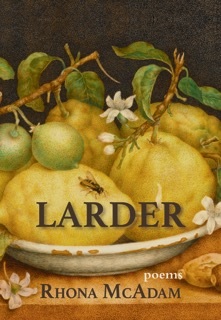
In her latest collection, Rhona McAdam navigates the dark places of human movement through the earth and the exquisite intricacies lingering in backyard gardens and farmlands populated by insects and pollinators, all the while returning to the body, to the tune of staccato beats and the newly discovered symmetries within the human heart.
“…A beautiful, filling collection, Larder is a set of poems to read at the change of the seasons, to appreciate alongside a good meal, and to remind yourself of the beauty in everything, even the things you may not appreciate before opening McAdam’s collection….”
Rhona McAdam is a writer, poet, editor, and Registered Holistic Nutritionist with a Master’s in Food Culture from Italy and a deep-rooted passion for ecology and urban agriculture. Her work spans corporate and technical writing to poetry and creative nonfiction, often exploring the vital links between what we eat and how we live. Based in Victoria, BC, and available via Zoom, Rhona is always open to new writing commissions, readings, or workshops on nutrition and the culinary arts.