-
More milk; lady carpenters; syrup of a different stripe
Read Full Post: More milk; lady carpenters; syrup of a different stripeIn my continuing quest to understand the elusive factors in meat production and climate change, I came across an archived broadcast of BBC journalist Simon Parkes‘ investigation into the carbon footprint of milk in Britain. It’s an interesting story and the factors that affect methane production are not always what you might think. (Download RealPlayer if your media player has trouble with .ram files)
On Friday I was attended Kate Braid‘s reading at Planet Earth Poetry. She’s published two books this past year, and she treated us to readings from both: Turning Left To The Ladies – about her past as a construction worker; and A Well-Mannered Storm: The Glenn Gould Poems. Making reference to the passing of PK Page, she also read Page’s poem, “The Filled Pen” and another by Rumi.
And on Saturday I attended some of the Big Leaf Maple Syrup Festival in Duncan, which was positively mobbed by visitors of all sizes, and who wouldn’t be drawn by the twin attractions of sugar and train rides? I missed out on the train, but took in the syrup tasting, held in the old school house at the Forest Discovery Centre
hosted by Mara Jernigan

for Slow Food, using this Maple Products Flavour wheel as a guide to aromas and flavours. We sampled half a dozen local syrups and one Easterner for comparison.

A producer panel gave us a chance to hear from some of the Sap Suckers, who spoke about the ins and outs of tapping maples, as well as evaporation,
bottling and hygiene issues. One of the best we tasted, I thought, turned out to be a science project by a local schoolgirl!

It’s a different flavour from the commercial maple syrup, which is smooth and sweet with no real aftertaste. This stuff has more complex flavours, and, I thought, quite a bit of green twig on the finish. As the participants attested, many of them voting for the Eastern version, we tend to prefer what we’re used to, and if that is a fairly bland sweet taste, that’s what we’ll go for. Bitterness is a hard sell in North America, which doesn’t feature much from that part of the palate in its cultural preferences. The flavour wheel itself was developed around Quebec syrups, so maybe it needs a couple more spokes for Western ones.
-
More fishiness
Read Full Post: More fishinessFish are ever-topical these days. Last week’s BC Supreme Court ruling that froze out new fish farm licenses for another 10 months is a victory for those opposed to the farms on the grounds they are insufficiently regulated to protect the ocean environment, and in particular the wild salmon whose numbers are shockingly low for reasons that many believe are tied to sea lice infestations from the farms. The predictions of possible extinction for pink salmon in the Broughton Archipelago are still out there, so the federal government’s takeover of fish farm regulation had better make for some swift improvements.
One of last year’s Slow Food newsletters included an article about seafood sustainability by Victoria-based fish expert John Volpe, who puts his finger on the problem (or one of them): “Seafood often remains a blind spot in the otherwise educated consumer’s knowledge base.”
A few articles to shed a bit more light, including one about trawling; one for chefs, from the Culinary Institute of America; one about oysters; and one from the New York Times (still free for the moment) about balancing health with seafood sustainability.
There is a lot of information out there about climate change’s effect on the ocean which is worth knowing about; I predict the dual ills of warming and acidification will soon put those all-you-can-eat seafood buffets of yore into the history books alongside the excesses of Rome.
On a more positive note, thanks to Marci for pointing me towards Todmorden, West Yorkshire, which has a dazzling website showing off the town’s efforts towards sustainable food production. One of their projects is aquaponics, which combines food and fish in a truly virtuous circle of water. Check it out:
-
Food & migraines
Read Full Post: Food & migrainesIn my many years as a migraine sufferer, I have more than once been subjected to tedious, if well-intentioned lectures on the general theme that, contrary to what I might know about my own body, my migraines are entirely due to food allergies.
So I was pleased to read in a back issue of The Skeptic a piece called Unconventional Migraine Treatments, about the widespread misapplication of research into migraines and food allergies. The author, Peter Adamson, unpacks the research in a widely quoted but monumentally inapplicable study called “Is Migraine Food Allergy?” (a sampling of only 88 children – and no adults) which misappropriators use
to ‘prove’ that allergies trigger or cause migraine. (The ambiguous use of allergy in the title permits… use [of] the traditional broad definition, namely ‘unusual sensitivity’, which allows them to include food intolerance.)… None mentioned that the children studied had ‘severe and frequent migraine’, that almost half of them also ‘had behaviour disturbance (mostly hyperkinetic)’, that over a third had rhinitis and 16% had epilepsy.
Not one mentioned the authors’ caution:
However, we cannot securely extrapolate to other groups of patients, such as those with infrequent mild migraine or adults.Nor did they mention the authors’ warning:
Diets are dangerous and socially disruptive, so such treatment should be adopted only when the symptoms are severe and only under experienced medical and dietetic supervision.AACHs having cited this ‘proof’ that migraine is caused/triggered by allergies, then prescribe their favourite, often very restrictive, diets to migraineurs of any age.
(AACHs = alternative and complementary healing systems and their practitioners).
That line about diets being socially disruptive is hugely under-discussed, I feel. Food allergies and intolerances are endemic in our neurotic and chemicalized culture, and many of the resulting diets – paralysing in their restrictions, and making dinner party pariahs of their followers – are, IMHO, the work of quacks who manipulate the anxiety and desperation of people struggling to stay afloat in this anxious and desperate world.
This is not to dispute that there are very real allergies and intolerances to foods out there, but I think the terms are over-used, and, as explained above, inappropriately used, at worst by some “practioners” to make money from vulnerable people. I also believe writers like Felicity Lawrence who propose that allergies and intolerances may be caused by eating processed foods, not by the pure form of the food; she made this argument memorably about commercial bread in her book Not on the Label. You’ll hear the same argument from Red Fife Wheat growers. I think the toxins present in chemical fire retardants or plastic cookware or fast foods deserve a wide berth, instead of heaping blame on good quality, nourishing food.
To those who have suggested to me that I try cutting back on wheat or dairy or tomatoes or whatever the latest dietary demon is in order to see if it helps my migraines, my answer is and will always be that I would prefer to live a normal, sociable life, eating what I please. And what I please does not include most fast or processed foods. It does include wine, cheese, chocolate and coffee in varying amounts which I do not find cripple me consistently or even occasionally. Even if there actually is a food issue at the root (which I doubt) (I choose to blame my ancestral fellow-sufferer, name of Granny, and all the grannies before her) I am prepared to suffer a day or two a month for a mostly normal life. That’s maybe 25 days of discomfort against 340 days of enjoying my food; not a bad ratio.
And if I am to enjoy my food when eating out, I’d like to do it without being deafened by my neighbours or have conversation drowned in “ambient” dance music. And at last! Someone has pointed out the acoustical failings of contemporary restaurant design. Of particular value is this list of pointers if you want to make sure of a quieter dining experience:
- Sit in tables in alcoves, which provide a barricade against sound waves.
- Avoid sitting by the bar or kitchen.
- Avoid sitting near large parties, who tend to talk louder.
- Ask for additional light and look at your dining companion. Without realizing it, we read lips.
- Ask management to turn the music down, even if you get dirty looks. Not only does this reduce noise, but people will then talk more softly.
- Look at photos of the restaurant ahead of time. No carpet or tablecloths and boxy dimensions should raise red flags.


Latest Posts
- Writers at Word!
- Sublime and Twisted Readings coming up!
- Sublime
- Good weather for reading
- The world, the world
- Sublime launch!
Aldeburgh Poetry Festival Barny Haughton BBC BC poets Berkswell blackberries Black Stilt Bologna book launch Borough Market Carlo Petrini Catalonia Cyrus Todiwala dairy Daunt's Books Dijon Edinburgh Fanny Bay Feast of Fields Food and Morality food history food journalism Jenna Butler lardo Malahat Review Michael Pollan Okanagan olive oil tasting olive trees Omnivore's Dilemma Our Food Our Future Oxford Parmigiano-Reggiano Planet Earth Poetry poetry poetry readings Poetry videos prosciutto salumi Sean O'Brien Suffolk ticks Wendy Morton Wired Writing Yvonne Blomer
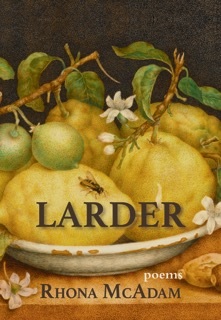
In her latest collection, Rhona McAdam navigates the dark places of human movement through the earth and the exquisite intricacies lingering in backyard gardens and farmlands populated by insects and pollinators, all the while returning to the body, to the tune of staccato beats and the newly discovered symmetries within the human heart.
“…A beautiful, filling collection, Larder is a set of poems to read at the change of the seasons, to appreciate alongside a good meal, and to remind yourself of the beauty in everything, even the things you may not appreciate before opening McAdam’s collection….”
Rhona McAdam is a writer, poet, editor, and Registered Holistic Nutritionist with a Master’s in Food Culture from Italy and a deep-rooted passion for ecology and urban agriculture. Her work spans corporate and technical writing to poetry and creative nonfiction, often exploring the vital links between what we eat and how we live. Based in Victoria, BC, and available via Zoom, Rhona is always open to new writing commissions, readings, or workshops on nutrition and the culinary arts.