-
Au revoir Ottawa
Read Full Post: Au revoir OttawaTWUC‘s meetings ended on Sunday after a lot of discussion about copyright, and the promise to issue this press release, and create this Facebook group. The gist of the problem from the writers’ point of view is a change to copyright legislation in Bill C-32, and specifically changes to Section 29 which asserts that:
Fair dealing for the purpose of research, private study, education, parody or satire does not infringe copyright.
This aims to simplify matters for people who want to copy our work – but at the expense (literally) of those whose livelihood is to create it. The problem is that if the word “education” is added, the act then allows any instructor to copy any copyrighted work for free. The financial implications are huge for writers whose works are studied or used in schools, colleges, universities and training facilities large and small.
Currently there is a licensing arrangement (with Access Copyright) which puts a very modest fee in the pockets of publisher and author. For most Canadian writers, this amounts to a total copyright earning of around $500 a year once the pot has been divided. As about 80% of this is estimated to come from educational copying, one small change to this act means a whacking cut to a slender earning. And so the writers of Canada are calling for that change to be revoked and will pursue legal action if it is not.
So, meeting over, I spent a couple of days more in Ottawa. Saw the Hill

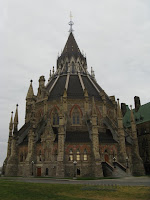
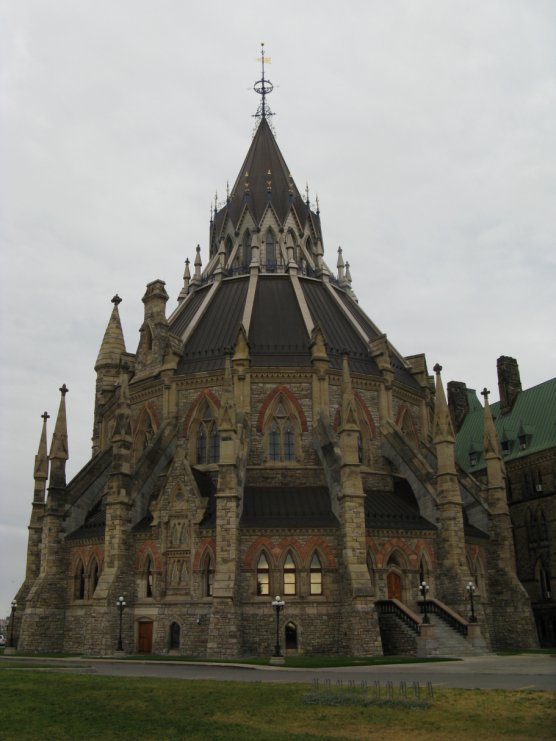
and the beautiful Parliament library, saved from fire in 1916 by a fastidious librarian who remembered to close the door when leaving;
and the cat sanctuary, where the cats come, so it seems, in all shapes and sizes;
and the Rideau locks;

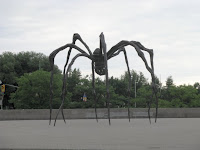
and, in memory of Louise Bourgeois, the National Gallery’s spider (which has marble eggs, I now know).
And then dined at a very nice tapas-style restaurant, Play, where the portions are small and shareable and include Ricotta “gnudi” – described to us as a naked noodle, tasty on its tapenade pillow and wearing a fetching little hat of confit garlic;
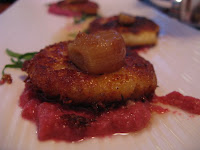
and asparagus with prosciutto

which was good, but a shocking abuse of prosciutto – which should be served raw in slices thin enough to reveal a Parma sunset. A nice piece of bacon, designed to be chunked and fried, would have been a more rational choice here I think.
A couple of the less photogenic items – grilled romaine dribbled with melted Ermite and garnished with caramelized onion and chopped cashews, and the tempura pickled ginger with a tamarind dip – were excellent.
My final day included a tour of the Gatineau, with lunch in Wakefield, tea (and a tiny cake)
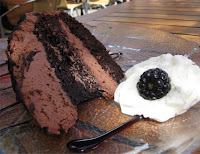
in Chelsea, a look at Meech Lake
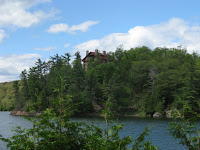
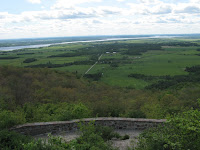
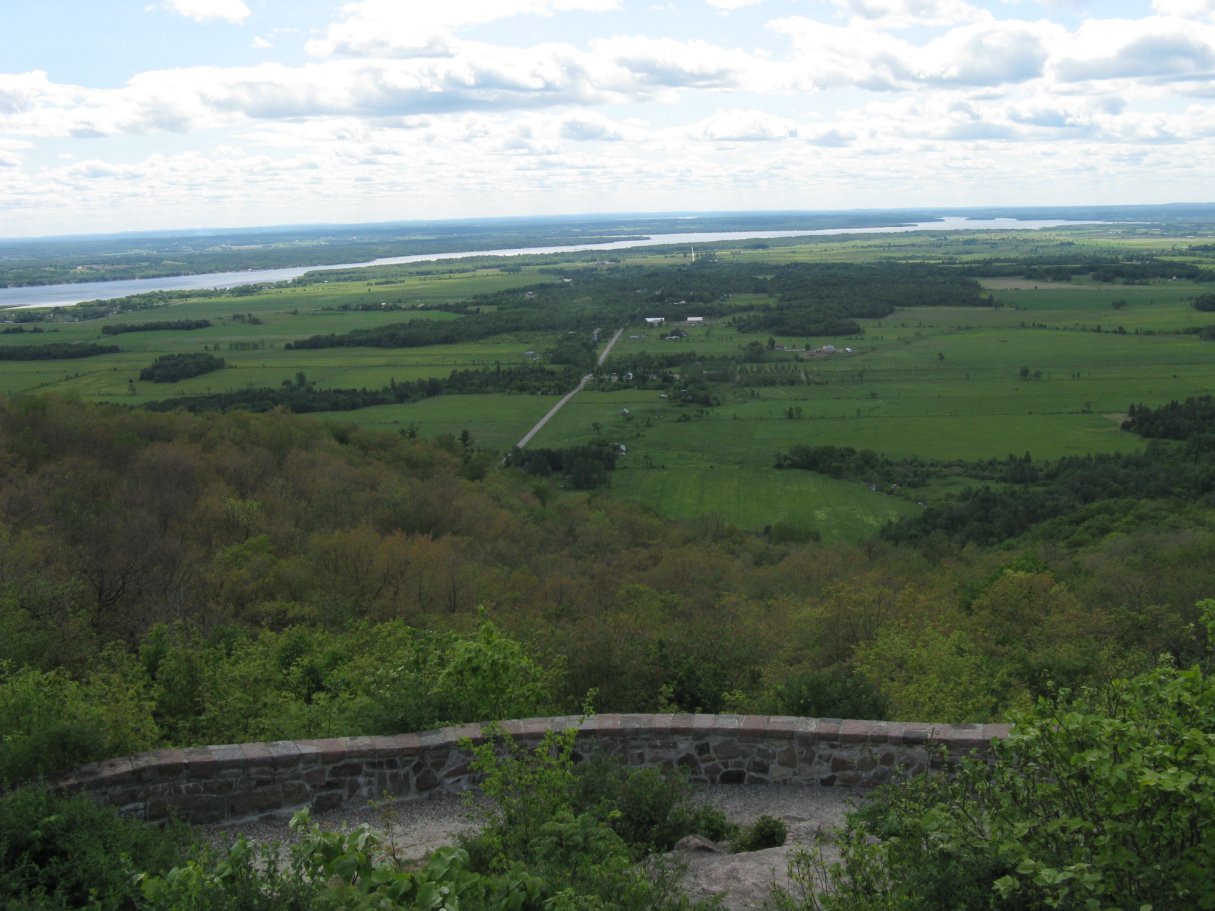
and a last vista: the Ottawa Valley, seen from a viewpoint on the Eardley Escarpment.
-
TWUCing it up in Ottawa
Read Full Post: TWUCing it up in OttawaThe Writers Union AGM in Ottawa started off Thursday night with a talk by Hal Wake, who did a smooth job of recapping the past fifty years of Canadian writing – though by his own admission under questioning (by a nonfiction writer), he was talking as most do about fiction – and withstood the asking of impossible questions by an audience that included a good many of the past 25 union chairs. Who included (name-dropping unavoidable here): Graeme Gibson, David Lewis Stein, Andreas Schroeder, Eugene Benson, Rudy Wiebe, Betty Jane Wylie, Gregory M. Cook, Trevor Ferguson, Susan Crean, Dave Williamson, Bill Deverell, Maggie Siggins, Susan Musgrave, Christopher Moore, Audrey Thomas, Barry Grills, Penney Kome, Bill Freeman, Brian Brett, Ron Brown, Susan Swann and Wayne Grady.
Another past chair, Margaret Atwood, joined us today to be part of a panel on small magazines and presses in Canada and talked about the earliest days of literary publishing in this country.
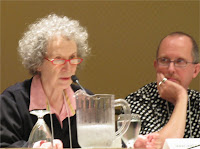
John Barton and Maurice Mierau were the other panelists. Christopher Levenson, co-founder and former editor of Arc, chaired the panel; Barton had worked with him on Arc before moving to Victoria to take the helm of the Malahat Review, which is is now steering through the choppy waters of reduced government support and greatly diminished funding. He has a lot to say about the manner in which this has been done, and about the resilience and inventiveness required of today’s literary editors as they fight for survival under a federal government that requires a minimum subscription level of 5,000 before a journal can even apply for funding.

Mierau spoke largely in his capacity as Associate Editor at Enfield & Wizenty, and offered the opinion that publishers in Canada are handcuffed by the funding requirements for Canada Council block grants, and proposed a system that incorporated more commercial titles and aimed for funding based on sales. About which I – representing that most unsaleable genre of poetry – have mixed feelings.
Preceding this interesting panel were others including one on the teaching of creative writing (is it possible to teach this?) featuring Catherine Bush, Genni Gunn, Tim Wynne-Jones and Ania Szado. Conclusions: well yes (sort of predictable since all the panelists teach/have taught/plan to teach creative writing) but it’s complicated.
Other panels covered social media for writers which was a predictable knotting of silvery brows as we struggled to grasp the new realities of marketing ourselves in the digital age. The panelists, Hugh McGuire, Nichole McGill and Jenny Bullough offered kindly guidance on the ins and outs of managing our personal brand online. A lunchtime talk that nudged us Beyond Blogging was also useful, with a lengthy discussion on tweeting, as well as other useful concepts like url shorteners and Google analytics.
After all that I had to find some serious sustenance. The Kasbah Village makes a mean Merguez with couscous…

…washed down with ample house red and conversation, making it a slightly woozy walk back to the National Library to hear Marie-Claire Blais deliver the Margaret Laurence Memorial Lecture – which is soon, with the preceding lectures, to be collected into a book which will be sold to raise funds for the Writers Trust, which sponsors the event.
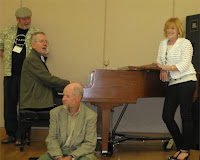
After which there was a reception. And after many of the millers-about had wandered off, there was some impromptu singing by – among others – Douglas Gibson and Sid Marty, with the piano stylings of Brian Brennan
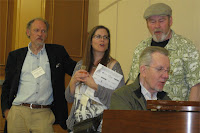
accompanied by the tempestuous twirlings of Greg Cook and Dorris Heffron

and the soulful “Summertime” of Genni Gunn.
-
Hali work party bugs
Read Full Post: Hali work party bugsLast week’s work party at Haliburton Farm was a bit of planting – some fingerling seed potatoes going surplus. The smartweed had taken over a lot of the prepared beds so we weeded as we went, and came upon a few hungry bystanders: cutworms,
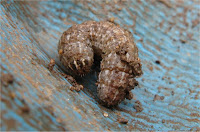
slugs,

and a few (but only a few, fingers crossed) of those potato-loving wireworms, the bane of organic gardening.
Wandered around a bit afterwards, noting the onion flowers
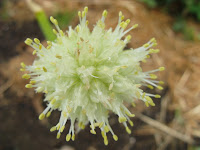
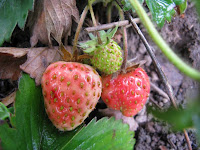
and the proximity of strawberry time!
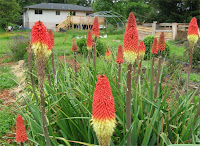
The farmhouse, with the rebuilt farmstand on the right.
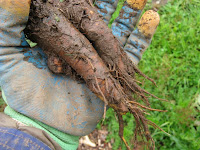
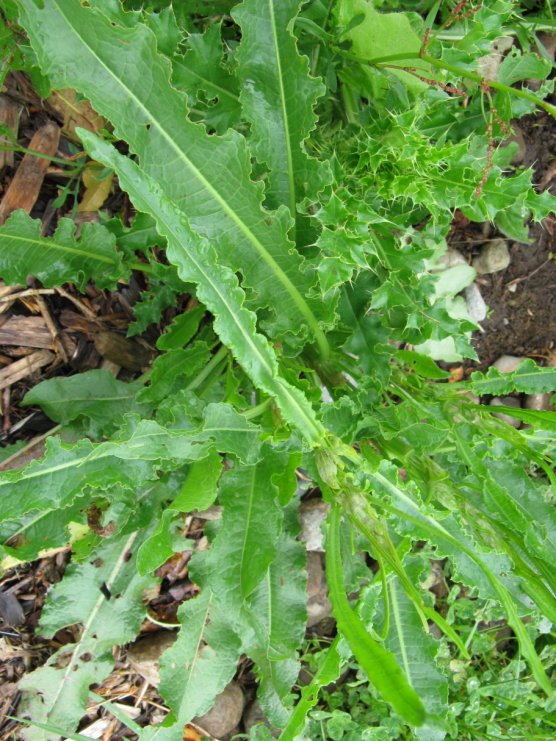
Tried an experiment with dock (yellow dock, I think?)
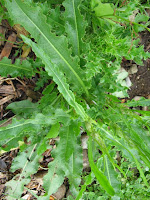
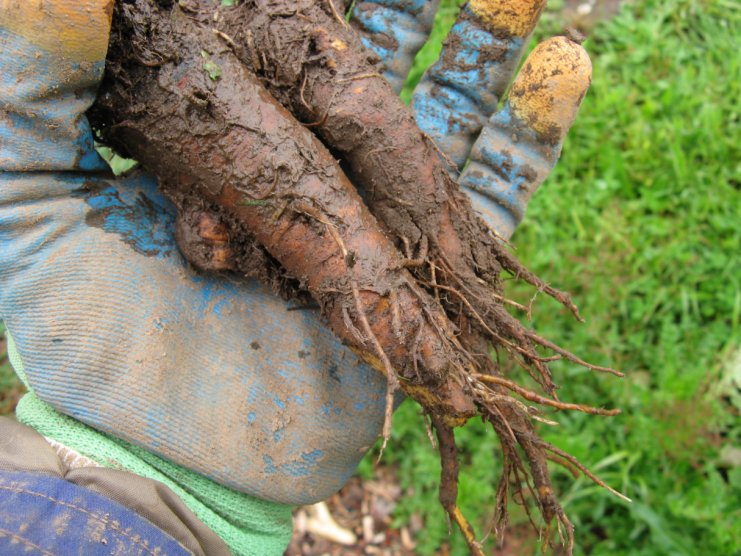
whose roots were the size of carrots.
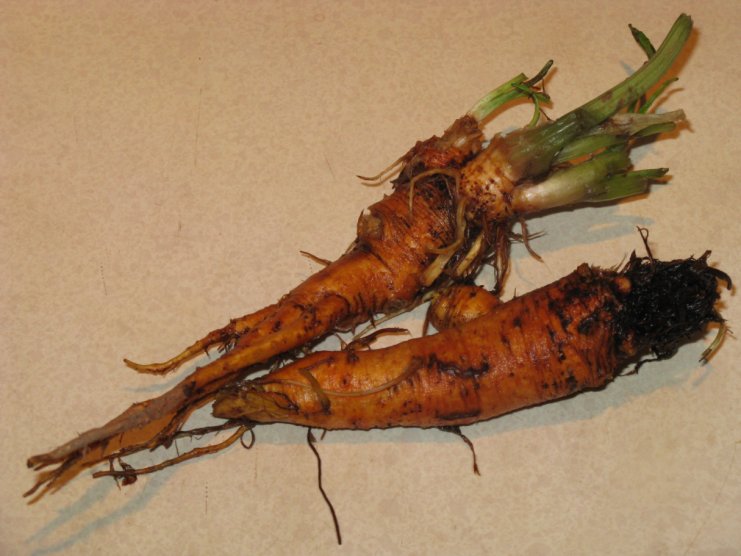
Kind of looked like carrots too, once cleaned up.
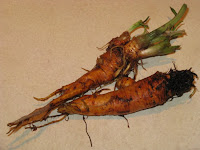
Rather pretty and very aromatic – a kind of perfumed soapy smell.
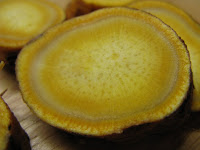
You can eat the leaves, and make a tea from the root which is said to be good for the liver and digestion. I’d had some burdock & dandelion root tea in Duncan at Seedy Saturday, but mine was fit, I’d say, for the plants, a kind of deluxe compost tea maybe. Very bitter roots; like a lot of plants, some parts are bitter and others edible at different times of the year.







Latest Posts
- Writers at Word!
- Sublime and Twisted Readings coming up!
- Sublime
- Good weather for reading
- The world, the world
- Sublime launch!
Aldeburgh Poetry Festival Barny Haughton BBC BC poets Berkswell blackberries Black Stilt Bologna book launch Borough Market Carlo Petrini Catalonia Cyrus Todiwala dairy Daunt's Books Dijon Edinburgh Fanny Bay Feast of Fields Food and Morality food history food journalism Jenna Butler lardo Malahat Review Michael Pollan Okanagan olive oil tasting olive trees Omnivore's Dilemma Our Food Our Future Oxford Parmigiano-Reggiano Planet Earth Poetry poetry poetry readings Poetry videos prosciutto salumi Sean O'Brien Suffolk ticks Wendy Morton Wired Writing Yvonne Blomer
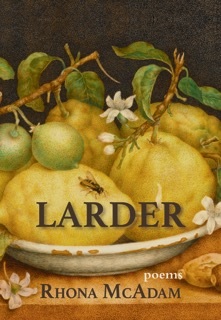
In her latest collection, Rhona McAdam navigates the dark places of human movement through the earth and the exquisite intricacies lingering in backyard gardens and farmlands populated by insects and pollinators, all the while returning to the body, to the tune of staccato beats and the newly discovered symmetries within the human heart.
“…A beautiful, filling collection, Larder is a set of poems to read at the change of the seasons, to appreciate alongside a good meal, and to remind yourself of the beauty in everything, even the things you may not appreciate before opening McAdam’s collection….”
Rhona McAdam is a writer, poet, editor, and Registered Holistic Nutritionist with a Master’s in Food Culture from Italy and a deep-rooted passion for ecology and urban agriculture. Her work spans corporate and technical writing to poetry and creative nonfiction, often exploring the vital links between what we eat and how we live. Based in Victoria, BC, and available via Zoom, Rhona is always open to new writing commissions, readings, or workshops on nutrition and the culinary arts.