-
Farm tour: salad greens and looong greenhouses
The COG-VI tour this month was to 30-acre Kildara Farms, organic since 1994 and run by Brian and Daphne Hughes. They started off with an apple orchard; went into strawberries but tired of feeding the deer, and are now supplying year round organic greens to local supermarkets.
They rinse the greens, then wash them in food grade hydrogen peroxide solution (1:1000) and then rinse again and spin them dry (equipment and surfaces are sterilized with 1:25 solution). When asked why they use this rather than bleach, which many organic suppliers in the US use, Brian replied, “One word: chlorine.” He says there’s always chlorine residue regardless of rinsing. For two years they have used a strict testing protocol, to avoid any issues with food-borne illnesses. As many travellers have found, salad greens, because they are eaten raw, are particularly vulnerable to these – if birds or other wildlife come into contact with them while growing in the fields or in open greenhouses. So Brian has the greens tested twice weekly for peace of mind, and provides test results to the retailers as well.
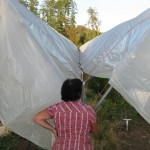
We looked at two different sets of greenhouses. The first were designed by British farmers whose company – Haygrove – quickly cornered the polytunnel market. They’re immense structures which can be extended to cover acres of ground, and use y-shaped posts that allow them to be extended efficiently in rows. They’re also simple to construct and inexpensive (by greenhouse standards) to erect, using legs which can be screwed into the ground and hold fast to clay soil. You can add deer fencing around the perimeter, which is open for better ventilation. Because the plastic is lashed in place by ropes rather than clipped, it is simpler and quicker to put up and take down. Any greenhouse is vulnerable to bad weather and these are no exceptions: during one particularly bad storm the plastic came loose twice in the same day. But they are otherwise working very well and are easy to ventilate further in hot weather, by just lifting and clipping the plastic as needed.
Next we looked into some Harnois greenhouses, made in Quebec. Fancier and more expensive, and full of winter greens – in this case Mizuna – which can grow unheated, or be covered by row cover if it get very cold. The watering system mists from overhead: more efficient than watering tapes, according to Brian, but in need of constant checking as the heads get clogged very easily.


The greehouse sides are enclosed so need to be ventilated during hot and sunny days. Pickers were at work while we were there, taking advantage of the evening cool (the greens start wilting by about 11 am). They chill the greens overnight before washing, sorting, weighing and bagging them. Kildara uses biodegradable bags – they used to use plastic clamshells but discovered that people were failing to recycle these and sending them to the landfill, so opted to change to bags for environmental reasons.


Kildara is one of a number of farms and food places on the North Saanich Flavour Trail this weekend.
-
Home on the farm, with apples and blackberries
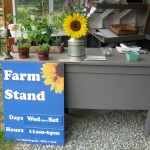 I’ve been enjoying my afternoons on the farm stand. People drift in and browse the offerings. Mostly they buy something. Sometimes they ask questions: do we sell pea shoots? How do you cook fava beans? What do you do with collard greens? Sometimes I can’t contain myself and show them obscure and beautiful vegetables, and sometimes they buy those too, as they are a curious and interested segment of the population. I’ve been bringing in cookbooks – especially the wonderful Jane Grigson‘s entertainingly written Vegetable Book and the exemplary Farmer John’s Real Dirt on Vegetables.
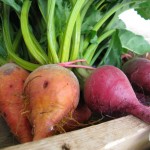
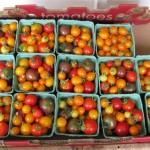
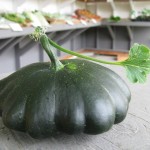
Here are some of last week’s farm stand offerings. Chioggia beets are the ones with the exquisitely pretty striped interiors. There’s a dazzing variety of cherry tomatoes, and several kinds of pattypan squash (also called custard marrow) – yellow, pale green (=white) and green.
Tis the season for seed saving and some of that is going on as well. Some of the garlic harvest will be saved for seed. And the plants that have gone to seed are often dried las shown on tarps to keep them from self-seeding in the beds. Once they’ve dried out, the heads will be removed and the seeds culled and sorted.
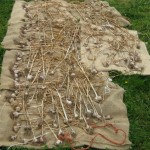
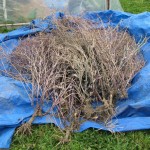
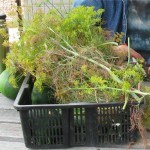
There’s a fair amount to do in the fields, so the farmers and work parties are keeping busy.
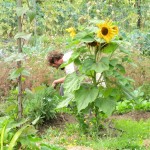
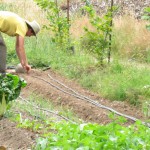
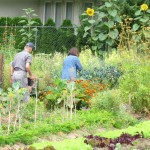
As am I with my apple tree which is laden. Here it is before and after picking a first basket of apples (est. 30 lbs).


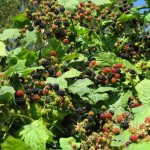
Will be juicing some with blackberries, if we ever get enough hot sunshine to sweeten the berries that are tempting us from ditches and hillsides.
-
Time of the stinking rose
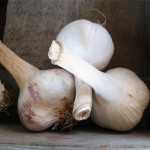 It’s all about the garlic just now. Harvests are in. Those who haven’t experienced devastating losses due to excess moisture and rot are crowing about the enormous healthy bulbs that are popping up at farm stands all over Vancouver Island. They cost between $2 and $3 a bulb at farmers markets; more than that if sold by weight, as they’re plump, fresh and juicy and a world away (literally) from the cheap bulbs from China.
Farmer Ray at Haliburton Farm certainly has something to crow about. Customer after
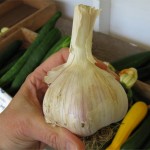 customer came by and marvelled at it, and insisted it must be elephant garlic! But it’s just good old organic hardneck garlic. Ray’s farming smarts, winning ways with compost and several years of patient experimentation have led to a record yield this year: some 1000 bulbs pretty nearly the size of a tennis ball. He planted deeply, spaced well and mulched it well in March with a thick layer of some of his amazing organic compost.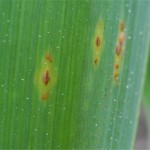
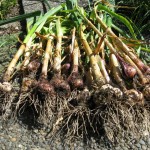 My own yield – harvested nearly two weeks ago – was more modest, but I believe all 14 cloves I planted came up and, aside from some split bulbs the bulbs look healthy and firm with no sign of mold. Like last year, they showed some rust that had persisted on the overwintering leeks, despite ministrations with home-made sulfur spray. It didn’t affect the bulbs, though, and they’re drying in an airy corner of the shed as I write.
After they’ve dried properly in another few days I’ll cut them down and peel off the grubby wrappers. The choicest bulbs will be saved for seed. One thing I learned this year, thanks to a lively discussion on the COG listserve, was to check the base of the cloves for two distinct ‘footprints’ – and if found, to separate the cloves even if there is only one clove skin, because otherwise they’ll split after planting. I did successfully pull up and replant a split clove but it’s not recommended. The fatter the bulb and cloves you plant, the bigger your plants will be next year, says Ray.
I planted a mixture of soft and hard necked and so finally got scapes this year, which I put
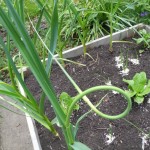 into soups and so on where garlic was called for: felt happy about this as it was great to get fresh garlic of any kind at the end of a long dark spring.
I’ve been thinking on how to store the garlic this year. I usually just keep it with the onions in a loosely covered bin or mesh bag. Various people I’ve talked to have been freezing it and two versions I’ve heard are: peel the cloves and freeze in ziplocks (easy to slice paper thin); or grate or mince and freeze in a slab in a tray, then cut the block into clove-sized pieces and keep frozen to pull out the right portion for your recipe. You can also dehydrate it. I haven’t really enough to start experimenting I think, but am planning to plant more for next year.
One of many interesting facts gleaned from the helpful folks at Boundary Garlic Farm is that “Supermarket garlic has usually been kept cold in controlled storage. If garlic has been kept cold it soon begins to sprout when brought to room temperature.” They recommend storing at a constant room temperature in one of those plastic mesh bags – that if you’re like me you’ve stashed away thinking it might come in handy for something…




Latest Posts
- Sublime
- Good weather for reading
- The world, the world
- Sublime launch!
- Planet Earth Poetry – Readings by Volunteers, Victoria 2026
- Poetry at the Goldfinch
Aldeburgh Poetry Festival Barny Haughton BBC BC poets Berkswell blackberries Black Stilt Bologna book launch Borough Market Carlo Petrini Catalonia Cyrus Todiwala dairy Daunt's Books Dijon Edinburgh Fanny Bay Feast of Fields Food and Morality food history food journalism Jenna Butler lardo Malahat Review Michael Pollan Okanagan olive oil tasting olive trees Omnivore's Dilemma Our Food Our Future Oxford Parmigiano-Reggiano Planet Earth Poetry poetry poetry readings Poetry videos prosciutto salumi Sean O'Brien Suffolk ticks Wendy Morton Wired Writing Yvonne Blomer
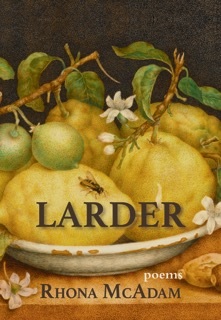
In her latest collection, Rhona McAdam navigates the dark places of human movement through the earth and the exquisite intricacies lingering in backyard gardens and farmlands populated by insects and pollinators, all the while returning to the body, to the tune of staccato beats and the newly discovered symmetries within the human heart.
“…A beautiful, filling collection, Larder is a set of poems to read at the change of the seasons, to appreciate alongside a good meal, and to remind yourself of the beauty in everything, even the things you may not appreciate before opening McAdam’s collection….”
Rhona McAdam is a writer, poet, editor, and Registered Holistic Nutritionist with a Master’s in Food Culture from Italy and a deep-rooted passion for ecology and urban agriculture. Her work spans corporate and technical writing to poetry and creative nonfiction, often exploring the vital links between what we eat and how we live. Based in Victoria, BC, and available via Zoom, Rhona is always open to new writing commissions, readings, or workshops on nutrition and the culinary arts.