-
Genetically-modified October
There has been a fair amount of GMO action, good and bad, this month.
On October 10, the Healthy Saanich Advisory Committee bravely invited public input into their deliberations on the question of whether to allow Genetically-Modified (GM) seed crops into the municipal district. [For those who don’t live here, Saanich is one of the largest of our 13 municipal districts and 3 electoral areas that make up what is commonly known as Victoria (plus the Gulf Islands), but more accurately named the Capital Regional District. It is also a daunting mixture of urban, suburban and rural (peri-urban really, on this increasingly crowded tip of Vancouver Island) areas.] The Healthy Saanich Committee took the public input into their own deliberations, and will be making a recommendation against allowing GM crops to Saanich Council in November. One of the presenters requested that the meeting where the recommendation would be made should be one where the public could be present.
At least fifteen residents made written presentations to the committee, and another fourteen each made five-minute verbal presentations to the committee, who will have left the meeting groaning under the weight of much additional reading. Local farmers, gardeners, citizens, doctors, scientists and church groups were represented, and thirteen of the fourteen presenters spoke emphatically against allowing GMOs into the community.
In my five minutes I spoke as one of the millions of people in North America who have, for the past 18 years, been obliged to consume GM foods without our knowledge or consent, because our federal government has twice blocked the introduction of mandatory GM food labelling, thereby removing our choice over whether or not to eat it. And GM ingredients are present in, so the estimates go, some 70% of the foods in Canadian grocery stores (if you eat a lot of processed foods, your consumption is probably higher than that). Other presenters pointed out the failure of governments to require adequate long-term studies of GM products on animal and human health and on the environment. Still others argued that GM crops would increase the amount of pesticides used on our soil, and therefore the quantity of pesticides introduced into our diets and water supply.
In a timely reminder that the pesticide threat was no idle supposition, we’ve just had news that Canada is on the brink of approving GM corn and soybeans – destined for human and livestock consumption – designed for use with the pesticide 2,4-D (an ingredient in Agent Orange), which is needed because Roundup-Ready GM crops have created glyphosate-resistant weeds, creating what had been predicted from the outset: an increase in pesticide use, not the decrease originally promised by the biotech industry.
 In Ontario, farmers gathered to protest the planned introduction of GM alfalfa into Canadian fields. The prospect is more than worrying, because alfalfa is a hugely important crop, which forms the bottom of our own food chain. Organic growers are heavily dependent on it both as a livestock feed, an export crop and a cover crop. Since the only alternative Canadians have if they don’t want to eat unlabelled GM foods is to buy certified organic (no GM ingredients or agricultural inputs are allowed in Canada’s certified organic production), this puts our whole organic food system at risk. Given the rates of contamination of non-GM corn, soy and canola by their GM counterparts in North America, and the sorry tale of the “Triffid” flax that killed Canada’s European flax export trade, it is a certainty that GM alfalfa will cross with no
n GM.
And finally, Michael Pollan has written a thoughtful analysis of California’s pending vote on mandatory labelling of food containing GMOs, coming up November 6, and the need in today’s damaged food system, for a more vigorous and less one-sided blending of food with politics.
-
Gary Nabhan – Climate change and traditional diets
 Tuesday after Tuesday has slipped by in another busy month. A couple of Tuesdays ago, American ethno-botanist Gary Nabhan visited the University of Victoria to give one of the Landsdowne Lectures. A distinguished writer, teacher and conservation biologist from Arizona, Nabhan has published work whose subject matter ranges from tequila, to place-based foods, to diabetes in desert-dwellers, to the marriage of science and poetry, to his special passion for chile peppers. He delivered a fascinating and fast-moving talk to a crowded lecture theatre, covering climate change, indigenous diets and the need for adaptation and knowledge-sharing among First Nations communities struggling to protect sources of their native plants and other food sources.
He began with an expression of concern about the rapidity of climate change inserting itself into food security: the ravages of drought, he said, are changing what’s going to be on our plate in the near and long term. If you don’t think that climate change alters access to food, wait and see what happens to food selection and price in both developing and developed world this year. Five Canadian provinces, 1,800 rural counties in US and 7 Mexican states have experiences droughts and climactic disasters this year that count as the worst in recorded history. Newly introduced plants, weeds and insects are causing problems for traditional plants even as climate works its changes.
He spent quite a bit of time on the notion of terroir, and its “relationship to place” that draws lines between flavour and culture. Both physical environment and cultural perceptions contribute to the particular flavour profile in indigenous foods. It doesn’t really make much difference whether landscape, soil or culture is the most important to these flavours, since all these things are now being affected by climate change. It is affecting both wild and managed place-based foods, like heirloom vegetables and fruits, heritage livestock and poultry, and “Salmon nation” foods, some of which were introduced, while others went feral: giant camas, Olympia oysters, Pacific littleneck (butter) clams, wapato, Hooker’s onion, moss cranberry all of which had stewardship traditions.
Traditional foods in all cultures are undergoing both availability and flavour shifts due to climate change. Where once terroir was perceived as a stable quality, now its definition is being scrambled by the “new normal” of climate change: both flavours and price will change as a result. “Many grape varieties may now be at their ripening limits,” he observed: they won’t taste the same unless we grow them at different latitudes which can offer them the growing season and temperatures they’re accustomed to.
Other foods just simply won’t be able to be grown where they used to be: for example many wild and cultivated fruits and nuts require adequate winter chill hours and optimum mean temperatures that are no longer available. The wild relatives of cultivated crops have not been well studied, but will also be subject to these changes: lacking the winter chill hours for budding, fruiting and optimum yield. The bog cranberry, cloudberry, trailing blackberry, Pacific crabapple and beaked hazelnut are a few examples.
This whole situation puts any traditional food products – such as those protected by geographical indications – at particular risk, worldwide, as climate change begins to bite. Seed banks are not the answer, since they lock seeds into climactic conditions that will no longer exist by the time the seeds are needed.
He turned to his own beloved chile peppers as an example of what’s happening to traditional crops. They are particularly vulnerable to changes in climate, as they flower and set fruit in hurricane season. Drought has brought disruption: low yields, insect predation (the nitrate counts increase due to drought stress, which attracts insects); freak freezing weather in 2011 killed 60-80% of the American chile crop that year.
Ironically, we have, through urbanization, inadvertently created laboratories to study climate change: urban heat islands can forecast what will happen in adjoining rural areas within a few decades. Now is the time to be observing those changes and learning from them.
The action required? Assisted migration of heat-stressed plants or food animals is one option, though this won’t help wild foods. Knowledge will have to be shared by southerly neighbours as the growing conditions move northwards. Traditional agro-ecological practices will be needed in order to create climatically buffered micro-habitats for vulnerable foods, in a system he called “ethno-mimicry” – preserving foods that are ceremonially, medicinally or nutritionally necessary in indigenous food systems.
Traditional food managers are not passively victims of climate change, but are already adapting, through such methods as water harvesting and conservation, or using “nurse plants” to shelter temperature-sensitive edibles and medicinals. We’ll need new alliances of producers and consumers to redesign food systems for resilience, changing our “food prints”.
Knowing where our food comes from, he concluded, is “the surest way we have to lodge ourselves within this blessed earth.”
-
Stuffed & stirred
 Raj Patel made a welcome visit to Victoria last week, supporting the Horticultural Centre of the Pacific’s efforts to raise funds to rebuild the greenhouse, gardener’s office and tool shed that were destroyed by fire last year. For such a high profile name and entertaining speaker there was a puzzling number of empty seats, but those who came were treated to a whirlwind tour through the complexities of feeding an imbalanced world.
Author of Stuffed and Starved and The Value of Nothing, Patel is fond of an hourglass metaphor (you can see this graphic explained on page 3 of Food Security in a Volatile World) to explain the world’s food economies. Consumers are the numerous bulge in the hourglass’s wide top, farmers & producers make up the wide bottom, and a few corporations act as gatekeepers, pinching the middle and squeezing profits from both ends. The aim, he says, is to try to keep those corporations out of the relationship between consumers and producers: in that way, food can be fairly exchanged and there is no need for hunger.
We do have enough food for the world, we just don’t distribute it well, because we’ve commodified it and a small minority is fixated on making large profits rather than nourishing populations. What we have is wasted and poorly distributed. India leads the world in diabetes – some cities have 20% rate. In his own family every man over 50 must watch his blood sugar.
He spoke about market economies and the disastrous effects they’ve had on food security by removing the obligation found in, for example, feudal economies, where the landlord ensured that food was distributed in times of hardship. In a market economy, there is no such concept. In India, he said, a nation of farmers, the market economy was forced upon a working feudal system by the British, who reaped vast financial rewards and left the country in economic ruin. Where famines had happened once in a hundred years in India, after the British occupation they occurred every four years.
Market economy damages food security by treating food as infinitely produceable and marketable, failing to recognize that it takes time to grow and produce: if there’s a food shortage, it can’t be solved until the crop comes in. Patel reminded us of the concept of grain reserves – a tradition of grain stores whose loss puts the world at tremendous risk. The Mayans, he said, had enough for 15 million people for 6 months; the US public corn store has enough for 9 hours. This is a public grain store: there are private ones, but this will not feed a hungry public in times of need.
Haiti was another example of a food economy crippled by the imposition of a market economy. It had been self-sufficient in rice, but following American intervention and then an American-backed coup, Haiti made a forced entry into market economy. Local rice farmers were swiftly driven out of business by subsidized American rice farmers. There was widespread deforestation and poverty. Farmers were driven into cities to work in sweatshops. Even before Haiti’s earthquake, the country was being hammered into worse poverty by the likes of economist Paul Collier who maintained that Haitians could pull themselves out of debt if the 8 hour sweat shops were made 24 hour (workers were being paid around $3 a day at this time and the American government cooperated with such profitable US clothing companies as Fruit of the Loom, Hanes, Dockers, Nautica and Levi’s in stalling a minimum wage increase to $5 a day, which we now know thanks to WikiLeaks).
Patel expended much of his venom on the World Bank, where he once worked. To illustrate its workings he suggested we watch the Terry Gillian film Time Bandits, in the scene where Robin Hood distributes goods to the poor, while a big thug behind him punches the peasant in the face. And that, he said, is the world Bank. It goes around setting up market economies and lending money that can’t be repaid. Lending more money to cover the debts.
He turned to agriculture, at the root of the food security issue. GMO crops are said to be more productive, he observed. In fact they are, but it has nothing to do with genetic manipulation: it is that seed companies are dedicating their conventional seed breeding efforts to develop the strains that they are pairing with the GMO. So it’s not technology, it’s old fashioned seed breeding that’s improving the yields; but it’s the genetic manipulation of those strains that makes the improved varieties unavailable to organic farmers and those who don’t want/can’t afford to invest in GMO.
He mentioned as well one of the great media blackouts of the past five years: the IAASTD report (Agriculture at a Crossroads) was buried after 4 years work by 400 scientists from 64 countries, working under the request of the United Nations to predict ways to feed the world’s population. The report to its cost said industrial agriculture has had its day and that small scale ecological farming methods are our only hope. Biotech might have a role to play, the report said, but the jury was out.
In brighter news, he spoke about food sovereignty initiatives in Malawi where they’re growing millet, sorghum, cow peas – traditional subsistence crops grown for local consumption. In what sounds like a permaculture move to me, they’re also growing leguminous trees which will also fix nitrogen in the soil while providing shade: 15% more shade means 15% more yield – these are the practicalities of climate change. Despite the success of these crops, children are going hungry, because harvest is woman’s work. Gender roles impair success, so to counter this they’re holding cooking parties, where men, women and children cook together: the women teach the men how to cook.


Latest Posts
- Sublime
- Good weather for reading
- The world, the world
- Sublime launch!
- Planet Earth Poetry – Readings by Volunteers, Victoria 2026
- Poetry at the Goldfinch
Aldeburgh Poetry Festival Barny Haughton BBC BC poets Berkswell blackberries Black Stilt Bologna book launch Borough Market Caerphilly Carlo Petrini Catalonia culatello Cyrus Todiwala dairy Dijon Edinburgh Fanny Bay Feast of Fields ferries Food and Morality food journalism Michael Pollan olive oil tasting Omnivore's Dilemma Our Food Our Future Oxford Parmigiano-Reggiano persimmons Planet Earth Poetry poetry poetry readings Poetry videos prosciutto salumi Sean O'Brien sensory analysis Suffolk ticks tortelli di zucca Troubadour Wendell Berry Wendy Morton Yvonne Blomer
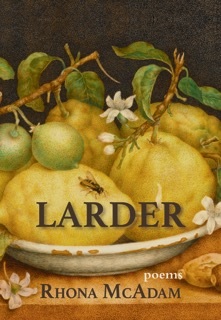
In her latest collection, Rhona McAdam navigates the dark places of human movement through the earth and the exquisite intricacies lingering in backyard gardens and farmlands populated by insects and pollinators, all the while returning to the body, to the tune of staccato beats and the newly discovered symmetries within the human heart.
“…A beautiful, filling collection, Larder is a set of poems to read at the change of the seasons, to appreciate alongside a good meal, and to remind yourself of the beauty in everything, even the things you may not appreciate before opening McAdam’s collection….”
Rhona McAdam is a writer, poet, editor, and Registered Holistic Nutritionist with a Master’s in Food Culture from Italy and a deep-rooted passion for ecology and urban agriculture. Her work spans corporate and technical writing to poetry and creative nonfiction, often exploring the vital links between what we eat and how we live. Based in Victoria, BC, and available via Zoom, Rhona is always open to new writing commissions, readings, or workshops on nutrition and the culinary arts.