-
Sharpen those pencils
A couple of submission opportunities have crossed my inbox lately.
The “Words for Wilderness” prose and poetry contest, sponsored by the Washington Wilderness Coalition (WWC), seeks work that comes from the heart of the wilderness and the writer. It can include both personal work that revels in the experience of nature as well as writing that explores political aspects of civilization’s relationship with wilderness. Winners will read their work at an event in late June. Deadline May 17, 2006
Seal Press, an imprint of Avalon Publishing Group, Inc. is seeking articles by women for a couple of new collections of essays about travel. Greece: A Love Story (deadline June 1st) needs essays on the Greece that lies behind postcards; and Go Your Own Way (Deadline: May 15, 2006) is seeking original, personal stories by women on the experience of traveling alone in all corners of the globe.
-
Flax, linseed and poetry in Chicago
When did linseed become flax? I often get startled looks when I call those little beggars in the Red River Cereal linseed, but I sure wouldn’t dare call the oil version by that name, because we know linseed oil as a furniture polish, traditional oil for cricket bats, and paint solvent, not as the trendy and expensive wonder-supplement we call flax seed oil.
The source of all this is a plant whose full and proper name is Linum usitatissimum, as we might have guessed by the names of other of its products, linoleum and linen for example. It is also grown as an ornamental plant in gardens, its sky blue flowers opening only in the morning. Other uses include dye, paper, medicines, poultices, fishing nets and soap, as well as a handy plug for drains (wrap it up first though eh?). If you’re not keen on sardines or cold water/oily fish, ground flax seed or flax seed oil are particularly good sources of Omega-3. It’s not something I’ve seen used as a central ingredient in cooking – its flavour is pretty nondescript – but you can add it for nutritional and/or decorative reasons to a number of baked goods, soups, grains etc.
I was leafing through my new copy of PN Review which includes a review of the University of Chicago’s recent exhibition The Making of Modern Poetry. The show’s over now, and on the wrong side of this continent, but I liked the reported response by John Ashbery to an acceptance by a literary magazine of his poem Europe, exclaining it was “the best news since the Treaty of Utrecht“.
In my wanderings on the U of Chicago site looking for information on the exhibition, I encountered Poem Present, where you can, if you have QuickTime or an MP3 player, hear and view past readings, including a reading and lecture by Robert Creeley who visited the university the year before he died. What a wonderful world.
-
Sweet sleep
I recently attended a series of lectures from the Arthritis Society designed for people destined for but not already committed to a meaningful relationship with osteoarthritis. The last talk was on diet and nutrition, and someone asked about the “Arthritis Diet” books and articles you see everywhere. The nurse giving the lecture said that these are based on studies of rheumatoid arthritis, which is tied to the immune system, not the more common osteoarthritis which has more to do with wear and tear. She conceded that we do all have sensitivities, so it may be that some foods are better/worse than others for our individual situations, but that there is no one diet that will help people with OA. That having been said, calcium, and vitamin D3 and Omega-3 fish oils which help us absorb it, are particularly important to arthritis sufferers for maintaining bones and connective tissues.
Sugar is a major irritant for a lot of arthritis sufferers, which interestingly has to do with insulin levels. As the instructor told it, if you eat sweets or drink alcohol at night before bed, you end up with higher insulin levels after the insulin has done its work processing all that sugar; like a bored teenager looking for something to do, the insulin crosses the blood/brain barrier and interferes with the release of serotonin, which means you don’t sleep properly, which means your body – inflamed joints and all – do not rest either, and you all feel the worse for it in the morning.
But further readings on the subject suggest to me that doesn’t appear to be what really happens. It’s not insulin but tryptophan that is (we hope) crossing the blood-brain barrier, as it’s needed to produce serotonin. Eating sweets and refined (white) sugars and starches are said to be bad because although they cause serotonin levels to rise, they only raise the serotonin levels for 1-2 hours, which I guess is one reason you might fall heavily asleep after drinking alcohol, and then wake up a couple of hours later. Whole grain starch (whole wheat, brown rice, oatmeal):
Triggers a slow, sustained release of insulin that lowers blood levels of most large amino acids except tryptophan, which remains in the blood and can enter the brain. As a result, serotonin levels rise gradually, and blood-sugar levels remain stable, without the rise and fall experienced with sugar or refined grains.
So… you should eat a nice bowl of – sugarless – oatmeal before bed? Or even better, write yourself a soothing little sonnet.
To Sleep
O soft embalmer of the still midnight!
Shutting, with careful fingers and benign,
Our gloom-pleas’d eyes, embower’d from the light,
Enshaded in forgetfulness divine;
O soothest Sleep! if so it please thee, close,
In midst of this thine hymn, my willing eyes.
Or wait the Amen, ere thy poppy throws
Around my bed its lulling charities;
Then save me, or the passed day will shine
Upon my pillow, breeding many woes;
Save me from curious conscience, that still hoards
Its strength for darkness, burrowing like a mole;
Turn the key deftly in the oiled wards,
And seal the hushed casket of my soul.–John Keats
I came across another sleep – or rather not sleep – poem which features dogs and which I could have written myself at 3 am last Friday, when old Prince next door was feeling sad. Though it turns out I didn’t need to since Emiliano de Lucas got there first.


Latest Posts
- Sublime
- Good weather for reading
- The world, the world
- Sublime launch!
- Planet Earth Poetry – Readings by Volunteers, Victoria 2026
- Poetry at the Goldfinch
Aldeburgh Poetry Festival Barny Haughton BBC BC poets Berkswell blackberries Black Stilt Bologna book launch Borough Market Caerphilly Carlo Petrini Catalonia culatello Cyrus Todiwala dairy Dijon Edinburgh Fanny Bay Feast of Fields ferries Food and Morality food journalism Michael Pollan olive oil tasting Omnivore's Dilemma Our Food Our Future Oxford Parmigiano-Reggiano persimmons Planet Earth Poetry poetry poetry readings Poetry videos prosciutto salumi Sean O'Brien sensory analysis Suffolk ticks tortelli di zucca Troubadour Wendell Berry Wendy Morton Yvonne Blomer
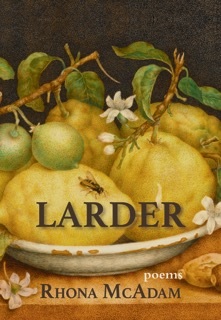
In her latest collection, Rhona McAdam navigates the dark places of human movement through the earth and the exquisite intricacies lingering in backyard gardens and farmlands populated by insects and pollinators, all the while returning to the body, to the tune of staccato beats and the newly discovered symmetries within the human heart.
“…A beautiful, filling collection, Larder is a set of poems to read at the change of the seasons, to appreciate alongside a good meal, and to remind yourself of the beauty in everything, even the things you may not appreciate before opening McAdam’s collection….”
Rhona McAdam is a writer, poet, editor, and Registered Holistic Nutritionist with a Master’s in Food Culture from Italy and a deep-rooted passion for ecology and urban agriculture. Her work spans corporate and technical writing to poetry and creative nonfiction, often exploring the vital links between what we eat and how we live. Based in Victoria, BC, and available via Zoom, Rhona is always open to new writing commissions, readings, or workshops on nutrition and the culinary arts.