-
Food security on the Island
I went to Courtenay to attend a day of meetings on food security last Friday, organized by VIHA and held at the Crown Isle golf club. Not the most appropriate setting – all that farmland covered with artificially managed turf is a bit troubling to say the least – but it was comfortable, and the food was good.
About 90 of us, I’m told, made the trek from all over Vancouver Island and the Gulf Islands to sit together and talk about food security. The concerns were many and of considerable weight: though there’s been questionable record-keeping on our food supply on this island, it’s considered accurate to say that only 5-7% of our food is raised here; the rest is ferried over from the mainland. There are widespread concerns about the water crisis in California which will inevitably affect our food supply over the coming year. Like the rest of the Western world, we have food quality challenges – and the correspondingly poorly nourished and increasingly overweight population – that are increasing the strain on our health systems. And we as a planet sit on the edge of predicted world-wide shortfalls in food.
So there is huge impetus to improve the island’s self-sufficiency in food production, against the economic and political weight of real estate development. The agricultural vote has historically been too low to get the attention of politicians — but there is a provincial election coming.
We broke into groups to tackle food security (“A situation in which all community residents obtain a safe, culturally acceptable, nutritionally adequate diet through a sustainable food system that maximizes self-reliance and social justice” –Hamm & Bellows, from a 2003 article in the Journal of Nutrition Education and Behavior) by discussing three questions. Firstly, what knowledge, skills and abilities are needed in communities to become food secure and work towards sustainability, and how are these to be identified and shared; secondly, how do communities move towards long term food sustainability while dealing with short-term and immediate needs; and finally, how do we work together to become a collective voice on food security, and what steps can we take today to improve the security and sustainability of our food supply?
There was a lot of discussion, of course, from nurses, nutritionists, farmers, students, chefs, food retailers and more. Some points I found interesting:
- Education has in a way been our food supply’s nemesis: the farmers’ children leave the farm to get an education so they can have a better life than their parents. Schools feed this removal from the land and the ensuing loss of respect for farmers which helped to rob them of a livelihood; as did the cultural and economic shift to commodity production over market gardening or backyard food production.
- Half of the province’s ALR land is apparently not currently farmed.
- Taxation that is set according to a minimum return from farming sets an impossible hurdle for new farmers.
- Greenhouse growing, a viable way to produce food, was initially encouraged on the Island, using coal heating to support the local coal industry; but now coal is a carbon tax bad-guy and the capital outlay to start over is crippling for nonprofits.
- Food preservation is a central, much-needed skill which seems to be much in demand.
- The school system badly needs a mandatory agricultural component, but cracking the curriculum is very difficult.
- Government policies should include mandated backyard food growing.
- We need to start thinking of food as medicine.
Some interesting organisations, places or sources of information I encountered at the meeting include:
- The Aboriginal Agriculture Education Society of British Columbia
- ATTRA – the National Sustainable Agriculture Information Source (American)
- BC Food Systems Network
- Cowichan Green Community
- CR-FAIR (Capital Region Food and Agriculture Initiatives Roundtable)
- Food Link Nanaimo
- Heritage Foodservice Co-operative Association – an article about this here
- Innisfree Farm
- Island Farmers Alliance
- Island Organic Producers Association
- Lush Valley Food Action Society (we had a fab reception here the first night, which included some drumming and milling about with excellent nibbles from Brambles, and some irresistible fry bread that went well with some jam that resulted from the Lush fruit tree project)
- Small Scale Food Producer Association
And all that talk about food makes a person hungry. We had started off with a good breakfast – smoked salmon hollandaise, house muesli, fresh yogurt and so on – and broke for an even better lunch. I don’t think I’ve been at a meeting that had such a good one. Fresh local greens, lots of seafood – including beautifully cooked planked salmon, Fanny Bay oysters, crab legs, spot prawns, tuna carpaccio and several smoked fishes – and apple-rhubarb crumble and local cheeses to finish.

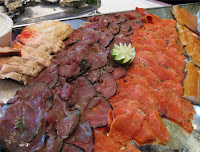
Well deserved kudos to the chef.
In the last of the three sessions I was in, about steps that can be taken now to help the food security situation, we had a participant who floated the idea of an Island food infrastructure investment fund – a fund that could be drawn from in order to tap the many matching grants that are out there but beyond reach since few have the money to kick things off. So by the time we left the room the fund had begun at $60. By the end of the wrap-up plenary, it had jumped to $250.

As we left, there on the golf course was a small crowd of wild food to wish us farewell.

I couldn’t leave town without visiting Brambles, the new (3 months old) market
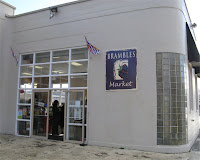
which sells only local (Vancouver Island or BC) products. I’d had some gorgeous beets (golden and rainbow) at the reception on Thursday which had come from here, so I made a beeline for the produce (a lot of which comes from my local farm shop hangout, Michells). They had many other tempting things too, including tins of line-caught albacore tuna, an amazing looking meat counter (they make all their own sausages), lots of great fruit juices, local cheeses and chocolates. Lucky for my food budget I was taking the long way back to Victoria so had to pass on the perishables.

That night we said a proper farewell to Courtenay at Locals, an exceptional restaurant tucked away in a strip mall.
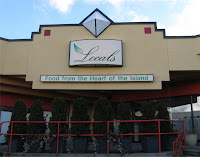
As its name suggests, it serves local foods and wines. Everything we had was excellent, from the smoked tuna salad with its natty daikon sash
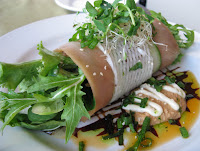
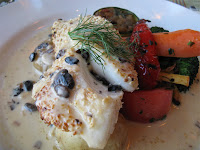
to the fresh sablefish – baked in a cloak of fennel
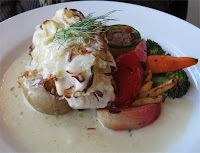
or pan-seared in sesame seeds with a bit of black bean, and some nice fresh vegetables – more pretty beets –
and since the dessert menu is abnormally tempting, they offer a boon to the indecisive, a sampler that includes pumpkin-chai latte brûlée; a chocolate tower; lavender ice cream with oregon grape jelly; and a kind of apple crumble which was much better than that may sound.

After a last stroll along Fanny Bay – where we experienced the other side of the herring run, which is the herring roe that washes up on the beaches
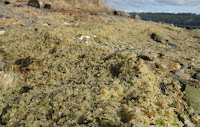
in such quantities you think at first there’s been a spill of sawdust – it was time to head back down the island.
-
Mindful consumerism and the joys of precycling
The Story of Stuff – pass it on and watch it with your kids! We saw this short ‘n snappy number last night in an instructive meeting of the BCSEA, on the topic of The Mindful Consumer.
But first, our speaker, Michael Nation, talked about spending a year of trying not to buy anything new – that is, new consumables, like clothes or gadgets or machines. He repaired, improvised, bartered and did without; he darned his socks, had his shoes resoled, borrowed books from the library, mended his garden tools, replaced the damaged cord on his iron instead of buying a new one; and at the end of the year his bill for personal consumables was in the neighbourhood of $700, including a flight to Calgary to be at the ceremony of a friend who became a Canadian, and a pair of new shoes (he’s a runner).
There was some discussion then about the irony (or do we mean madness) of governments telling us we must buy our way out of the recession, when surely this of all times is the moment to change our values and give up on consumerism, which is a dead-end road if ever there was one. Though nobody uttered the word, we were deep in the territory of precycling, where you simply don’t acquire packaging and disposable items, including recyclables – particularly wise strategies nowadays when even the recycling industry is in crisis.
Throughout the evening, others shared their mindful consumer ideas: buy everything from clothes to building supplies at thrift and salvage shops or at ReStore; bring thrift store china and cutlery into the office kitchen instead of paper plates and plastic cutlery; take tupperware or other refillable containers with you if you buy takeaway foods; cut off television service; explore Transition Towns; refuse bags and packaging at grocery stores and demand to have your meat wrapped in paper instead of embalmed in styrofoam; buy your new stove from a second hand store (the new ones are designed to be replaced rather than repaired if they short out); recycle junk mail as computer paper, shopping lists or usable envelopes; use washable fabric ( “family cloth” for toilet paper (or for pity’s sake, at least recycled paper brands!); replace shot zippers on otherwise usable clothing (the replacement zippers are usually better quality/longer lasting anyway)… and on and on it will go.
Someone did mention the need for people to regain lost skills in food preparation. One start might be in learning to deal with leftovers. Or take some notes from this article, about San Francisco chefs – and chefs are under more pressure than most of us to throw away all but the best bits of anything – trying to be more conscientious in the kitchen.
-
The Alices have it
Thanks to Mary’s tip, I was able to watch this clip, recently featured on 60 Minutes, to see Alice Waters talk about why good, clean and fair food is worth the investment.
And Alice Major will be reading in Sechelt this week, and after that points east, as she promotes her lovely book The Office Tower Tales.


Latest Posts
- Sublime
- Good weather for reading
- The world, the world
- Sublime launch!
- Planet Earth Poetry – Readings by Volunteers, Victoria 2026
- Poetry at the Goldfinch
Aldeburgh Poetry Festival Barny Haughton BBC BC poets Berkswell blackberries Black Stilt Bologna book launch Borough Market Carlo Petrini Catalonia Cyrus Todiwala dairy Daunt's Books Dijon Edinburgh Fanny Bay Feast of Fields Food and Morality food history food journalism Jenna Butler lardo Malahat Review Michael Pollan Okanagan olive oil tasting olive trees Omnivore's Dilemma Our Food Our Future Oxford Parmigiano-Reggiano Planet Earth Poetry poetry poetry readings Poetry videos prosciutto salumi Sean O'Brien Suffolk ticks Wendy Morton Wired Writing Yvonne Blomer
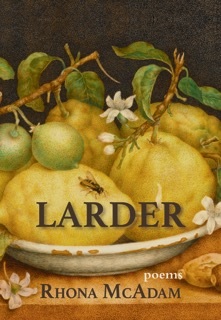
In her latest collection, Rhona McAdam navigates the dark places of human movement through the earth and the exquisite intricacies lingering in backyard gardens and farmlands populated by insects and pollinators, all the while returning to the body, to the tune of staccato beats and the newly discovered symmetries within the human heart.
“…A beautiful, filling collection, Larder is a set of poems to read at the change of the seasons, to appreciate alongside a good meal, and to remind yourself of the beauty in everything, even the things you may not appreciate before opening McAdam’s collection….”
Rhona McAdam is a writer, poet, editor, and Registered Holistic Nutritionist with a Master’s in Food Culture from Italy and a deep-rooted passion for ecology and urban agriculture. Her work spans corporate and technical writing to poetry and creative nonfiction, often exploring the vital links between what we eat and how we live. Based in Victoria, BC, and available via Zoom, Rhona is always open to new writing commissions, readings, or workshops on nutrition and the culinary arts.