-
Post-fuel farming
A Farm for the Future is an excellent documentary (shown on BBC last month) by farmer-film maker Rebecca Hosking, on how farmers can overcome total dependence on fossil fuels.
It does a great job of explaining what the problem is with current farming methods, and what the fuel crisis will do to them and to our food supply, and how biodiversity, low-energy methods and good planning rather than back-breaking labour can increase food production enough to feed the world.
The picture’s pretty choppy in places (at least on my screen) but the sound is good, and the story it tells, of alternatives to fuel-heavy farming, and hope for a truly sustainable future of food production, is more encouraging than almost anything I’ve seen lately.
The solution offered is, of course, an English one, suited to an English climate. Cuba’s success story in dealing with a fuel-less agriculture is that of another small country with a different climate from our own. The bigger question is how large countries with more extreme climates – Canada, the US, Australia – and well-entrenched and protected industrial fuel-based agricultures can adapt to the loss of fuel.
-
Agriculture on the Peninsula and the Agricultural Land Reserve
…or: what I learned in my last class at Dunsmuir. I had signed up for three linked courses on local agricultural issues. The first was a talk by local organic farmer Brian Hughes, who described a typical year’s activities.
The second, last week, was a talk by Brent Warner about the state of play in agriculture these days, with much discussion about the effects of poor nutrition (whether from bad food choices or from poorly nourished plant or animal sources) on health: obesity and its related health costs through type 2 diabetes and other diseases (one in three BC children are now deemed clinically obese). There was as well talk about farmers’ markets and new opportunities in food retailing and agricultural diversification, if the market and issues such as food traceability and food safety (particularly for older, younger and immune-compromised populations) are properly understood.
Tuesday’s final class was a sobering talk about the Agricultural Land Reserve, and its governing body, the Agricultural Land Commission, by Bob Maxwell, an agrologist and farmer, and Ivan Mishchenko, an organic blueberry farmer. Maxwell walked us through the soil and climate categories – the agriculture capability measures – that are used to determine agricultural land values, preparing the ground as it were for Mischenko to tell us about uses and abuses of the ALR in its current form.
Established in 1974 from various campaign promises made by competing political parties (thank heavens in this case for election rivalries!), the ALR sets aside agricultural land so that it can either be preserved as farmland or farmed. In a time when the planet is facing unprecedented loss of arable farmland through soil degradation, deforestation and population growth, this has saved a lot of good quality land in British Columbia which would otherwise have been paved over long ago.
Statistics familiar to me from the Farmlands conference explain the extreme competition for three percent of the province’s land, where 80 percent of the population lives and which also produces 80 percent of the gross agricultural receipts.
What has happened is that in these two much-desired areas (the Okanagan and the lower mainland/south-eastern Vancouver Island – retirement meccas for Canada because of mild climates and pretty scenery) developers and speculators have managed to make money and do deals to get their way in too many (but not all) cases. There are a number of ways of dodging the rules.
Firstly, there is a mechanism whereby land can be traded out of one area and into another, which is why 90% of the ALR land traded out of the ALR is in northern BC, and not in those two more desirable (climate and soil quality) areas. Some 72% of land has been taken out of ALR protection in the south of the province since 1974.
Put another way, for every acre (.404 ha) of prime farmland added to the ALR, 2.8 acres (1.13) have been taken out for urban development. This matters if the world is to feed itself, since we need .5 ha (1.2 acres) per person for a nutritious and diverse diet that includes both plant and animal foods. At present in BC, where the population is 4 million, we have .63 ha/capita land (not all of it being farmed); the population is estimated to be 6 million by 2035, at which point our ALR land will work out to .42 ha/capita.
A second way land gets removed from the ALR is to make it unusable for farming. Owners can apply for soil fill permits, which sound harmless enough. But this is tied to urban development: undesirable fill from excavation sites (which may include clay, gravel, rock and concrete) is being dumped on top of arable land. Disposal sites for this kind of rubble are very scarce, which makes buying land and getting people to pay you for dumping a lucrative sideline. But this activity covers and makes unusable the agricultural land beneath, and it also damages the drainage in surrounding farmland, making the neighbouring lands less productive as well. Once the land is unusable for farmland, you have good reason for removing it from the ALR and building another development on top.
Good growing soil takes centuries to develop, but can be destroyed in days by this kind of activity; even low-grade agricultural land is useful and necessary to farming, whether for placing farm buildings or pasturing unlikely animals like llamas. And yet we live in a short-sighted society that allows people to profit from this kind of activity, which robs our own future of the ability to feed itself, instead of charging its perpetrators with crimes against humanity.
We were offered some ways to work to preserve the ALR and agricultural land:
1. Support local food systems by buying and growing locally.
2. Advocate to the ALC and local government: do not allow them to say they heard no community concern when they made decisions.
3. Organize your community to protect farmland.
4. Encourage local government to form an agricultural advocacy committee and an agricultural area plan.
5. Ask your local government to develop buffer policies, to provide green strips between urban developments and agricultural land, to allow the sometimes dusty and smelly work of agriculture to go on without conflict.
6. Ask food retailers to carry locally grown food. -
End of Dunsmuir
On Sunday I attended a meeting of more than 100 local residents who squeezed into a meeting room to learn more about the closure of Dunsmuir Lodge which is scheduled for this Saturday. The facility has long been a venue for continuing studies as well as a conference centre boasting one of the most reliably good restaurants around, not coasting on its unparalleled views of the Saanich Peninsula or its proximity to John Dean Park.
The University of Victoria had been left this property in 1985 and decided to close it last October, but without any discussion with the local residents; and it was clear from the tone of the meeting that the university has sucker-punched its own fortunes through its handling of this and other legacies which it had sold off in the past.
Though the university says it’s not selling Dunsmuir, at least not right now, it is certainly costing a bundle to close the doors and put its 70 employees out of work. A meeting had been planned for earlier this month but the university said it was ‘not ready’ to answer questions yet, so it waited until six days before the closure to face the music. A fact sheet was distributed which said
“While the facility is covering day-to-day costs, it does not generate enough income for much needed upgrades…UVic has made significant upgrades to the facility over the past few years but it cannot continue to divert resources from its core educational mission to operate the lodge to make it viable for the long term.”
I think one woman – an adult course-taker – spoke for almost all those present when she said “we too are your core educational mission”. Other points made included the observation that North Saanich had waived property taxes on the facility because of its educational status; what would happen now? And residents were livid that no local consultation had been taken on ways of raising the estimated $2million upgrading bill; the costs of closure are about $100,000 to close the doors and another $100,000 per year to keep it on mothballs – that is assuming no tax bill suddenly lands on the doorstep.
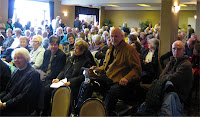
The attendees got downright angry when the spokeswoman described Dunsmuir as “remote” – as was pointed out, the airport is practically on its doorstep, with the ferry terminal some ten minutes up the road; any replacement venue – and facilities of this size and suitability to purpose simply do not exist – is unlikely to be any closer to UVic, if that is the measure of remote. The spokeswomen declined to say where they’d been looking for replacements, but I gather everything from theatres to church halls have been looked at.
The staff who lose their jobs, many of them after 20 years, were told that the timing was arranged just for them, so they could jack in boring old job security and seek exciting new seasonal work in the tourism industry.


Latest Posts
- Sublime
- Good weather for reading
- The world, the world
- Sublime launch!
- Planet Earth Poetry – Readings by Volunteers, Victoria 2026
- Poetry at the Goldfinch
Aldeburgh Poetry Festival Barny Haughton BBC BC poets Berkswell blackberries Black Stilt Bologna book launch Borough Market Carlo Petrini Catalonia Cyrus Todiwala dairy Daunt's Books Dijon Edinburgh Fanny Bay Feast of Fields Food and Morality food history food journalism Jenna Butler lardo Malahat Review Michael Pollan Okanagan olive oil tasting olive trees Omnivore's Dilemma Our Food Our Future Oxford Parmigiano-Reggiano Planet Earth Poetry poetry poetry readings Poetry videos prosciutto salumi Sean O'Brien Suffolk ticks Wendy Morton Wired Writing Yvonne Blomer
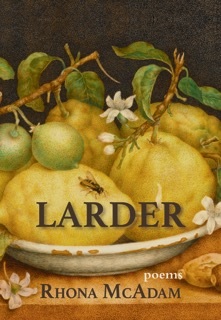
In her latest collection, Rhona McAdam navigates the dark places of human movement through the earth and the exquisite intricacies lingering in backyard gardens and farmlands populated by insects and pollinators, all the while returning to the body, to the tune of staccato beats and the newly discovered symmetries within the human heart.
“…A beautiful, filling collection, Larder is a set of poems to read at the change of the seasons, to appreciate alongside a good meal, and to remind yourself of the beauty in everything, even the things you may not appreciate before opening McAdam’s collection….”
Rhona McAdam is a writer, poet, editor, and Registered Holistic Nutritionist with a Master’s in Food Culture from Italy and a deep-rooted passion for ecology and urban agriculture. Her work spans corporate and technical writing to poetry and creative nonfiction, often exploring the vital links between what we eat and how we live. Based in Victoria, BC, and available via Zoom, Rhona is always open to new writing commissions, readings, or workshops on nutrition and the culinary arts.