-
Unhampered hampering and a cold poem
I spent today at Joyce & Peter’s annual hamper-stuffing party, held at their beautiful B&B;/home, Earle Clarke House. The event, which the couple has been hosting since they first began the parties in Toronto in 1995, invites anyone who cares to come along with some part of a Christmas meal – frozen turkey, fresh vegetables, Christmas pudding and the like – to join in assembling these into hampers donated to needy families around Victoria. It begins around noon with stacks of empty hampers and an air of calm organization
But before long the place is thronged with workers, who settle in to sort the contents
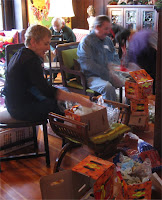
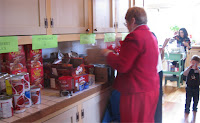
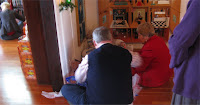
and start filling hampers
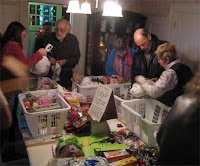
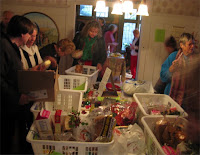
and by 3pm the long stairway had filled with Christmas hampers, waterproofed against the constant drizzle (better than last year’s surprise snowfall)
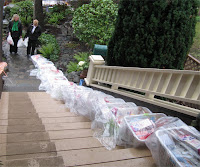
which the Salvation Army will have picked up this evening. By the time I left at around 4pm with the assembly line working at full steam, the hampers were all the way down the stairs
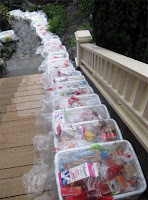
and around the corner.
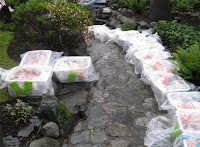
The number of promised turkeys which had begun at 81 – already breaking last year’s record-breaking count (78) had been bolstered through the afternoon, and the stack of bins to put them in was shrinking. We’ll hear the final count soon I’m sure.
I wasn’t one of the 86 poets who built last year’s communal poem at Leaf Press, but I might chip in on this year’s. Check it out and sharpen your pencils: they’re accepting couplets (no rhyme required) till the end of December:
“We invite you to send couplets — what’s it really like out there on the streets/fields/forests … or in those unprepared homes during this time of high fuel prices? The working title: “Cold”. “
-
Cheap Value and a Carless Christmas
I’ve been reading Cheap: The High Cost of Discount Culture, by Ellen Ruppel Shell, and have just had my heart broken. I’m a longtime fan of Ikea, like the rest of the world have admired their brilliant marketing and positioning, but have now had to face the reasons their prices are so low, and they are the same reasons cheap food is underpriced. Somebody’s getting exploited along the way, only this time the victims include the world’s most vulnerable and least protected forests.
Ruppel Shell does interview Ikea’s forestry coordinator who is responsible for ensuring the wood they use is harvested sustainably, and notes that they have fired suppliers for using illegally harvested wood, but then goes on to say:
“Unfortunately this approach is unlikely to prevent all or even most infractions because the suppliers are too many and too dispersed to ensure adequate monitoring… Her team consists of eleven forestry monitors worldwide – five in all of vast China and Russia combined, certainly not enough eyes and ears to closely monitor such a massive enterprise. [Anders] Dahlvig [Ikea president & CEO] said that he regretted this but could do nothing about it. Hiring more inspectors would be costly, adding to the price of his company’s products. This, he said, was unacceptable.”
She also explains that Ikea’s founder has made a deal with Vietnam’s prime minister for lower tariffs, docking fees and ‘ensured access to wood’ in exchange for hiring more Vietnamese.
“Vietnam, itself in constant threat of deforestation, is a major Southeast Asian hub for processing illegally logged timber. While Ikea suppliers are instructed to follow the Ikea way, Vietnamese enforcement of environmental and human rights regulations is notoriously haphazard.”
Illegal logging contributes hugely to worldwide deforestation, the book points out, and is thereby contributing in unknown quantities to climate change. But nobody wants to talk about it because then we’d be facing (deja vu) the real costs of what we buy. Only this time we’re talking about remarkably cheap furniture; Ikea is by no means the only culprit as worse offenders include other large North American discount chains (like Wal-Mart, Home Depot and Lowe’s).
The book is fascinating and reveals the roots of discount culture, the psycho-manipulation we’re subjected to when we shop, and the big business interests behind it. Essential Christmas reading!!
Meanwhile, Raj Patel (of Stuffed and Starved) is proving again why he is an author of our generation. He created a blog around his last book (and a Facebook page) and is busy promoting his new one, The Value of Nothing, with a snappy Youtube video (directed by Scott Hamilton Kennedy, who made the Academy Award nominated documentary The Garden, which exposed the political machinations behind the fight over a 14-acre site in Los Angeles). Check it out:
My Christmas gift to the environment is a month of carlessness. My insurance is due tomorrow and – for budgetary as well as altruistic reasons – I am going to postpone renewing it for at least a month. I have looked at some numbers. It’s not an expensive car to run, but averaged over a year with insurance, gas and maintenance, it cost me $225 a month last year. Here in Victoria it’s very difficult to get everywhere by public transit, and the options for travelling on the Island are severely limited as well. Monthly bus passes cost $73.25 (plus tax, making it around $80) or $2.25 a trip; the buses are all, I believe, equipped with bike racks so you can combine your modes of travel. Taxis start at $3.10, and the fleets are almost all hybrid vehicles now. I’ve seen a dog-taxi around town too, which is good to know. There is a car co-op in town but membership is fairly steep with few vehicles (and no cars in my neighbourhood).
I will most miss being able to nip out to the farm shops on Saanich Peninsula: most are unreachable by public transit, and the urban farmers’ markets are closed till March. And old Anton may need a few more trips to the vet over the season…

So… interesting times ahead.
-
Terra Madre Day at the cidery
The Slow Food Vancouver Island & Gulf Islands is as slow as its name is long.. we celebrated Terra Madre Day – really December 10 – on December 13, with a Christmas potluck and book exchange at Merridale Cidery.
As might be expected, it was a well above average selection of winter foods which we thought we’d better tuck into before they got cool – a definite issue in the chilly confines of the distilling room
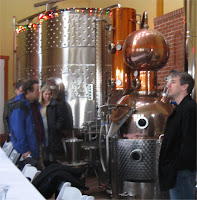
where we gathered and managed to warm with many bodies, excellent food and beautiful music.
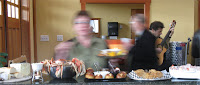
Many fine foods, including local Dungeness crab,
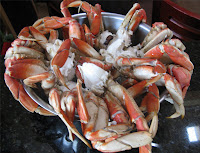
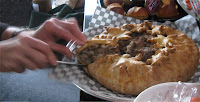
local prawns

an amazingly delicious chard tart,
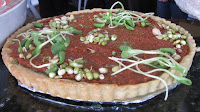
and Hilary’s Cheese:

A convivium, demonstrating what is meant by the name:

After the food, we had a short film about Terra Madre and some short talks by people who’d attended the event as delegates in previous years. Then there was the traditional (to this convivium) cookbook exchange which involved a fair amount of thievery as people were allowed to steal previously opened books before opening one from the pile. The most-stolen book: Alice Waters – Chez Panisse Cookbook.


Latest Posts
- Sublime
- Good weather for reading
- The world, the world
- Sublime launch!
- Planet Earth Poetry – Readings by Volunteers, Victoria 2026
- Poetry at the Goldfinch
Aldeburgh Poetry Festival Barny Haughton BBC BC poets Berkswell blackberries Black Stilt Bologna book launch Borough Market Caerphilly Carlo Petrini Catalonia culatello Cyrus Todiwala dairy Dijon Edinburgh Fanny Bay Feast of Fields ferries Food and Morality food journalism Michael Pollan olive oil tasting Omnivore's Dilemma Our Food Our Future Oxford Parmigiano-Reggiano persimmons Planet Earth Poetry poetry poetry readings Poetry videos prosciutto salumi Sean O'Brien sensory analysis Suffolk ticks tortelli di zucca Troubadour Wendell Berry Wendy Morton Yvonne Blomer
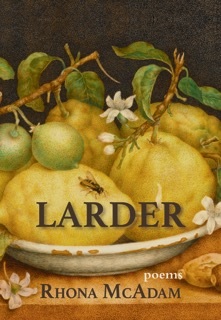
In her latest collection, Rhona McAdam navigates the dark places of human movement through the earth and the exquisite intricacies lingering in backyard gardens and farmlands populated by insects and pollinators, all the while returning to the body, to the tune of staccato beats and the newly discovered symmetries within the human heart.
“…A beautiful, filling collection, Larder is a set of poems to read at the change of the seasons, to appreciate alongside a good meal, and to remind yourself of the beauty in everything, even the things you may not appreciate before opening McAdam’s collection….”
Rhona McAdam is a writer, poet, editor, and Registered Holistic Nutritionist with a Master’s in Food Culture from Italy and a deep-rooted passion for ecology and urban agriculture. Her work spans corporate and technical writing to poetry and creative nonfiction, often exploring the vital links between what we eat and how we live. Based in Victoria, BC, and available via Zoom, Rhona is always open to new writing commissions, readings, or workshops on nutrition and the culinary arts.