-
Not talking about poetry and not eating oysters
Read Full Post: Not talking about poetry and not eating oystersI enjoy talking prosody or fine technical points in the context of a workshop, but otherwise I’m not a one to want to discuss poetics with all and sundry. On this matter I was glad to find a kindred spirit in WS Merwin, who made a few seemingly timeless points when his 1956 collection Green With Beasts was made Poetry Book Society Choice:
“I don’t usually like literary conversations, though I deeply enjoy talking with writers other than poets about the practical side of getting things written. I like talking with some people about particular poems: though I think that in such conversations all I usually do is to try to describe a quality that excites my enthusiasm in a poem. I do not like writing about poetry… Above all I do not like trying to generalize about poetry…
…I think that one of the dangers of modern poetry has been a tendency to become inbred. Its small audience enhances the danger. It even seems possible for some poets to write as though critics, even particular schools of critics, were a fit and sufficient audience for poetry.”
He then makes
“one of the few general statements I feel safe in making about poetry. It is a mystery. It is a metaphor of the other mysteries which comprise human experience. But, like some other mysteries, it gives us a feeling of illumination – one mystery giving us a name by which to know another.”
I’ve been feeling some illumination from reading a collection of writings by MFK Fisher called The Art of Eating. Her prose is exquisite. In The Well-dressed Oyster she begins, firing on all cylinders and out of both barrels:
“There are three kinds of oyster-eaters: those loose-minded sports who will eat anything, hot, cold, thin, thick, dead or alive, as long as it is oyster; those who will eat them raw and only raw; and those who with equal severity will eat them cooked and no way other.
The first group may perhaps have the most fun, although there is a white fire about the others’ bigotry that can never warm the broad-minded.”
One suspects her allegiances lie with the second group.
“..almost every oyster-eater who does not belong whole-heartedly to the third and last division, would die before denying that a perfect oyster, healthy, of fine flavor, plucked from its chill bed and brought to the plate unwatered and unseasoned, is more delicious than any of its modifications. On the other hand, a flaccid, moping, debauched mollusc, tired from too much love and loose-nerved from general world conditions, can be a shameful thing served raw upon the shell.”
At least we have her words to savour, in lieu of a leisurely oyster harvest on the beach, since red tide has robbed us of some of our summer fun.
-
Poetry family trees and brassica subspecies
Read Full Post: Poetry family trees and brassica subspeciesSomething else of interest from the Poetry Paper I mentioned earlier, a feature called The Poetry Family Trees. Featured poets – just-appointed US poet laureate Donald Hall, Sinead Morrissey, Michael Symmons Roberts, Lorna Goodison, Adrian Mitchell – were asked the following questions, which are interesting ones for all of us to keep in the backs of our minds.
- Which ‘family tree’ do you think you belong to as a poet – which poets do you recognise as your precursors?
- Why do you like these poets and what do you value them for?
- The first poem/poet that made an impact on you. When and why?
- The next book by someone you’re most looking forward to?
- How much time do you spend reading poetry in an average week?
- And what proportion are contemporary/from earlier centuries?
- What else do you read?
Continuing with the many-named vegetable theme, here’s another one for you: Chinese cabbage. I’m in favour of going by the Chinese simplified name, “Large White Vegetable”. But if you want to do a closer identification, we’re talking Brassica campestris, aka Brassica rapa – subspecies pekinensis, Che-foo type. You may also encounter it as: wong baak, won bok, wong nga bok, da baicai, pe-tsai, pai-tsai, pechay, or nappa, napa, Siew Choy/siu choy, tsina, kubis gna, hakusai, celery cabbage and Peking cabbage; some of these names might attach themselves to another category of pekinensis – Chihili type – which is greener and leafier. We are gravely warned against confusing it with another Brassica subspecies – chinensis – better known as bok choy or pak choy and is also called Chinese white cabbage, Chinese mustard, white mustard cabbage.
A good source of vitamin A, this vegetable – let’s call it Chinese cabbage – has been grown in Asia since the 5th century, and in North America for about a hundred years. It forms the basis of the Korean wonder-food Kimchi (yum!). It is a wonderful salad vegetable owing to its tender, juicy, mildly spicy flavour. The best ever quick salad meal, which I first had in someone’s home in Prague of all places, is:
About 2 cups Chinese cabbage, in 1 inch chunks
3 rashers bacon
1 clove garlic
1/4 lemon
1/4 cup good olive oil
Cook the bacon; cut in 1 inch pieces. While you’re cooking the bacon, mince or press the garlic and toss it with the cabbage. Toss in the bacon, squeeze the lemon and drizzle the olive oil. Grind a bit of pepper over it all if you must. Mix fleetingly and eat hungrily. Speak to no one you haven’t shared this with – at least until the garlic subsides.There is something ecstatic in this meal for me: the collision of hot salty bacon with crunchy cold cabbage, the tartness of the lemon and bite of garlic. And the trusty olive oil doing what oil does: dispersing all those discrete flavours across the tastebuds
-
Little Boris, big Ted and a whole bunch of rapini
Read Full Post: Little Boris, big Ted and a whole bunch of rapini
Hard to blog these days: too many distractions. World Cup, dog walks in the glorious sunshine, weeds glaring at me from the stony margins of my garden, and now little orphan Boris (*no* idea why that photo suddenly loaded..?!) who is lodging here for a week while he gets over a nasty cold. Like Anton the wonder dog he is from local rescue society Animals For Life.
It’s been hard to make time to read these days. Still, even with Boris gnawing at the corners of the book and purring remorselessly, I managed to get through the first chapter of Poetry in the Making: An Anthology of Poems and Programmes from “Listening and Writing”, a rare old (1967) Ted Hughes book I found on ABE. In his note to teachers in the first chapter, he shines some light on the magic of writing exercises. Time limits of, say, 10 minutes “create a crisis, which rouses the brain’s resources: the compulsion towards haste overthrows the ordinary precautions, flings everything into top gear, and many things that are usually hidden find themselves rushed into the open. Barriers break down, prisoners come out of their cells.” With all that rushing it’s hard to still the internal critic, let alone an external one, so I liked the way he raised a hand to that: “As in training dogs, these exercises should be judged by their successes, not their mistakes or shortcomings.” Woof to that.
And woof to vegetables of many names. When I innocently picked up a bag of something labelled Rapini, I was in for an interesting journey. Aka Broccoli Raab, it may also be labelled raab, rapa, rape, rapine, rappi, rappone, taitcat, Italian or Chinese broccoli, broccoli or broccoletti di rape, cime de rape, broccoli de rabe, Italian turnip, turnip broccoli, rabe, broccoletto, or broccoli di foglia. Rapini works for me.
Originating in the Mediterranean and also China, it is actually a descendant from a wild herb. Although it looks and tastes like it, I discover that it is not a member of the broccoli family. It is, however, closely related to turnips! It is grown as much for its long-standing, tasty mustard-like tops as for their multiple small florets with clusters of broccoli-like buds, which never form heads. When you buy it, it should have bright-green leaves that are crisp, upright, and not wilted. I looked at some recipes – though in the end I thought, like most vegetables, it was nice either raw or simply steamed and tossed with lemon and butter.




Latest Posts
- (no title)
- Sublime and Twisted Readings coming up!
- Sublime
- Good weather for reading
- The world, the world
- Sublime launch!
Aldeburgh Poetry Festival Barny Haughton BBC BC poets Berkswell blackberries Black Stilt Bologna book launch Borough Market Carlo Petrini Catalonia Cyrus Todiwala dairy Daunt's Books Dijon Edinburgh Fanny Bay Feast of Fields Food and Morality food history food journalism Jenna Butler lardo Malahat Review Michael Pollan Okanagan olive oil tasting olive trees Omnivore's Dilemma Our Food Our Future Oxford Parmigiano-Reggiano Planet Earth Poetry poetry poetry readings Poetry videos prosciutto salumi Sean O'Brien Suffolk ticks Wendy Morton Wired Writing Yvonne Blomer
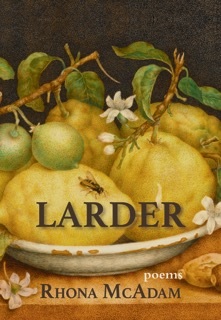
In her latest collection, Rhona McAdam navigates the dark places of human movement through the earth and the exquisite intricacies lingering in backyard gardens and farmlands populated by insects and pollinators, all the while returning to the body, to the tune of staccato beats and the newly discovered symmetries within the human heart.
“…A beautiful, filling collection, Larder is a set of poems to read at the change of the seasons, to appreciate alongside a good meal, and to remind yourself of the beauty in everything, even the things you may not appreciate before opening McAdam’s collection….”
Rhona McAdam is a writer, poet, editor, and Registered Holistic Nutritionist with a Master’s in Food Culture from Italy and a deep-rooted passion for ecology and urban agriculture. Her work spans corporate and technical writing to poetry and creative nonfiction, often exploring the vital links between what we eat and how we live. Based in Victoria, BC, and available via Zoom, Rhona is always open to new writing commissions, readings, or workshops on nutrition and the culinary arts.