-
Preserving the harvest: apples
Read Full Post: Preserving the harvest: apples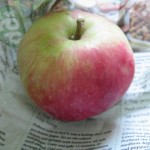 I came upstairs from a round of apple-wrapping to find some questions on apple preserving from Ruth, who is the lucky recipient of a quantity of hangingoverthefence apples.
Like me, she had heard that wrapping apples individually in newspaper is the way to go. She’d read that coloured inks are toxic so to avoid those, but I’ve been told that Canadian newspapers use soy-based colour inks so they are ok (but glossy inserts are not). (I don’t know if this is really the case or not, so if in doubt, avoid them.) I’d heard it from the Compost Education Centre which suggests that you can add newspaper to your compost (for a “brown” layer), which means the apple wrapping can do double duty if you end up with some spoilage later in the season: you can just chuck the whole thing into the pile. The point of wrapping is to keep the apples from spoiling one another if they’re bruised or damaged. Lacking a root cellar, I am fortunate to have a little bar fridge that I use just for apples and it works reasonably well.
My first year of bounty, Adrienne gave me a wonderfully liberating tip: you can pee
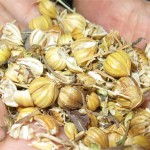
 l, core and slice apples and put them in ziplocks in the freezer – works brilliantly for cooking apples. Don’t worry if they brown a little en route to the freezer as they go brown when you cook them anyway. But I suppose if you can’t bear the thought of any brown, you can always dip them in syrup while you work, as the PickYourOwn folks recommend. But I don’t find they brown too badly if you work quickly on fresh and fully ripe apples. The ones in the picture were frozen a year ago with no syrup or preservative: I’d still use them in baking.
If the apples are of a fairly firm texture you can slice and dehydrate them (my tree is a yellow transparent, which produces very soft apples great for applesauce but impossible for drying). Here are some instructions on drying apples in a dehydrator, an oven or a hot car!
I have an apple peeling machine which makes a lot of the labour-intensive aspects slightly less so. As long as you’re dealing with firm, regularly-shaped and very fresh apples. It doesn’t work well on my transparents which tend to be soft and misshapen. It’s also less frugal than I when it comes to peeling and coring: such is the trade-off with labour saving devices of all kinds.
Or you can make applesauce and can that – it’s a high acid food so you don’t need a pressure canner, just a pot large enough to cover the jars with water and process (boil) for 20-25 minutes depending on the jar size and altitude (again from the PickYourOwn website, good instructions on applesauce, with photos) I’ve made it with plums or quince and those are nice combinations; perhaps saskatoon-applesauce or raspberry-applesauce would be good if you have an alternative source of berries.
I own a centrifugal juicing machine so that’s what I use. Because my apples are very tart I always add carrots for sweetener (sugar as a last resort); or blend them with sweeter varieties or other fruit. This year I decided to use up some surplus jam from my larder, so I
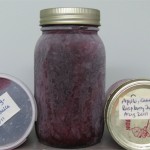 heated that and added it to blackberries I’d picked, and strained the juice and used that for sweetener. I also used raspberries and carrots. I don’t have a recipe, just go by taste. I put the juice into jars or plastic tubs, cover them and freeze them. Because the liquid expands while freezing, if you’re using screw-top jars, be sure to leave the lids loose until the liquid freezes, to avoid any messy explosions.
I have made apple butter in years past, but find I don’t use it.
-
Linen, flax, apples and more apples
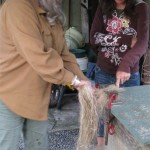
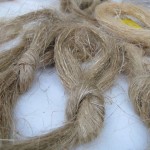
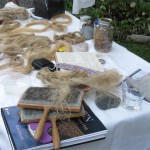
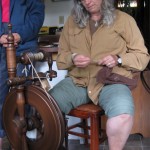
Read Full Post: Linen, flax, apples and more applesOn the last day of August I wandered along to a potluck information session on the Linen Project that Denise – who’s been driving the project forward under Victoria Transition‘s Reskilling umbrella – hosted. Although the sun was setting and the day’s participants had scattered, there was a full scale exhibition set up in the garden, and a spinner demonstrating how to spin linen from flax fibre that had been retted, broken, scutched and hackled by willing volunteers. A perfect plant, flax, offering flowers, food and fibre.
Meanwhile, the fruit continues its burst of plenty in these summery September days. I joined three other Fruit Tree Project volunteers this morning to pick a tree that yielded a spectacular 260kg of apples before we had to leave with promises to return.
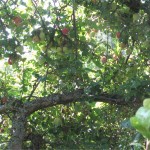
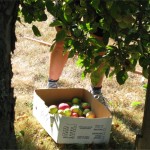
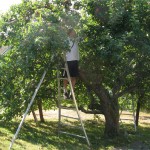
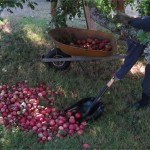
After weeks of picking, juicing, freezing, baking and sharing my own apples, I finished stripping my yellow transparent tree on the weekend, which also had a record yield, and squeezed around 30kg into the Fruit Tree Project’s cooler, which is busting at the seams while its coordinators work to distribute the bounty between charities and local processors.
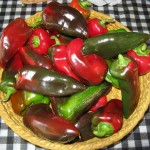
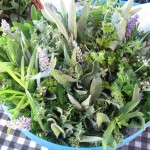
Things continue to flourish at Haliburton Farm too where our veg boxes this week included a first crop of apples from the farm’s replanted orchard, some herb bundles pretty enough to grace a table, and some rather beautiful sweet peppers.
-
Fruit Tree Project strikes again
Read Full Post: Fruit Tree Project strikes again I spent a fruitful morning yesterday with a dozen teens from the CISV Peace Bus out at Island View Beach on my first pick of the year for the Fruit Tree Project. As part of their cross-Canada tour, the teens involve themselves in community projects, aiming to make the trip carbon neutral. Picking local fruit fits the bill because it means less imported fruit is needed to feed the communities and enterprises where the unwanted urban fruit is distributed.
We were picking from trees that had been planted in a beachside campsite that the CRD took
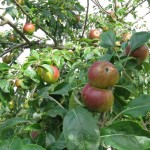 over a few years ago. Because the irrigation that had watered the trees had to be taken out (not up to code, apparently) there hasn’t been any watering since then, so the fruits tend to be small while the trees adapt to their new micro climate.
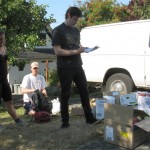
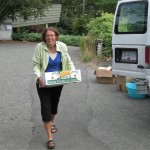
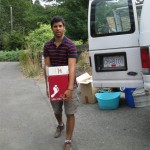
The Fruit Tree Project van holds all the ladders and picking equipment, together with weigh scales and as many sturdy boxes as can be found. Jesse, one of the program coordinators, lays it all out ready for the arrival of the bus, and gets everyone started, while a local TV cameraman covered the event.
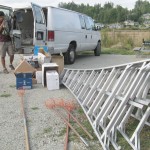
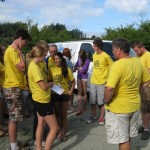
A peaceful period of picking passes
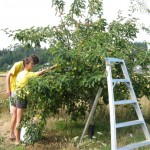
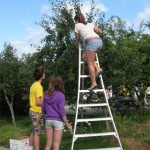
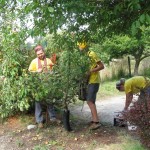
and then it’s time to weigh and load the fruit in the van, clean up the fallen fruit, and head off to store it.
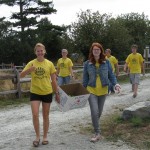
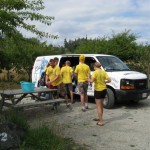
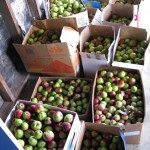
The cooler at Fruit Tree Project’s HQ – LifeCycles – where it’s normally kept is full to bursting while the team works on distributing the seasonal bounty to community groups and local food processors. So, with the help of Fruit Tree Project co-coordinators Renate and Jesse, we park nearly 500 lbs of apples in a trusted garage while the smaller quantity of pears and plums goes back to LifeCycles.
Latest Posts
- (no title)
- Sublime and Twisted Readings coming up!
- Sublime
- Good weather for reading
- The world, the world
- Sublime launch!
Aldeburgh Poetry Festival Barny Haughton BBC BC poets Berkswell blackberries Black Stilt Bologna book launch Borough Market Carlo Petrini Catalonia Cyrus Todiwala dairy Daunt's Books Dijon Edinburgh Fanny Bay Feast of Fields Food and Morality food history food journalism Jenna Butler lardo Malahat Review Michael Pollan Okanagan olive oil tasting olive trees Omnivore's Dilemma Our Food Our Future Oxford Parmigiano-Reggiano Planet Earth Poetry poetry poetry readings Poetry videos prosciutto salumi Sean O'Brien Suffolk ticks Wendy Morton Wired Writing Yvonne Blomer
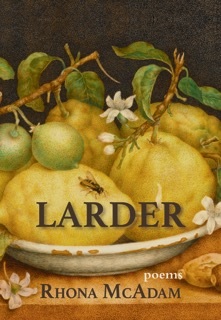
In her latest collection, Rhona McAdam navigates the dark places of human movement through the earth and the exquisite intricacies lingering in backyard gardens and farmlands populated by insects and pollinators, all the while returning to the body, to the tune of staccato beats and the newly discovered symmetries within the human heart.
“…A beautiful, filling collection, Larder is a set of poems to read at the change of the seasons, to appreciate alongside a good meal, and to remind yourself of the beauty in everything, even the things you may not appreciate before opening McAdam’s collection….”
Rhona McAdam is a writer, poet, editor, and Registered Holistic Nutritionist with a Master’s in Food Culture from Italy and a deep-rooted passion for ecology and urban agriculture. Her work spans corporate and technical writing to poetry and creative nonfiction, often exploring the vital links between what we eat and how we live. Based in Victoria, BC, and available via Zoom, Rhona is always open to new writing commissions, readings, or workshops on nutrition and the culinary arts.