-
More quince, more poetry
Read Full Post: More quince, more poetry


There’s a very nice greengrocer on Turnham Green Terrace, whither my yellow friends have followed me. These quince are enormous and flawless, the size of grapefruits, a world away from the lumpy lemon to orange-sized treasures I was working with in Victoria.
I’ve been in London a bit less than a week and have so far had one lunch at Carluccio‘s, taken in one reading (Tamar Yoseloff and Katy Evans-Bush, at CB-1 in Cambridge) and made one visit to the British Library. Tonight I’ll be in Islington attending a great big reading at Poetry in the Crypt (Stephen Watts, Cristina Viti, Ales Machack, Jane Kirwan and Jane Duran).
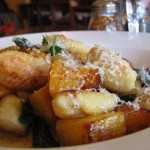
When in Cambridge, I supped with the poets at The Punter, where we passed on the Movember blackboard special: lamb fries. Instead, I had gnocchi with roasted pumpkin and “frazzled sage,” which came in a creamy pumpkin sauce and was rather good. My second such dish in a few weeks, as I’d had a similar one (without the creamy sauce – instead pan-fried in clarified butter I’d guess) at La Piola before I left Victoria.
-
Quinceaholic
Read Full Post: Quinceaholic
Quince, coing, membrillo, mela cotogna, safarjal Those who have been tiring of my obsessive ravings about quince recipes will be pleased to know I have not touched a paring knife for about a week now. I had been blessed this year with a large quantity of quince– which I did my best to whittle my way through before abandoning a last box to others and disappearing off to England.
Before I left I tested just about every recipe I had time to try, both sweet and savoury. Here’s a recap of some of the ideas I checked out, including those already mentioned in an earlier post.
Quince jelly is, of course, just about the best thing to do with quince. Beautiful, aromatic and delicious.
 But I didn’t make any this year, at least none that set properly. Instead I used some of the unset jelly (or quince syrup, we’re calling it) as the base for oven-poached quince, which was gorgeous. Three hours in a slow oven turned the fruit and its syrup (flavoured with orange and vanilla, or lemon) ruby red. It also helped the fruit remain firm enough to can for future use, in a quince sticky cake, for example.
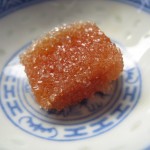 I know that many people faced with a quantity of this fruit immediately think of quince paste (membrillo). I have made my share of this tangy sweet which takes a cheese plate to new heights. But not this year. I have learned that there is only so much quince paste one really needs in one’s life, and it can be tricky to hand off to others as it can’t just be stuck in a gift box, but needs to be refrigerated and dusted with sugar before serving. When it’s been stored for a while, it has a tendency to drool a glorious puddle into its dish, as messy as it is delicious. And sadly, it does not keep forever, though it can last several months in the fridge.
This year, I’ve been browsing some savoury dishes. Lamb tagine with quince is a popular one, as quince has a subtle flavour that pairs well with lamb and is popular in Middle Eastern cooking. Quince soup comes in many varieties: with sweet apple cider and dates; with kabocha squash and Thai spices; with celeriac; and with plum wine and chocolate crème. Pumpkin chestnut risotto with quince sounded wonderful – but also like rather a lot of ingredients competing for attention.
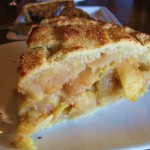 Quince dessert recipes are quite numerous (particularly in French) but quince clafoutis seemed to be one of the most popular. A quince and apple pie that I was lucky enough to sample at La Piola was wonderful. Cakes include an upside-down, one with almond, a pudding cake and a sticky quince & ginger cake.
 -
Scallops, poetry and lots of SPIN
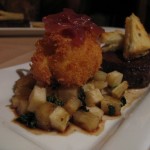
Read Full Post: Scallops, poetry and lots of SPIN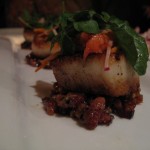 It’s been quite a week. Tuesday I enjoyed a meal at Camille‘s which was very nice food, very nicely served. Starters included some gorgeous scallops, sporting leafy hats and nestled on a bed of bacon. A nice bit of organic beef came with a curiously delicious egg that had been poached and then deep-fried and made to feel crisply oriental. And
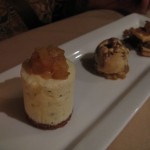
  the apple dessert trio – kaffir lime frozen ricotta the highlight – outclassed my caramel pot de crème with apple foam, but we shared. And the wines were wonderful, particularly the apricot-raisiny delights of the
  Pentâge Late Harvest dessert wine, dessert wines being one of my favourite things.
The Malahat Review is another of my favourite things, and its Fall launch reading at The Well was jam-packed with literature lovers. I must say I’ve seldom enjoyed a reading more. Attentive and large audience, talented and entertaining fellow readers, nice ambiance. And some rather good salt and vinegar kale chips, which in their clear plastic baggie rather gave me the appearance of a purveyor of puff than an advocate of antioxidants.
Anyway. I was up first, followed by Julie Paul reading a tantalizing beginning to a short story; then Richard Osler in good poetic form, Tom Wayman in passionate voice dedicating his first poem to the Occupy people, and Zoey Peterson sending us home to contemplate his delightful prize-winning story.
Thursday night at Fernwood Community Centre I’d guess there were nigh on a hundred of us gathered to hear Curtis Stone, the cycling SPIN farmer of Kelowna. He gave a terrific talk about his business and a great preview of the three-day workshop he’ll be leading in April.
When he started Green City Acres, he had no farming background at all – just nine years of tree planting and a great love of cycling, and so he took himself on a tour of urban farms in Canada and the US to see how urban agriculture was being done. He learned his trade from the manual sold by Wally Satzewich and Gail Vandersteen’s SPIN farming enterprise, and through a couple of years’ trial and error. And has emerged as a generous and enthusiastic teacher-farmer.
In his first year of operation he made about $22,000 and worked 16 hour days. “Like you would for any startup small business,” he says. This past year so far he’s pulled in $60,000 from the three quarters of an acre he farms – spread across half a dozen backyards. With a partner helping ease the load this year he’s been working 50 hour weeks – and adds “most of our time is cycling.” On their bikes they pull custom-designed trailers piled with tools, compost, produce, even bales of hay and a small rototiller. His startup capital costs were around $7,000 and he believes it’s possible to make $100,000 an acre.
He tills lawns in three stages to kill the grass and give himself time to test the soil for clay-sand ratios and pH level, so that he knows what amendments to use to boost its fertility. He gets food waste from restaurants and composts prolifically for his production which is organic but not certified. His first plot was a needle-strewn wasteland with poor, contaminated soil which he had to fill and remediate. He says the drug users who used to shoot up on the property still come by there, but now they come to look at the garden, which is flourishing.
He thinks that the scattered fields of SPIN farming offer a lot of advantages, as plantings are spread between different microclimates, soil conditions, light conditions, biodiversity (weeds and pests) and land configurations, so if one row or crop is lost, chances are that the other plots – all planted in standard 2″ by 25″ beds – will be ok. And growing intensively on such a small scale offers other advantages: SPIN farmers can grow a wide variety of produce in small amounts, much closer to their market than rural farmers; they have a much smaller capital outlay – hand tools and small machinery; and because they deal directly with their market (CSA, restaurants or farmers markets) their profits stay in their own pockets.
Stone is a big proponent of CSA programs, which he dubs “modern crop insurance” as it spreads the risk of growing between farmer and consumer. And the customers are well served too, by eating food that is extremely fresh, very locally grown, by someone who lives and works in their own community.
On Friday, I escorted a veteran to the cenotaph in Duncan and was rewarded with lun
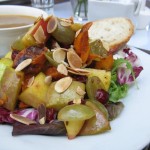 ch at Bistro 160, which was chanterelle soup and a very fine roasted yam and apple salad. The fuel was needed to tackle the very large quantity of leaves that had blown up my driveway on that stormy day: gifts from the gods of mulch, to be enjoyed by my garden beds (and a whole new generation of slugs, I’m sure) over the winter.
Latest Posts
- (no title)
- Sublime and Twisted Readings coming up!
- Sublime
- Good weather for reading
- The world, the world
- Sublime launch!
Aldeburgh Poetry Festival Barny Haughton BBC BC poets Berkswell blackberries Black Stilt Bologna book launch Borough Market Carlo Petrini Catalonia Cyrus Todiwala dairy Daunt's Books Dijon Edinburgh Fanny Bay Feast of Fields Food and Morality food history food journalism Jenna Butler lardo Malahat Review Michael Pollan Okanagan olive oil tasting olive trees Omnivore's Dilemma Our Food Our Future Oxford Parmigiano-Reggiano Planet Earth Poetry poetry poetry readings Poetry videos prosciutto salumi Sean O'Brien Suffolk ticks Wendy Morton Wired Writing Yvonne Blomer
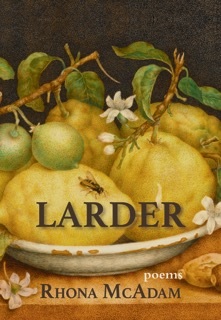
In her latest collection, Rhona McAdam navigates the dark places of human movement through the earth and the exquisite intricacies lingering in backyard gardens and farmlands populated by insects and pollinators, all the while returning to the body, to the tune of staccato beats and the newly discovered symmetries within the human heart.
“…A beautiful, filling collection, Larder is a set of poems to read at the change of the seasons, to appreciate alongside a good meal, and to remind yourself of the beauty in everything, even the things you may not appreciate before opening McAdam’s collection….”
Rhona McAdam is a writer, poet, editor, and Registered Holistic Nutritionist with a Master’s in Food Culture from Italy and a deep-rooted passion for ecology and urban agriculture. Her work spans corporate and technical writing to poetry and creative nonfiction, often exploring the vital links between what we eat and how we live. Based in Victoria, BC, and available via Zoom, Rhona is always open to new writing commissions, readings, or workshops on nutrition and the culinary arts.