-
Is nothing safe?
Read Full Post: Is nothing safe?Appalled to see that a salmonella outbreak in the UK was traced to Cadbury’s chocolate bars! But relieved to see that the source was not the chocolate but the crumb base. So purists can rest easy and carry on with that therapeutic intake.
Yesterday I found the perfect activity for the first gentle day of our heat wave: a visit to Merridale Cidery. We did the self-guided tour to see where and how the cider was made, admired the acres of apple trees and then enjoyed a small tasting of half a dozen of their products. Apple juice was thoughtfully provided for our under-age companion, who was at an age to enjoy the faerie fixtures that were strategically placed to help her endure the tour.
Scrumpy and Traditional Cider were my favourites. In West Country dialect, “scrump” meant to steal apples, and so Scrumpy was the name for pilfered apple cider. At 11% alcohol it was described as a “sit down” cider, and mercifully Merridale has departed from the traditional recipe which calls for raw pork as one of the ingredients.
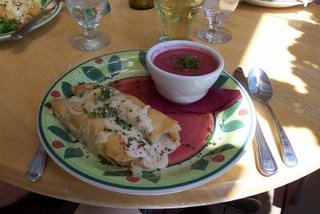
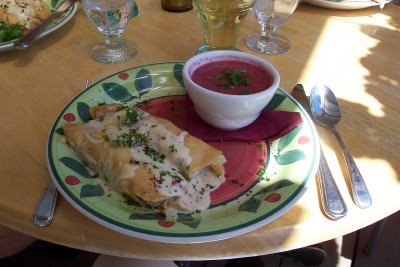
Merridale puts on a mean spread in La Pommeraie Bistro, where we sat outside on the covered veranda and admired the orchard. I had some very nice pulled pork and apple crepes and the soup of the day, a cold honeydew-raspberry concoction which the waitress accurately described as “a smoothie without all the sugar”. It was garnished with chopped mint and gently flavoured with dill and was just the thing for a warm summer day.
The perfect surprise for this melting heat we’re facing was the arrival of my copy of Loutro Poems, an anthology of poetry by writers who attended World Spirit poetry courses 200-2005, lavishly illustrated with colour photos. As if I could forget…
-
Boris, Billy, Ted and a nice roast chicken
Read Full Post: Boris, Billy, Ted and a nice roast chicken
A little awkward to post while being harassed by my desk ornament (yes, folks, Boris is back… he had the sneezes and needed another round of antibiotics so, well, umm…)
Been reading a new Billy Collins (The Trouble With Poetry and Other Poems, Picador 2006) and liked this bit, from Monday:
The proofreaders are playing the ping-pong
game of proofreading,
glancing back and forth from page to page,
the chefs are dicing celery and potatoes,
and the poets are at their windows
because it is their job for which
they are paid nothing every Friday afternoon.And a little more from Ted Hughes:
Much has been said about the therapeutic value of uninhibited writing, and though no doubt that can go to the point where mere confusion enters, it is one way of talking about the pleasures and the healing effects of reading and writing poetry.
All imaginative writing is to some extent the voice of what is neglected or forbidden, hence its connection with the past in a nostalgic vein and the future in a revolutionary vein.
I had a revolutionary experience with a roast chicken on the weekend. Following the guidance of Lynne Rossetto Kasper, I rubbed a whole chicken with olive oil and then slathered on a paste of 1 tbsp minced rosemary, 1 large minced garlic and 1/4 tsp salt, stuffed a couple of sprigs of whole rosemary in the cavity, covered it in plastic and refrigerated it for 24 hours, and then roasted it at 350f at 20-25 mins/pound, the first half on its breast and the second half breast side up, basting it with cooking juices at intervals until the thickest part of the thigh read 170f on the thermometer. It was gorgeous. The finish was to drizzle it with a 3-4 tbsp artisan balsamic vinegar (or slice it first and and drizzle with balsamic). It was beautifully moist and well flavoured.
While I told Jennifer about this triumph, she reminded me that only a few weeks ago I had been reading to her about the use of salt on meats. A magazine I’m extremely fond of is Cooks Illustrated, which is a food nerd’s dream, featuring experiments from America’s Test Kitchen (something I’d never heard of before I started reading the magazine). In the August issue they were performing merciless experiments on barbecued chicken and explained (with diagrams) the effects of salting chicken for 3 or 6 hours. At 3 hours the flesh does not absorb the salt and you end up with dry chicken (which is why popular wisdom says not to salt roasting meats). But after 6 hours, the salt is drawn into the flesh and you end up with flavour from the salt and from any other water-soluble flavouring agents (e.g. herbs and spices but not oil-solubles like capsaicin, the hot element of chili peppers). They prefer salting to brining if you are dealing with chicken because they found brining made the skin soggy, and salting leaves it crispier.
-
Fry on Form and Anchovy Amnesty
Read Full Post: Fry on Form and Anchovy AmnestyA book that has, I’m told, not received the best of reviews lies open by my chair these days, and I’m enjoying it so far. The Ode Less Travelled is Stephen Fry’s guide to Unlocking the Poet Within. It’s a manual of metre, rhyme and form by someone who writes privately himself:
“I do not write poetry for publication, I write it for the same reason that, according to Wilde, one should write a diary, to have something sensational to read on the train.”
(If only we Canadians had trains to read on we might be better poets and diarists…?) He quotes Auden on the difficulties of writing free verse:
“The poet who writes ‘free’ verse is like Robinson Crusoe on his desert island: he must do all his cooking, laundry and darning for himself. In a few exceptional cases, this manly independence produces something original and impressive, but more often the result is squalor – dirty sheets on the unmade bed and empty bottles on the unswept floor.”
Lynne Rossetto Kasper has certainly produced something original and impressive in The Splendid Table, her 1992 guide to the cuisine of Emilia-Romagna, the Heartland of Northern Italian Food. Interesting and unusual recipes, including this pasta sauce (which I have only slightly tweaked) which she says comes from the cooks of Modena’s and Ferrara’s Jewish communities. It features a substance unfairly despised and misunderstood in North America: the amazing anchovy. Be not afraid, and you will be fed.
Lemon Anchovy Sauce (Bagnabrusca):
2 2-oz cans anchovy filets
1 cup cold water
6 tbsp extra virgin olive oil
1 large clove garlic, minced
1/2 cup water
2 large fresh tomatoes, peeled, cored and chopped
6 tbsp minced flat-leaf parsley
3 tbsp fresh lemon juice
Freshly ground black pepper to taste.- Rinse the anchovies and soak them in the cup of cold water for 10 minutes. Drain and coarsely chop.
- In a 12-inch heavy skillet, heat the oil over medium heat. Add the garlic and saute until faintly golden but not brown.
- Add the parsley and anchovies and heat briefly, 30 seconds or so. Immediately stir in the 1/2 cup water and cook over low heat about 2 minutes, until the anchovies melt (isn’t that the coolest thing??).
- Blend in the tomatoes and lemon juice, raise the heat to medium, and cook 1 minute.
- Generously season with black pepper and scrape the pan over hot drained pasta – tagliarini is recommended. Toss to coat. Sprinkle with a further tablespoon of chopped parsley and serve (without parmesan or other cheese).




Latest Posts
- (no title)
- Sublime and Twisted Readings coming up!
- Sublime
- Good weather for reading
- The world, the world
- Sublime launch!
Aldeburgh Poetry Festival Barny Haughton BBC BC poets Berkswell blackberries Black Stilt Bologna book launch Borough Market Carlo Petrini Catalonia Cyrus Todiwala dairy Daunt's Books Dijon Edinburgh Fanny Bay Feast of Fields Food and Morality food history food journalism Jenna Butler lardo Malahat Review Michael Pollan Okanagan olive oil tasting olive trees Omnivore's Dilemma Our Food Our Future Oxford Parmigiano-Reggiano Planet Earth Poetry poetry poetry readings Poetry videos prosciutto salumi Sean O'Brien Suffolk ticks Wendy Morton Wired Writing Yvonne Blomer
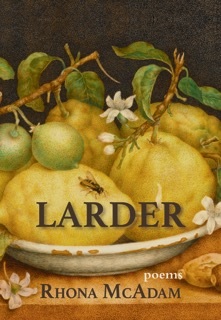
In her latest collection, Rhona McAdam navigates the dark places of human movement through the earth and the exquisite intricacies lingering in backyard gardens and farmlands populated by insects and pollinators, all the while returning to the body, to the tune of staccato beats and the newly discovered symmetries within the human heart.
“…A beautiful, filling collection, Larder is a set of poems to read at the change of the seasons, to appreciate alongside a good meal, and to remind yourself of the beauty in everything, even the things you may not appreciate before opening McAdam’s collection….”
Rhona McAdam is a writer, poet, editor, and Registered Holistic Nutritionist with a Master’s in Food Culture from Italy and a deep-rooted passion for ecology and urban agriculture. Her work spans corporate and technical writing to poetry and creative nonfiction, often exploring the vital links between what we eat and how we live. Based in Victoria, BC, and available via Zoom, Rhona is always open to new writing commissions, readings, or workshops on nutrition and the culinary arts.