-
The difficulty of eating local
Read Full Post: The difficulty of eating localOne of the difficulties of trying to eat local food is that you can’t trust food labels, at least not in Canada. Last October, CBC’s Marketplace broadcast an enlightening program about the meaning of the ‘Product of Canada’ label, which you can watch again online, in which they revealed that this branding means that 51% of the production costs (not even the content) were spent in Canada. This is allowed thanks to legislation created in 1985, when 20% of Canadian food was imported; now we’re at the 40% stage, it is starting to sound downright silly, let alone outdated.
So in the example given, of Highliner frozen fish products branded ‘Product of Canada’, the fish may have been farmed in Vietnam, Indonesia or China and then shipped frozen to Canada for processing, becoming Canadian somewhere en route. When the program-makers went to Lunenburg, the published address for Highliner, they were told that no fishing boats had come in there for six or seven years.
All of which is problematic to consumers: they can’t make informed choices, because the information they’re using is flawed and misleading. They can’t vote with their wallets against poor labour practices, potentially unsafe food production practices, unsustainable fishing practices, or unsound ecological practices, and they can’t even support local producers because they cannot tell (from packaged goods anyway) which products are truly local.
-
Slow cider and fast poetry
Read Full Post: Slow cider and fast poetryGot to my first meeting of the Slow Island gang – in fact our Slow Food convivium‘s AGM, held at Sea Cider Farm, where we sipped and sampled our way through the evening, gazing out across the young apple trees to little James Island, where a couple of the young members are starting an organic farm. Quite a task, given they can’t live on the island, and everything they need has to be ferried across (but all in all a much better idea than the island’s last role as a TNT factory).
Sinclair Philip, Mara Jernigan and Nick Versteeg raised all kinds of issues, from Terra Madre to the destruction of Garry Oak meadows by Vancouver Island developers.
One thing Nick raised was the trade sanction wickedness Canada is doing now, which is being under-reported in the press. I suggest to all of us in this country that we drop a line to our MPs and register our dissatisfaction with the idea of Canada using trade sanctions to try to force genetically modified products on Europe, which surely has the sovereignty to decide what it allows into the farms and kitchens of its member states.
Basically, since 2003, GM-producing countries, including the US, Canada and Argentina, have been lobbying the WTO to force Europe to allow GMO imports. And in 2006, the WTO agreed that the EU had to allow GMO imports whether they wanted them or not. Unfortunately, Europe is not one country, and its 27 member states are not generally in favour of allowing GM products (– and really, is the power of collective dissent against economic pressure from others not one of the very points of trade organisations?). The US is holding its economic cudgel off until June of this year, but Canada’s deadline to have the EU comply with the WTO was February 11.
Speaking of dates, as I’m sure all the church-goers know, we’ll have to get our greens on early this year, as St Patrick’s Day has been moved to 15 March, by order of the Vatican, because this year’s early Easter causes 17 March to fall in Holy Week. Apparently no liturgical feast may take place during Holy Week, so St Patrick had to move aside.
Last night, St Patrick’s Eve, as it were, was also the reading at Planet Earth Poetry by visiting Saskatchewanian Glen Sorestad, who gave us a delightful display of his wares,
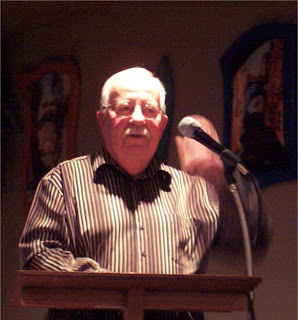
handsomely introduced by Susan Stenson

And then there were signings

and off we all disappeared into the night.
-
Over-fed and over here; and Alice Waters’ food values
Read Full Post: Over-fed and over here; and Alice Waters’ food valuesCBC’s current affairs program, The Current, did a piece this morning on Raj Patel’s book on food security – the access of populations to food – and global food economics this morning. Stuffed and Starved is the first book I’ve come across that has its own trailer: cool! It comes down hard on organisations like the WTO for helping to oil that machinery that forces small farmers off their land, allowing big business to take hold of food productions and supermarket offerings, and speaks out against ‘free’ trade policies that can only worsen the situation for farmers and consumers alike. My copy is awaiting my attention, as is a similarly titled book, Paradox of Plenty: A Social History of Eating in Modern America, by Harvey Levenstein.
Meanwhile, some good thoughts from Alice Waters in an interview from last October:
…every decision we make about the food that we eat has consequences. And they aren’t just about people’s personal health. There are consequences in terms of the healthcare system for all of us if people eat food that makes them sick. And there are environmental consequences. But I think the thing that people don’t understand is that there are cultural consequences.
When we’re eating fast food, we’re not just eating the food, we’re eating a set of values that comes with the food. And it’s telling us that food should be cheap. It’s telling us that food should be the same no matter where we are on the planet. It’s telling us that advertising confers value. That it’s OK to eat 24 hours a day. That there are unlimited resources. It’s telling us that the work of the people who grow or raise the food is unimportant — in fact we don’t even need to know. And all of those values are informing what’s happening in the world around us. We’re ending up with malls instead of beautiful places to live in.


Latest Posts
- (no title)
- Sublime and Twisted Readings coming up!
- Sublime
- Good weather for reading
- The world, the world
- Sublime launch!
Aldeburgh Poetry Festival Barny Haughton BBC BC poets Berkswell blackberries Black Stilt Bologna book launch Borough Market Carlo Petrini Catalonia Cyrus Todiwala dairy Daunt's Books Dijon Edinburgh Fanny Bay Feast of Fields Food and Morality food history food journalism Jenna Butler lardo Malahat Review Michael Pollan Okanagan olive oil tasting olive trees Omnivore's Dilemma Our Food Our Future Oxford Parmigiano-Reggiano Planet Earth Poetry poetry poetry readings Poetry videos prosciutto salumi Sean O'Brien Suffolk ticks Wendy Morton Wired Writing Yvonne Blomer
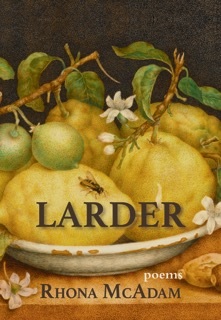
In her latest collection, Rhona McAdam navigates the dark places of human movement through the earth and the exquisite intricacies lingering in backyard gardens and farmlands populated by insects and pollinators, all the while returning to the body, to the tune of staccato beats and the newly discovered symmetries within the human heart.
“…A beautiful, filling collection, Larder is a set of poems to read at the change of the seasons, to appreciate alongside a good meal, and to remind yourself of the beauty in everything, even the things you may not appreciate before opening McAdam’s collection….”
Rhona McAdam is a writer, poet, editor, and Registered Holistic Nutritionist with a Master’s in Food Culture from Italy and a deep-rooted passion for ecology and urban agriculture. Her work spans corporate and technical writing to poetry and creative nonfiction, often exploring the vital links between what we eat and how we live. Based in Victoria, BC, and available via Zoom, Rhona is always open to new writing commissions, readings, or workshops on nutrition and the culinary arts.