-
A lot of words on waste
I spend a lot of time thinking about waste. (And wonder: is this a waste of my time?)
Waste is inescapable in this culture, and we need to be talking and acting more decisively. Rubbish is engineered into every product we pick off a shelf. How much money have I wasted buying things that didn’t work, that didn’t last? What further damage are we doing to our environment by our willingness to live the throwaway life?
Waste doesn’t stop with the craziness we call consumerism; it’s patterned into our style of eating as well. Truly ethical meat eating demands that we use the entire animal if we kill one for food. My sister-in-law told me a hair-raising tale of an acquaintance who buys whole pre-cooked broiler chickens for her family, cuts the breast meat off and throws the rest into the garbage because nobody in her family will eat anything but white meat. Such people, in my opinion, don’t deserve to eat meat at all.
However. This article about nose to tail cooking concentrates on one body part that those raised on safely anonymous chicken nuggets or pre-formed luncheon meat will have particular problems preparing. Not so the bold souls at The Punter in Cambridge, whose Lamb Fries I had reported on back in November.
Some groups feel strongly enough about commercial food waste to do something about it. On my course in Italy we learned about Last Minute Market, which whisks unwanted food away from Italian supermarkets and processes or redistributes it. Second Harvest does this in Canada.Back in November, some plucky Londoners threw a free lunch for 5,000 to raise awareness about food waste.
It’s never too early to start preparing ourselves for Waste Reduction Week, coming up in October. There are so many things we could do. How about bringing your own container for takeaways? Takeoutwithout is a great idea in Toronto; you can do your own thing by investing in a tiffin box and taking that. One British journalist experimented with the concept of shopping packaging-free a couple of years ago; and another offered 20 suggestions for reducing food waste. Our own David Suzuki has a few ideas as well. In the commercial kitchen, frugal is finding new panache among San Francisco’s chefs, according to this article.
People can educate themselves about using food they would otherwise have wasted, as this article shows, or learn to understand what the “best before” date means – because it’s not an arbitrary line after which your food will go bad.
Freegans and Freecyclers have understood this for a while. In her book Farm City, Novella Carpenter describes how she foraged in dumpsters and garbage bins to feed her urban animals. But there’s good, edible food in there still fit for humans too. In fact, here’s an excellent letter (originally written to the editors of Monday Magazine) from a resident of the Fernwood neighbourhood in Victoria, who watches waste more closely than most.
From: Edward Butterworth
Date: February 17, 2012
Subject: dumpster demiseDear Editor,
It is with great sadness that we, the Fernwood Urban Gleaners Group, note the passing of possibly the last major open dumpster in Victoria, outside Thriftys Hillside supermarket this week. It was our ‘golden’ dumpster, reliably supplying us enough good food to feed ten or more hungry mouths. We expect it to be replaced with a second locked compactor, as exist at all the other large supermarkets in town, thus ensuring that surplus food goes to waste.
Far be it from us to moralize about Thriftys’ behaviour. They are locked into a system which make such waste inevitable. I have no doubt that their decision was an ‘economic’ one with moral implications not even discussed. What I question is the narrow view of economic decisions, that don’t see waste in a world of scarcity, that don’t see degradation and pollution of the environment as debts being accumulated. It is not a moral shortfall but lack of consciousness, a sort of blindness to the consequences of our actions, to the fact that humanity is on the brink of paying these debts. Every plastic tub of yoghurt, sour cream, salsa, hummus, etc. we salvaged was recycled, saving them from the landfill.
I joked that dumpster diving was the best paid job I ever had. Organic fruit and veg., half a dozen $35 spiral sliced hams, boxes of organic yoghurt, milk, bulk nuts, artisan bread… One night I opened a garbage bag to find $400-worth of gourmet imported cheese. For a week I was the cheese fairy, dealing out exotic French cheese to all and sundry. It was the dumpster land of milk and honey too good to last, I suppose, in this world of impermanence.
So many people thought we were taking undue risks eating discarded food. But I have spent years wandering the third world and understand the rudiments of hygiene and food safety. Foodsafe is about ensuring zero liability and thus errs heavily on the side of caution. Cheese, for example, goes mouldy at a certain point, but unlike with bread, the mould can be cut off leaving the rest of the cheese good to eat. There was no sign of mould on any in that bag. There is still cheese in my fridge that was gleaned a month ago. I consider myself well-informed enough to take responsibility for my own body and what I put into it.
While I feel gratitude for the gift that was this brief window of abundance I am impatient to see change in this society. For example, while we enthusiastically recycle all plastics that come over our doorstep, supermarkets and all businesses are free to dump them with impunity and do so in huge quantities. I want to see regulations to stop this. Businesses would whine that this would undermine their profitability but with a level playing field they would just pass on the increased costs to consumers. Then we would begin to pay the real costs of what we consume without generating environmental debt. In a world where a billion people go hungry, in a society where homelessness is on the increase and people are expected to live on $650 a month on welfare, I want to see laws prohibiting such waste of food.
It was taboo when I was young.
Edward Butterworth
Had enough? If not, here are a few more links:
Food Waste in Canada (November 2010)
Why Wasting Food Wastes Nature (May, 2011)
Redirecting food waste (March 2011) -
Re-entry: Denise Dunn; IdeaWave
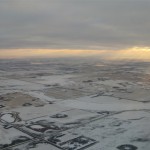 I bade farewell to Saskatchewan on Friday afternoon: a blizzard was in the forecast for the following day, but as we lifted off, it was clear enough for an atmospheric sunset, and at the other end of the journey, the rain paused so I was able to enjoy the freshly rinsed walk from the plane and the aromas of salt and cedar that greet arrivals to Victoria’s airport.
Saturday was too fraught for me to make it to the first day of IdeaWave, so I missed hearing
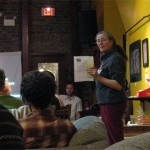 some great speakers, as was reported to me later. I did manage to go to the memorial service for Denise Dunn, whose sudden death leaves a mighty vacuum in the many spheres of her involvement, not least her generous and welcoming presence in Transition Victoria, where she was active in the Reskilling group, and led the Meet, Mend & Make evenings and the Linen Project. There were around 200 people gathered to remember her, so she got a good send-off.
After that I returned home to continue fretting over my talk on CSAs at IdeaWave this morning. It went reasonably well, although there was a total failure of technology when the lovely pages of my Powerpoint presentation galloped off on their own, so I cut the cord and went imageless and belowtech with my index cards. However. The technology worked well enough to animate quite a number of 10-minute presentations and I learned diverse and interesting stuff from some interesting speakers.
Some of us lunched at Ingredients, where my spicy quinoa chili was good and most welcome, particularly as we’d walked through a Victoria snowstorm – the kind that doesn’t stick – to get there. We stopped at a Chinese bakery on the way back to pick up a bit of sweet fortification (a warm sesame ball with a sweet red bean centre) for the last series of speakers. The afternoon was further fortified by the generous offerings of Lighthouse Brewery, and the final presenters met warmer and warmer applause, so it seemed.
Among the things I heard about over the course of the day were Makerspace (and the Maker Faires – of which there will be one in Victoria in July); the possibilities opened up by iPads to help people with developmental disabilities communicate; the food possibilities of marine plants; the possibilities of diamagnetics in space travel (and the amazing levitating ability of pyrolytic carbon); and a moving presentation by photographer Rob Jirucha about his project to try to photograph 34 elders who are seeking to transfer the language and culture of BC’s 34 distinct first nations languages while they still exist. Here’s a video he made of the project so far:
SENĆOŦEN Language Champion from Language Champions on Vimeo.
-
The future of meat?
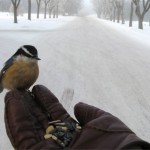 The last few days at the SWG writers and artists colony are shooting past. The nuthatches returned last week, in fighting form, shooing away chickadees and picking all the largest peanuts to stash in nearby tree trunks.
Meanwhile my inbox has been attracting distractions. Stan has been sending me some meaty articles so I am sharing them with the rest of you as you prepare to tuck into your Sunday roasts.
The Guardian has just posted an article about the £200,000 burger that’s been whipped up in a test tube, in a well-intentioned move to cut greenhouse gas emissions linked to intensive cattle farming. Fair enough, sez I: if people really don’t care to know where their food comes from, and few seem to, why not? Could it taste any worse than TVP, or a frozen supermarket soyburger? It might even be healthier than a school cafeteria burger or frozen hamburger patty, since it wouldn’t be walking around in its own contaminants. Gwynne Dyer had been talking about cultured meat earlier this week, and some months ago we learned about the amazing progress Japanese scientists had made in recycling.. erm.. certain waste products into meat-like substances.
We are eating, I hope, closer to the source of our food at the abbey, although there were some niggling questions in my mind about the historical accuracy of the menu for last week’s
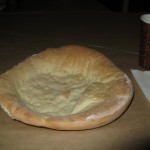 Medieval Feast, which featured breaded fried chicken and macaroni and cheese served on locally-made bread trenchers. Try it yourself next time you don’t feel like doing dishes and your meal leaves your guests hungry enough to eat their plates!
Latest Posts
- Sublime
- Good weather for reading
- The world, the world
- Sublime launch!
- Planet Earth Poetry – Readings by Volunteers, Victoria 2026
- Poetry at the Goldfinch
Aldeburgh Poetry Festival Barny Haughton BBC BC poets Berkswell blackberries Black Stilt Bologna book launch Borough Market Carlo Petrini Catalonia Cyrus Todiwala dairy Daunt's Books Dijon Edinburgh Fanny Bay Feast of Fields Food and Morality food history food journalism Jenna Butler lardo Malahat Review Michael Pollan Okanagan olive oil tasting olive trees Omnivore's Dilemma Our Food Our Future Oxford Parmigiano-Reggiano Planet Earth Poetry poetry poetry readings Poetry videos prosciutto salumi Sean O'Brien Suffolk ticks Wendy Morton Wired Writing Yvonne Blomer

In her latest collection, Rhona McAdam navigates the dark places of human movement through the earth and the exquisite intricacies lingering in backyard gardens and farmlands populated by insects and pollinators, all the while returning to the body, to the tune of staccato beats and the newly discovered symmetries within the human heart.
“…A beautiful, filling collection, Larder is a set of poems to read at the change of the seasons, to appreciate alongside a good meal, and to remind yourself of the beauty in everything, even the things you may not appreciate before opening McAdam’s collection….”
Rhona McAdam is a writer, poet, editor, and Registered Holistic Nutritionist with a Master’s in Food Culture from Italy and a deep-rooted passion for ecology and urban agriculture. Her work spans corporate and technical writing to poetry and creative nonfiction, often exploring the vital links between what we eat and how we live. Based in Victoria, BC, and available via Zoom, Rhona is always open to new writing commissions, readings, or workshops on nutrition and the culinary arts.
