-
Kneading with a k
 I’d been looking forward to the second offering of the Kneading Conference West, held in the idyllic gardens and fruit orchard of the Mount Vernon Research Station, where grains are being grown, tested and much discussed. Over this past September weekend they were also being ground, mixed, cooked and tasted to delicious ends.
There was enough variety to keep the 200 or so various types of grain geeks amused, from tasting sessions – grains baked into crackers or breads, or liquified into beer – to talks on the science of baking (complete with easy-to-grasp 3D models) to demos on how pizza can turn into pita.


There were baking workshops too. Last year I’d missed most of George de Pasquale‘s session on sourdough/artisan bread for home bakers so made sure to attend it this year, though it was packed to the rafters. He walked us through equipment, explained ingredients, and guided those able to reach the counter on mixing, kneading, shaping and fermenting bread dough.


He demonstrated with a few swift cuts how to make Epi


And he critiqued a baked loaf, explaining some of the features to test for done-ness and the physical clues of underproofed and properly baked loaves. There were other demos too: one of the keynote speakers, food writer Naomi Duguid, demonstrated some of her favourite flatbreads (Finnish barley bread, Naan, Pugliese and Burmese breads) with help from Toronto baker Dawn Woodward. Oregon barley scientist Pat Hayes was there showing off his wares and giving out samples of his team’s Streaker (naked) Barley, so named for its hullessness.


Then there were the mud people, led by Kiko Denzer, who slapped together a wood-fired oven in less than a day. One minute he was demonstrating an oversized hand blender in a bucket of mud and water, the next he was tamping down the base, and a few hours later it was done and decorated. Miraculous.


Andrew Whitley – who’d enlivened a panel on Thursday, discussing grain quality with Tom Dunston (an Oregon miller with Camas Country Mill) and Cliff Leir (of Victoria’s own Fol Epi Bakery) among others was the keynote speaker on Friday morning, introduced by last year’s barley baker, Andrew Ross from Oregon State University, and he gave us a rousing talk about his own history as a baker and small-scale grain grower, having started off in a spirit of self-sufficiency growing wheat for his own bread. He started and ran the Village Bakery in Cumbria for more than 30 years, during which time he produced rye bread that I had, to my delight, discovered at my local Waitrose in London when I lived there back in the nineties.


After reviewing his past life as a rural wholegrain baker using only local wheat in 1970s England, with a business plan someone had once summarized for him as “going to a place where there were no people, making a product for which there was no demand, from a material that was impossible to work with for its purpose,” Whitley’s talk ranged over issues facing all today’s eaters. There are the centralized production and monocropping issues that reduce choice for all of us and mean that in wheat breeding we’ve allowed production requirements to trump nutrition and taste (the only grains measured for such are for feedstock); the nutritional issues – the decline in nutritional value through breeding and milling “advances” (we have lost important mineral content through the change from stone ground to roller milled wheat, for example). And there’s the accelerated production time demanded by industrial operations, that rob our bread of the lactic acids and enzymes that work on naturally leavened bread to make it more digestible (not to mention tasty). He talked a bit about the Community Supported Bakery he’s supporting, the work of the Real Bread Campaign, and offered some ideas for bringing good bread to people who might not feel comfortable crossing the threshold of an artisan bakery. Bring our bread back home, he said, and gain liberation from larger corporations who don’t have our interests at heart.
And few would argue with that, enjoying excellent baked goods all weekend. We were certainly well fed and entertained through a superbly sunny and pleasant weekend. And really, how many times will someone offer you a slice of pie, freshly made with duck fat pastry and filled with caramelized apples? Not many, I’d say. I’ll be back…


-
Eat there then
 I’m a week behind in my entries, so here goes the catch-up. Last Sunday’s Eat Here Now festival looked to me to have been enormously popular, with lots of food being eaten and bought and talked about in Market Square.
The square had been divided into an eating and entertainment side, and a vendors’ side. Crowds seemed to be milling evenly between the two by the time I left, but as I arrived at lunchtime, I headed with sooo many others to the taste for a toony buffet provided by locally-oriented restaurants. Cosmo Meens, as always, drew a crowd, this time offering a curried tofu soup with focaccia, an offering from his new Hot and cold Cafe. Relish was there with a “Vietnamese sub” of house-smoked pork terrine and asian vegetables; Sooke Harbour House’s lovely little quinoa salad with salmon, seaweed and other local delicacies, came with an all-too tasty edible scoop, but I’d be surprised if many of them lasted long enough to do their job. All in all it was a hard day for vegetarians: aside from those mentioned, and some mushroom ravioli from Cowichan Pasta, almost every stand offered meat; of which Kulu’s spicy sausage got my vote, if only because it came laden with kimchi! (Luckily for the non-carnivores, Green Cuisine was open for business on the fringes of the festival.)


And then it was time to browse the vendors’ stalls, which of course included Haliburton Farm, where Farmers Nate & Mike were holding the fort; Libby Seabrook was doing a brisk trade in InfuseTea (her blueberry & rosemary blend is to die for, just for the record); Fry’s Bakery was selling mini-pizzas, blueberry scones and rather beautiful baguettes – can’t wait for them to open their shop on Craigflower Rd, which is rumoured to be happening later this month. City Harvest was there with urban abundance, Wildfire had some tempting shortbreads (lavender and local wheat were my picks) and Sun Trio’s tomatoes were as beautiful as the day was long and sunny.


-
Slow Food Lamb Roast
 Cory Pelan loves lamb, and he likes it best in a farmer’s field with lots of people bringing lots of lovely food to go with it. So yesterday afternoon he and the Slow Island convivium put on a summer party to raise funds for sending Vancouver Islanders to Terra Madre this October.
We sat on hay bales (invited to bring blankets to cover them) and watched the lamb turn on its spit until it was time to dine. Some idled away the time visiting the pig pens to see the heritage breed pigs that farmer Tom Henry raises there. Cory did the carving, assisted by Peter Zambri and watched by a host of hungry foodies.


By this time platter after platter of side dishes had arrived (I think it best to let the food speak for itself):


…and there was a groaning board of desserts as well.


Latest Posts
- Sublime
- Good weather for reading
- The world, the world
- Sublime launch!
- Planet Earth Poetry – Readings by Volunteers, Victoria 2026
- Poetry at the Goldfinch
Aldeburgh Poetry Festival Barny Haughton BBC BC poets Berkswell blackberries Black Stilt Bologna book launch Borough Market Carlo Petrini Catalonia Cyrus Todiwala dairy Daunt's Books Dijon Edinburgh Fanny Bay Feast of Fields Food and Morality food history food journalism Jenna Butler lardo Malahat Review Michael Pollan Okanagan olive oil tasting olive trees Omnivore's Dilemma Our Food Our Future Oxford Parmigiano-Reggiano Planet Earth Poetry poetry poetry readings Poetry videos prosciutto salumi Sean O'Brien Suffolk ticks Wendy Morton Wired Writing Yvonne Blomer
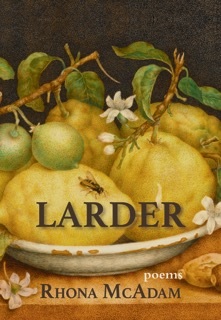
In her latest collection, Rhona McAdam navigates the dark places of human movement through the earth and the exquisite intricacies lingering in backyard gardens and farmlands populated by insects and pollinators, all the while returning to the body, to the tune of staccato beats and the newly discovered symmetries within the human heart.
“…A beautiful, filling collection, Larder is a set of poems to read at the change of the seasons, to appreciate alongside a good meal, and to remind yourself of the beauty in everything, even the things you may not appreciate before opening McAdam’s collection….”
Rhona McAdam is a writer, poet, editor, and Registered Holistic Nutritionist with a Master’s in Food Culture from Italy and a deep-rooted passion for ecology and urban agriculture. Her work spans corporate and technical writing to poetry and creative nonfiction, often exploring the vital links between what we eat and how we live. Based in Victoria, BC, and available via Zoom, Rhona is always open to new writing commissions, readings, or workshops on nutrition and the culinary arts.