-
ASLE 2013 – been & gone

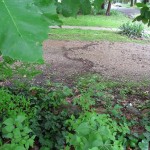
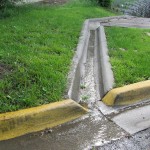
Water could have been the theme at ASLE 2013. At the opening reception, the Provost of KU promised us that Kansas is a great place when it’s not raining or snowing… but life does end up being a lot about water management when you get, as Lawrence did, five inches of rain in three days. Lots of impermeable surfaces on the hilltop campus mean lots of extra drainage. I guess it all ends up in the Kansas River, which ends up in the Missouri River, which ends up in the Mississippi and on into the Gulf of Mexico, instead of back in the groundwater. Although as we heard from Kelly Kindscher, the impassioned ethnobotanist who led our Friday afternoon tour of the university’s Native Medicinal Herb Garden, some of the topsoil is very deep and there are clay deposits of such depth that may be separating groundwater from deeper water deposits.
My first conference appearance was on Wednesday when I chaired a panel called Race, Gender, Garden, Region which rambled across Leslie Marmon Silko’s novel Gardens in the Dunes, gendered landscapes in early 20th century New England Ballads and an analysis of “
 A French Garden in England: A record of the successes & failures of a first year of intensive culture” by Helen Nussey and Olive J. Cockerell, a garden memoir from 1909, which sounded fascinating. It is charmingly illustrated by Cockerell – who had made a name illustrating fairytales – and faithfully records instructions, successes and failures. I’ll have to have a look next time I’m at the British Library.
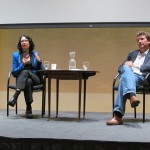 The first plenary I attended featured Stacy Alaimo and Cary Wolfe. Alaimo kicked off her discussion of deep sea environmentalism with an apt New Yorker cartoon, and then took us through some of the decade’s worth of work from the Census of Marine Life. Wolfe, referring to his recent book Before the Law: Humans and Other Animals in a Biopolitical Frame, riffed on such thoughts as what kinds of creatures is it ok to do what to; and whose lives count as lives and whose life counts as a “grievable life”.
Picking a couple of favourite presentations from favourite sessions – hundreds? thousands? to choose from – I was particularly moved by a paper by Hillary J Fogerty, from Missouri Southern State University, the irresistably-titled Why she can`t stop talking about the farmers market: Considering the role of activism and Advocacy in Food Studies Pedagogy and Curriculum. She described a research course for English students which she rewrote to allow students – largely from disadvantaged socio-economic groups – to study their own food security, developing research and writing skills while keeping food diaries, analyzing food advertising and ultimately in many cases changing the way they ate. She described students three years later shouting across parking lots at her to share weight loss, dietary changes and other improvements which were all the more remarkable for taking place in a town that is the headquarters for Tyson Foods, with Walmart down the road and in the looming shadow of Monsanto. Those students were likely directly dependent on those companies by direct or indirect family ties.
My other favourite, a no-brainer, was the personal essay by Dan Philippon describing a visit to Italy where he guest-lectured at the University of Gastronomic Sciences and spent time with his family visiting food producers in the Piemonte region. His talk, Slow Food or Small Food? Learning from Italian Producers, hinged on his visit to a small flour and polenta mill, Mulino Marino, and what he learned there about perceptions of quality, marketing, tradition and technology. He summed up his findings – what the producers he spoke to believed – as:
1. quality matters
2. organic and natural do not equal quality
3. history and tradition matter, but so do technology and innovation
4. local cannot be untangled from global
5. small food good; big food badI will finish in my next posting to mention my own paper, two different but inspiring plenaries and a field trip.
-
ASLE 2013 – and I’d never been to Kansas
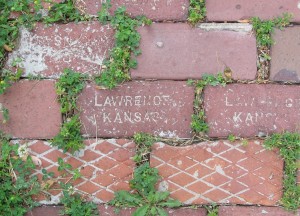 I arrived on the heels of a big thunderstorm that flooded basements and washed the place clean before disappearing off to neighbouring states. The air is still heavy with heat and humidity, and more storms are forecast but so far we’ve been lucky.
I flew into Kansas City, MO, which is across the Kansas River from Kansas City, KS, more or less. The Missouri River is also involved in ways I have yet to become clear on. Anyway I left that puzzle behind me and was whisked off to Lawrence, about 40 miles west, where Kansas University is hosting the tenth biennial ASLE conference, whose theme is Changing Nature: Migrations, Energies, Limits.
I spent Tuesday walking around the neighbourhood I’m staying in, which borders the university, and where there is, happily, no shortage of gardens to gawp at.


A bit of wildlife too. Funny to see the rabbits, not as pretty or numerous as the ones that entertained ASLE 2009. I throw in a gratuitous cat picture because I don’t have cats in my suitcases as often as I used to. And a Jaybird for the sports fans.


Pretty campus, on top of a steep hill which gets steeper during the hottest time of the day. And it has been warm. Not inside where the air conditioning is: there, it’s been very chilly. Never occurred to me to bring winter clothing for the meetings…


And finally, a couple more gardens. I suspect that exams and graduations got the better of the campus garden which does have some lettuce struggling for life against the weeds. But most gardens here suffer the effects of short growing seasons, which are short and powerful: hot sunny weather and lots of rain mean it’s hard to exert much control over what grows where once it starts. The school garden at right seems to be well in someone’s hands though, with the broccoli nearly ready. And that’s where I’ll leave it – more about the conference itself another time.


-
Plants to swap, buy and heal
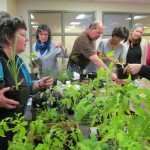 Wednesday’s fun was the GTUF plant swap, at which we shared around our surplus plant starts. It was our monthly meeting and this time the theme was growing and cooking herbs. A couple of our members – Donna Neve & Gene Monast – presented a wealth of information about the power of such herbs as sage and rosemary and extolled their many benefits – ease of growing, beauty in knot gardens and the like, and offered some delicious ways to use them, in breads, cookies and other baking. Then we pushed our chairs back and set to gathering plants for our gardens. Many of the starts had been grown from seeds shared at our seed swap back in January, so the plants go round and round the neighbourhood.
More plants were on offer at Haliburton Farm on Saturday, when the farmers set out a large display of vegetable and berry starts as well as succulents, ornamentals and native plants. The farm now includes five farming businesses, an organic seedling greenhouse and an organic native plant business, so it’s thriving and developing in interesting ways.


Last night I went to hear Karin Kilpatrick talk about healing with plants. She is the medically-trained partner of the amazing herbalist and food forester Richard Walker, who’s in town this weekend to give another of his dazzlingly informative and wide-ranging workshops on food forests. Karin is a doctor who’s worked emergency rooms and general practice in South Africa and rural Canada, and she told us about the “trance-breaking” first encounter with Walker, when he transformed one of her patients from “raw meat” stage eczema to perfect skin in two weeks using diet and herbal tea (the magic food was kicheree, and the tea was dandelion).
She has watched the vibrant health of rural Canadians plummet over the past thirty years of her medical practice and she is categorical in her diagnosis: inflammation, depleted immune systems and accelerated aging brought about by malnutrition. “You don’t give the immune system the right food,” she said, “and it loses.”
But our bodies are exhausted too by the stress of working and living in an oppressive system. The strain of working in increasingly demanding jobs with dwindling budgets takes its toll even from doctors: the pay-per-patient system imposed on GPs “keeps us all in serfdom,” explaining that after office and staff costs are taking into consideration she earns $7 per patient. In reducing patients to the sum of their parts, “it’s reductionist and dehumanizing.”
All colonization systems begin to take control of populations by taking away food autonomy, she observed, pointing to the way “we were sold a bill of goods: cheap, centralized food. We ate it and we got sick.” We do not live in a system where growing your food and healing yourself has a dollar value, and we live in a culture in thrall to monetary reward, so nothing will change unless we change ourselves.
She has changed her life, and sworn off the 10-minute rule for patient consultation. She takes fewer patients and spends longer with them, and she brings the chronically ill together in circle groups for extended education on how to nourish themselves back to health. She meets with them for an hour and a half each week, for 28 weeks, to teach them about nutrient-dense foods, stress management and natural cures for their conditions. “And I’m making my rent,” she added proudly.
Showing her roots – as a South African and as an allopathic doctor – she told us she had one day realized that she was guilty of “apartheid towards plants”. But she was not alone in this: all those who do scientific studies on plant remedies are guilty, because they don’t examine the effects of the whole plant as indigenous cultures do. Instead, science in its reductionist way seeks to find the “active ingredient” and extract that for study. And so of course the results are skewed (as Michael Pollan reported in In Defense of Food, in his discussion of nutritionism and the tragic misuse of plant compounds like beta-carotene instead of whole foods).
The most actively entertaining part of the evening came when we passed a bottle of Spilanthes (tincture) around the room and sampled for ourselves a powerful traditional antifungal, anti-inflammatory and analgesic remedy with some unusual properties, including tremendous qualities in stimulating saliva production. It may, we were warned, remind you of childhood experiments in putting a 9 volt battery in your mouth. And it certainly did fizz and sparkle on the tongue, lips and gums – Karin swears by it for dental hygiene and says it cured her abscessed tooth in days, and a patient’s cold sore in front of her eyes.
Anything more we can do to change the world? someone asked. Her answer was simple. Tell your health care system administrators that you want naturopathy, herbalism and other health-promoting practices included in health care coverage, so that we’re not just paying to treat sick people, but to make good health available to everyone.


Latest Posts
- Sublime
- Good weather for reading
- The world, the world
- Sublime launch!
- Planet Earth Poetry – Readings by Volunteers, Victoria 2026
- Poetry at the Goldfinch
Aldeburgh Poetry Festival Barny Haughton BBC BC poets Berkswell blackberries Black Stilt Bologna book launch Borough Market Carlo Petrini Catalonia Cyrus Todiwala dairy Daunt's Books Dijon Edinburgh Fanny Bay Feast of Fields Food and Morality food history food journalism Jenna Butler lardo Malahat Review Michael Pollan Okanagan olive oil tasting olive trees Omnivore's Dilemma Our Food Our Future Oxford Parmigiano-Reggiano Planet Earth Poetry poetry poetry readings Poetry videos prosciutto salumi Sean O'Brien Suffolk ticks Wendy Morton Wired Writing Yvonne Blomer
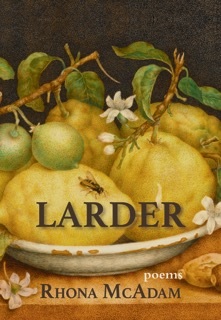
In her latest collection, Rhona McAdam navigates the dark places of human movement through the earth and the exquisite intricacies lingering in backyard gardens and farmlands populated by insects and pollinators, all the while returning to the body, to the tune of staccato beats and the newly discovered symmetries within the human heart.
“…A beautiful, filling collection, Larder is a set of poems to read at the change of the seasons, to appreciate alongside a good meal, and to remind yourself of the beauty in everything, even the things you may not appreciate before opening McAdam’s collection….”
Rhona McAdam is a writer, poet, editor, and Registered Holistic Nutritionist with a Master’s in Food Culture from Italy and a deep-rooted passion for ecology and urban agriculture. Her work spans corporate and technical writing to poetry and creative nonfiction, often exploring the vital links between what we eat and how we live. Based in Victoria, BC, and available via Zoom, Rhona is always open to new writing commissions, readings, or workshops on nutrition and the culinary arts.