-
Gluttony, by Allegra McEvedy
I was happy to find a place on a School of Life workshop last time I was in London. Alain de Botton‘s genius sideline, this eccentric school in Bloomsbury offers a dazzling range of talks, workshops and Sunday sermons as well as a supremely tempting gift shop. Here for your summer entertainment, is a sermon appropriate to these pages, Allegra McEvedy on Gluttony:
-
Bread and summer

Denman Island Strawberry Shortcake Things have gone into summer drift here at the Iambic Cafe. I’ve been jolted into action by my friends at the Kneading Conference West, who’d like me to share with you news of their upcoming gathering, September 12-14, to be held once again in the exquisitely perfect setting of the experimental orchard at the Mount Vernon Research Station. If you love bread and/or grain and want to spend a delicious weekend with farmers, millers, bakers and foodies in the gorgeous Skagit County countryside for a paltry $300 (meals included) you should register now! Keynote speakers this year include renowned New York grain grower/flour producer Thor Oechsner and Gastronomica founding editor Darra Goldstein and there will be workshops in artisan bread baking, pastry baking, grain growing, milling and wood-fired oven construction.
In other news, here’s a taste of my summer so far:

Reading in Bellingham 
Denman Isl.Garden Tour 
CSF seafood share 
Solstice Moon on the Gorge 
Oddly shaped fruit 
Canada Day on the Gorge 
GTUF garden tour 
Nettie Wiebe at CAFS 
Lots of farmers markets 
Haliburton Farm chicks -
ASLE 2013 – plenaries, poetry & medicinal plants
I managed to get a long overdue poetry reading into my ASLE week, attending the plenary reading by Maine poet Jeffrey Thomson and Colombian writer Juan Carlos Galeano, who teaches in Florida. I had first encountered Galeano at my first ASLE at UVic in 2009, where he read some of his translated poems from Amazonia, a charming collection that draws its inspiration from Amazonian folk tales. This time he read from that, accompanied by projected translations, as well as from a new work just published (in Spanish) in Peru, Special Report on the Wind. Thomson read from several works, notably his 2009 collection Birdwatching in Wartime; his anecdote about hanging back while the sounds of a group of students he was with faded and observing the way the forest animated after the humans had left stayed with me as a good metaphor for what a lot of presentations touched on.
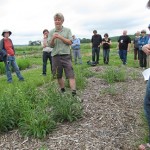 The Friday afternoon field trip I chose was a trip to the Native Medicinal Plant Research garden, which also houses the university’s community gardens. We were led down the garden path by the excellent Kelly Kindscher, a highly knowledgeable prairie ethnobotanist and wetlands advocate, who explained a bit about the program and let us pick, crush, sniff and ponder over many of the garden’s plants. The program’s main aim is to examine native plants for cancer-healing and antioxidant properties, and Kindscher made some interesting observations about the narrowness of that kind of research: what else might we be missing by focusing on molecules? As if to prove the point I caught myself asking which part of the immune-boosting Topeka Purple Coneflower (echinacea atrorubens) was used for tea. How locked we all are in our modes of thinking: had I not just heard Karin Kilpatrick say that one Western medicine’s many mistakes is failing to use the entire plant as native cultures do? Below, we look at Rattlesnake Master (Eryngium yuccifolium), Kelly demonstrates the invasive power of Milkweed (Asclepias syriaca. a good food – if cooked) ironically invading a patch of mint; and the star plant of the moment, the Long-Leafed Ground Cherry (Physalis longifolia) which is showing some powerful antioxidant properties, offering 14 new compounds that reduce tumour size in breast and pancreatic cancer.


Finally, my day came first thing on Saturday morning when I read my personal essay in the company of two quite different academic papers. I had not expected more than a couple of people to attend, since it was 8:30 in the morning and the room was murderously difficult to find, but we had a healthy gathering of 15 or so which was gratifying, and the discussion was interesting and friendly. The sessions I went to in the Species & Food subject stream were all pretty well attended; I understand it was the first time ASLE had had a food theme, so I expect it will continue. Since I have the floor, here is the panel in its entirety: Shamim Us-Saher Ansari, St. Louis Community College-Meramec: ‘You are What You Eat and How You Eat’: The Ethics and Aesthetics of Eating in French Canadian Culture as Dramatized in Willa Cather’s Shadows on the Rock; Bethany Ober, Penn State University: Expanding the Limits of Gender and Domesticity in Contemporary Ecofeminist Memoir; and Rhona McAdam, In your own backyard: Food sovereignty & the urban garden.
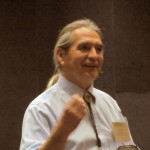 After that there was only time for one more session before I had to leave for the airport, and fortunately for me it was Daniel Wildcat. The title of his topic, After progress: Enacting systems of life-enhancement frankly put me off but I went anyway and was very glad I did, as he was an entertaining and persuasive speaker. Describing himself as a recovering academic, he spoke about how to respond to a damaged world, using “indigenous realism.” This is not, he stressed, naive romanticism: that label is better represented by the idea that humans are in charge of the balance of life on the planet. What we need, he said, is a cultural climate change, one that bridges the gap from knowing to doing and does not include a division between nature and culture. Storytelling is lost: the stories our children hear now are not the wisdom transmitted by their elders, but 30 second soundbites developed by corporations in order to teach kids to be consumers. We need to get from a sense of inalienable rights to one of inalienable responsibility, in a world of relationships not resources. The least each of us can do, if we can’t fix the planet, is to become a better relative and make the world a better place for nonhuman relatives.


Latest Posts
- Sublime
- Good weather for reading
- The world, the world
- Sublime launch!
- Planet Earth Poetry – Readings by Volunteers, Victoria 2026
- Poetry at the Goldfinch
Aldeburgh Poetry Festival Barny Haughton BBC BC poets Berkswell blackberries Black Stilt Bologna book launch Borough Market Carlo Petrini Catalonia Cyrus Todiwala dairy Daunt's Books Dijon Edinburgh Fanny Bay Feast of Fields Food and Morality food history food journalism Jenna Butler lardo Malahat Review Michael Pollan Okanagan olive oil tasting olive trees Omnivore's Dilemma Our Food Our Future Oxford Parmigiano-Reggiano Planet Earth Poetry poetry poetry readings Poetry videos prosciutto salumi Sean O'Brien Suffolk ticks Wendy Morton Wired Writing Yvonne Blomer
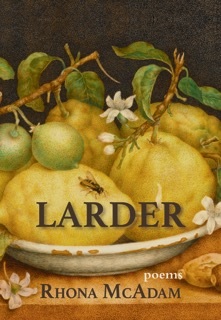
In her latest collection, Rhona McAdam navigates the dark places of human movement through the earth and the exquisite intricacies lingering in backyard gardens and farmlands populated by insects and pollinators, all the while returning to the body, to the tune of staccato beats and the newly discovered symmetries within the human heart.
“…A beautiful, filling collection, Larder is a set of poems to read at the change of the seasons, to appreciate alongside a good meal, and to remind yourself of the beauty in everything, even the things you may not appreciate before opening McAdam’s collection….”
Rhona McAdam is a writer, poet, editor, and Registered Holistic Nutritionist with a Master’s in Food Culture from Italy and a deep-rooted passion for ecology and urban agriculture. Her work spans corporate and technical writing to poetry and creative nonfiction, often exploring the vital links between what we eat and how we live. Based in Victoria, BC, and available via Zoom, Rhona is always open to new writing commissions, readings, or workshops on nutrition and the culinary arts.