-
So long Seattle
Amy Tan book-signing queue Nearly a week has slid by since I waved goodbye to Seattle in the drizzly rain, my drizzly cold wreaking its final revenge as I worked my way through as many in-flight movies as I could en route to London last Sunday night. To clear the decks for reports from the UK, here’s a short and inadequate summary of the end of my AWP.
The last day of the conference was a bit up and down. I had been taking things easy, perhaps too easy — so missed the first session entirely and arrived late to the second – which I left in any case as it was just not what I wanted to hear. And the presenters were following the maddening habit of refusing to stand at the podium, rendering them invisible to all but those in the front row. It’s always hard to pick panels that are what you expect, but this was the first I’d given up on.
However, the last session of the day was very much what I’d been looking for: Phillip Lopate again, and this time in good form on “Lightening Up the Dark: The Role of Humor in Memoir”. He was entertaining and erudite, quoting from Max Beerbohm here and Charles Lamb there, and in good pedagogical form about the many types of humour (dictional, mock pedantry, self deprecation and more). He read a bit from his own writings before Joe Mackall took his place on the podium, quipping that following Lopate was like being Danny DeVito accompanying Brad Pitt to a singles bar: “they’re not there for you but there’s decent overflow.” Mimi Schwartz brought the house down with an account of her husband’s leavening wit when helping her look for her mislaid breast prosthesis by calling “here titty titty.” And Suzanne Greenberg gave wry insights into how she guides students into using humour to personalize their first person writing, and the power of the “laughter of the truth revealed.”
It was a pretty good panel, though one of the panelists should really have presented his piece instead at the session I’d attended earlier, “Telling it All: Boundaries in Creative Nonfiction” in which the panelists each read pieces they felt crossed a line of some kind, and then talked about what they would and would not say in a piece of writing. It really comes down to your willingness to define and defend what is your story, it seems. One of the panelists maintained that his story had to be told regardless of how the other characters might be revealed in it; others felt a measure of queasiness at shedding poor light on parents and friends, or unfolding uncomfortable details. Emily Fox Gordon observed she’s made a kind of fetish out of being self-savaging – perhaps to show others she’s as hard on herself as they may feel she is on the people she writes about. Ann McCutcheon insists the question “whose story is it” must be respected, but warns that readers may feel that the memoir is the whole and only truth of a story.
And that was about all I could manage to take in for that day.

One small corner of the AWP book fair The very promising evening reading by Sharon Olds and Jane Hirschfield was, by all reports, a stunningly moving event, but I was too tired and sniffly to make it. And I have heard both before so missing it was relatively less irksome. I may have used up the last of my resources in a belated final sweep of the book fair – a boggling affair featuring thousands of exhibitors, most packing up or gone by then. Ah well, I had determined not to weigh my bags down for the onward travels, so just as well. And after a delightful supper (water buffalo burger?!) with a gang of writers, opted to return to the flat and pack up ready for the morrow’s journey.
-
AWP Seattle
 Entering day 3 of AWP 2014 – and the first overcast day we’ve had. Sun shone on the 12,000 writers toiling up and down the escalators of the Washington State Convention Centre, on their way to windowless rooms and intellectual overload. I’ve been concentrating on panel discussions to do with the less lofty aspects of a writer’s life: preparing book proposals, building audience, marketing strategies, grappling with the onslaught of social and other media that are required tools of the trade nowadays. I’ve been to sessions on creative nonfiction – head’s a whirl with present tense, past tense, first and third person points of view.
So far have barely managed a peek at the book fair – a couple of thousand booths I think –
 featuring Canada’s own Brick Books, with Kitty Lewis presiding. And made it to only one reading, last night’s, when I had a tough choice to make: Robert Hass, Eva Saulitis, and Gary Snyder or Gretel Ehrlich with Barry Lopez, and opted for the latter as I hadn’t had a chance to hear Lopez before, a good champion of environmental thinking.
Lopez was not the only creative nonfiction superstar here. It was standing room only for Thursday’s The I or the Eye: The Narrator’s Role in Nonfiction, which featured Phillip Lopate, Robert Root, Lia Purpura and Michael Steinberg (Elyssa East had been unable to make it, though the panelists seemed united in their admiration for her book Dogtown: Death and Enchantment in a New England Ghost Town). I was fading at that point – a poorly-timed cold – but Lia’s poet’s sensitivities spoke well to me (be more alert to qualities and increments of thought than focus on which voice is best for telling the story, she advised). The general gist, I suspect, was that the narrative voice depends on the story being told. But it’s always good to have erudite spins on that thought.
 I’ve spent a fair amount of time at panels about a writer’s use of new media. The one on Twitter was, ironically, booked into a room with no Wifi access, which hampered the reportage from the resident tweeter. In fact chairs have been set aside in every session for registered Twitter users: check #AWP14 for full coverage. People at the conference have the luxury of a tweet wall which should be flowing with the continuous fullsomeness of what’s been said here, but it was stationary the couple of times I’d passed it. Time enough for all that later. On with the final day’s sessions.
 -
Saving BC’s agricultural land
 In a day parenthesized by chilly rain, the sun decided to shine on today’s Food for the Future rally at the BC Legislature. For an hour or so, a swelling crowd of young, old and four-footed fans of food and farming milled about, drinking free coffee, eating free apples and nibbling free granola bars. Up on the stage, speakers called for action against wrong-headed changes to BC’s Agricultural Land Reserve. The “father of the ALR”, Harold Steves, as well as farmer-dynamo Nathalie Chambers, food-broadcaster Jon Steinman and others were there to explain the need for action.
Harold Steves And here’s the plan we were there to protest: BC’s government intends to put the administration of the Agricultural Land Reserve – which protects farmland from real estate and natural resources developers alike – in the hands of the oil and gas industry. The government claims to be committed to protecting our most productive farmland, but as any farming fool knows, “unproductive” farmland isn’t disposable: it is an integral part of sustainable farming. That “unproductive” land nurtures native vegetation, protects waterways and sequesters carbon. It provides habitat for the non-voting, non-human lives in our ecosystem: the greatly endangered pollinators of our crops and wild foods; the dwindling populations of fish, fowl and fur in our colonized landscapes; the irreplaceable minerals, mycorrhizae and bacterial life in our soil.
Anyone with concerns about this is urged to write directly to the one person who can stop this, BC’s oil & gas-industry-loving premier, Christy Clark. You can email her at premier@gov.bc.ca, or even better, send her a letter:
The Honourable Christy Clark
Premier of British Columbia
Box 9041. Station PROV GOVT
Victoria, BC V8W 9E1


Latest Posts
- Sublime
- Good weather for reading
- The world, the world
- Sublime launch!
- Planet Earth Poetry – Readings by Volunteers, Victoria 2026
- Poetry at the Goldfinch
Aldeburgh Poetry Festival Barny Haughton BBC BC poets Berkswell blackberries Black Stilt Bologna book launch Borough Market Carlo Petrini Catalonia Cyrus Todiwala dairy Daunt's Books Dijon Edinburgh Fanny Bay Feast of Fields Food and Morality food history food journalism Jenna Butler lardo Malahat Review Michael Pollan Okanagan olive oil tasting olive trees Omnivore's Dilemma Our Food Our Future Oxford Parmigiano-Reggiano Planet Earth Poetry poetry poetry readings Poetry videos prosciutto salumi Sean O'Brien Suffolk ticks Wendy Morton Wired Writing Yvonne Blomer
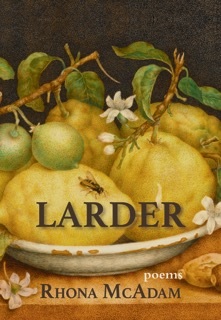
In her latest collection, Rhona McAdam navigates the dark places of human movement through the earth and the exquisite intricacies lingering in backyard gardens and farmlands populated by insects and pollinators, all the while returning to the body, to the tune of staccato beats and the newly discovered symmetries within the human heart.
“…A beautiful, filling collection, Larder is a set of poems to read at the change of the seasons, to appreciate alongside a good meal, and to remind yourself of the beauty in everything, even the things you may not appreciate before opening McAdam’s collection….”
Rhona McAdam is a writer, poet, editor, and Registered Holistic Nutritionist with a Master’s in Food Culture from Italy and a deep-rooted passion for ecology and urban agriculture. Her work spans corporate and technical writing to poetry and creative nonfiction, often exploring the vital links between what we eat and how we live. Based in Victoria, BC, and available via Zoom, Rhona is always open to new writing commissions, readings, or workshops on nutrition and the culinary arts.