-
Food for hungry brains – Capra and Counihan
Read Full Post: Food for hungry brains – Capra and CounihanRecently I posted a link to Time’s What the World Eats feature (and later found a related article), and have since found an NPR radio feature on the book (Hungry Planet) that these images come from. The NPR page features some interesting background and interviews with the photographers, who enlisted an impressive list of writers to flesh the book out, including Marion Nestle, Alfred W. Crosby, Francine R. Kaufman, Charles C. Mann, Michael Pollan, Carl Safina, and even our upcoming lecturer Corby Kummer.
Last week we had four things to occupy our minds. Still reeling from Serge Latouche‘s lectures, we were offered some therapeutic time in the kitchen with Barny Haughton, as previously reported. Then we had two head-spinning days with Fritjof Capra, a day of gelato, and a concluding meeting with Carole Counihan. I have covered the gelato day separately.
Speaking mainly from his book, The Hidden Connections: A Science for Sustainable Living, Capra explained his theories about food’s systemic role, from the molecular to the environmental level. In brief, he said his view was all about ecosystems; that every living thing – even a cell – is part of a system, and we consider anything in isolation at our peril.
He also expanded on the point that had brought him to Carlo Petrini’s attention: that living things are divided and defined by food. For example, the two categories at the base of the kingdoms, bacteria and protists (single celled nucleated mechanisms), ingest food through semi-permeable cell membranes; the intake of food actually determines the molecular (biological) identity of the cell. Distinctions between the other three kingdoms – fungi, plants and animals (humans) – are also through food. Plants are defined through photosynthesis; fungi send enzymes outside the organism, digest the food outside the organism and then ingest it in digested form. Animals ingest and then digest food. In the human realm: biologically we are animals, but for us food also has its cultural dimension – which we share through communal, social and cultural events. So, he argued, you need to understand cognitive as well as cultural elements to fully understand human relationships with food.
He talked as well about the globalised world: its foundation on the whims of electronic investors, which he described as a global casino. No longer, he said, are companies measured by ‘bricks and mortar’, but by their place in ‘analyst expectations’ – which can change in a moment with immeasurable impact on the lives of the real people who work for those companies, while enriching a global elite. Like us, he had been greatly affected by the film Life Running Out of Control, and its message about our unprecedented destruction of and genetic tampering with existing life forms.
So: to survive on this planet, we must change the rules of the game, he says. The underlying principle that making money is the only company value is outdated and dangerous. Human values are not laws of natures; they can be changed. He urges us to consider a new global civil society, built on networks and an underlying pair of basic values: human dignity – the right to shelter, housing, food, security, free speech, educational and religious freedoms; and ecological sustainability.
Implementing this kind of change includes three areas: addressing the negative impact of globalisation, reshaping governing rules and institutions, through such organisations as the International Forum on Globalisation; agroecology, reshaping food and agriculture, oppositn genetically modified foods and promotion of sustainable agriculture through such organisations as Slow Food; and ecodesign, redesigning technology, buildings and physical structures for sustainability, through such institutions as the Rocky Mountain Institute.
It was a relief to have some tangible resources to explore and find concrete ways to counter the bleak global vision we’d been thinking and talking about. It made me think some more about what and how I think about food; and sustainability and ecosystems have got to have more to do with the total picture.
Barny Haughton had asked if we felt optimistic about the potential for people, companies, countries to change, even in the midst of unassailable evidence of environmental damage. He didn’t get much of an answer, but he himself observed rather bleakly that from his experience he thought people unlikely to change unless forced to do so.
Indeed. We can talk till we are blue in the face about the need for change, but will we give up our cars, our pre-packaged convenience foods, our comfortable heat and cold, our plastics and fossil fuels? Just one more little car ride to the mall when we could have walked. Just one glass bottle we can’t be bothered to wash for the recycling. Just one more package of pre-washed salad with individual portions of inedible dressing, all in full plastic armour. Who else can stop it?
We had concluding food anthropology meetings with Carole Counihan, who shared her research into food cultures in the San Luis Valley of Colorado, and had us share our mini-research (observation studies of local food-related places) with her. Mine was the quirky and I think laudable Progetto Latte, one of several interesting enterprises of the Bertinelli family.
-
Gelatorama
Read Full Post: Gelatorama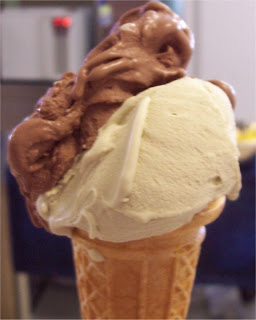
We spent Thursday at Gelato U, learning some things from the gelato equipment manufacturer Carpigiani, near Bologna. What did we learn? Hard to say. In a course really designed for companies who’d bought the incredibly expensive (25,000-35,000 euros for the basic gelato maker) equipment, we were given recipe after recipe for making four or five kilos of gelato at a time.
The instructor began with some distinctions between “ice cream” and “gelato”. Ice cream, he said, was made in high volumes, and so could not use fresh ingredients, but tended to use industrial flavourings. Gelato on the other hand, could be and was made artisanally (his definition of artisanal: not necessarily made at home, or even by hand, but in small quantities), with fresh ingredients. Another main difference was the over-run, which was 100% in ice cream and more like 45-50% in gelato; this turned out to mean the volume of air pumped into the final product by the industrial — err, artisanal? mixer/freezer. And a final difference was the fat and sugar ratio: gelato is lower in fat but higher in sugar than ice cream. He observed that higher fat doesn’t automatically result in a softer product, since fat freezes solid, so the serving temperature will have more to do with its texture than anything.
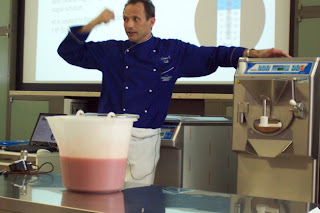
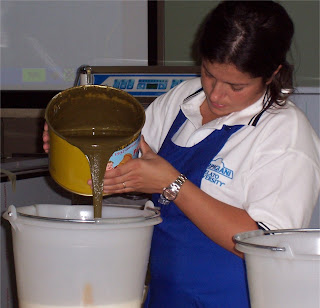
After dutifully noting all that down, we had to wonder anew what was really meant by ‘fresh ingredients’ when we watched the making of gelato. Yes, fresh fruit was used. But so was a powder which included stabilisers and emulsifiers, and protein, in the form of milk powder. And we were told that although fresh milk is a good ingredient, you could as easily use UHT or sterilised milk. To add fat, you could use fresh cream, but you could also use butter (as long as it was industrially-produced butter, made by centrifuge, and not the lower-tech kind made by skimming, as this could introduce bacteria into the mix). And all kinds of calculations come in when adding sugar: dextrose, sucrose, fructose all have different degrees of sweetness which must be balanced with the sugars introduced by fruit or other flavourings. The instructor spoke fondly of the companies who have laboured long to save the gelato maker the toil and trouble of crushing his own pistachios, and produced a neat tin of flavouring ready to pour. Here we see a nice can of hazelnut going into the mix.
The original gelato recipe, which originated (in Italy!) consisted of: milk, sugar and egg yolks. Apparently eggs are not used much now, because they make the gelato taste, well, eggy. Which is apparently a bad thing when you want to make it taste of many other things. So, gelato makers have isolated the functions that eggs served (fat to add texture and bind ingredients, protein to add structure, emulsification to smooth things out) and introduced powdered substances that may include alginates, pectins, starches, xanthan gum, gelatin, lecithin, guar gum and carageenan (identified by E numbers). The one gelato flavour that is still allowed to taste, or at least look, eggy is Crema, which is really only ‘custard’ flavour, and I had to wonder if fresh eggs are ever involved…
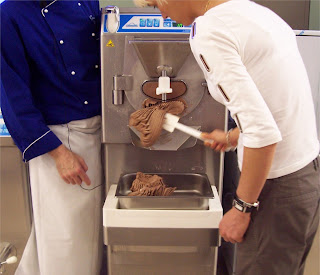
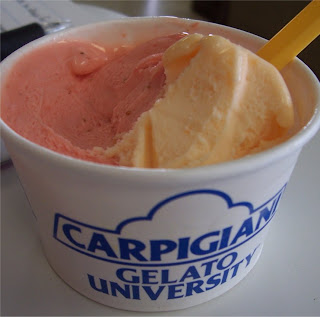
We sampled both sorbet (below, in lemon) and gelato (above, chocolate). In the demonstration we saw, the mix for the gelato needs to be ‘aged’: the milk, cream, stabilisers, emulsifiers, protein and sugars are combined, heated to 85 degrees celcius and then cooled, ideally overnight, before adding flavourings. This improves the texture, allows the mixture a longer shelf life (three days) and improves the flavours. Quite, well, all those powders after all; we did not learn whether if you used old fashioned ingredients like milk, eggs and sugar, the flavours would meld without aging.
A few other distinctions we learned: sorbet (sorbeto, sorbetto) is gelato made with water instead of milk; granita is gelato without the air (from mixing), stabiliser and emulsifier (it’s slush, basically); and semi-freddo (aka gelato caldo or gelato alto) is made with vegetable fat. Not sure about the last definition; I think the term semi-freddo, or indeed semifreddo, is used differently by different people: I’ve seen it used for various frozen desserts.
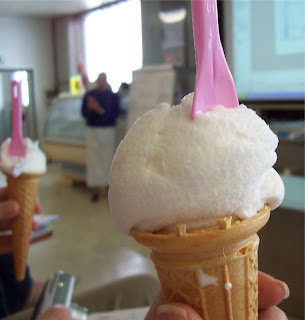
The verdict? Disappointing. The flavours ranged from bland to unbalanced, the texture fatty. The words “artisan-made gelato” will not impress any of us in future, since all they mean (as in fact we’d heard as well from another of our lecturers) is that the seller has mixed his batch of formula, from what we know now are bags of stabilisers and powdered milk, and poured it into his expensive machine in small quantities, and put it into the display case at what we hope are frequent intervals. The skill, I suppose, lies in the chemical skills of the mixer, the kind of milk and cream used, and the intensity, purity and freshness of the flavourings. Further research at Grom, K2 and other favourite outlets will be needed. We are all off to Piemonte next week and I hope will have occasion to revisit the excellent cafe/gelateria in Bra that we stopped in on a cold day back in March, which features some dazzling Presidia flavours.
-
We cook lunch
Read Full Post: We cook lunchHaving spent the weekend in the environmental vale of despond, we faced Monday with chef Barny Haughton, who talked about the efforts he and his more-than-a-restaurant Bordeaux Quay are making to live and work sustainably, modelling good behaviour as a restaurant and educational body. They aim to be carbon neutral within five years, having already invested in sustainable infrastructure and culinary techniques and following local food procurement policies (“if it grows in the West Country”, he says, “we don’t buy it elsewhere”).

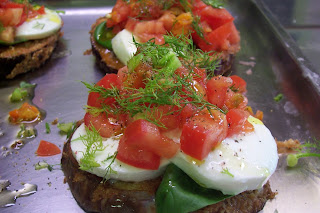
Tuesday, we all cooked together under Barny’s watchful hand, becoming one happy appetite making a communal lunch. We had been sent to the morning market to come in with a vegetable (or something) to contribute, and we had quite a feast: stuffed mushrooms, risotto milanese (made with fresh chicken stock), saltimbocca with salsa verde (with fresh herbs, anchovies, mustard, lemon, olive oil) aubergine towers, aioli with crudites, and a zucchini frittata.


In the process of making saltimbocca Barny explained a bit about the veal education campaign, which is to try to communicate to people who drink milk or eat cheese that they are actually forcing the production of veal, which it has become unfashionable to eat. If they then refuse to eat it, you end up with the situation as it is in England where the calves that are needed to initiate milk production are either shot and buried on the farm or shipped to Italy. This is not to minimise the brutality that has been exercised on veal calves in the past, but to say that veal is to beef what lamb is to mutton; people who eat lamb without qualm should be equally prepared to eat veal rather than perpetuate the waste of life that exists now amongst a confused public.



Latest Posts
- Writers at Word!
- Sublime and Twisted Readings coming up!
- Sublime
- Good weather for reading
- The world, the world
- Sublime launch!
Aldeburgh Poetry Festival Barny Haughton BBC BC poets Berkswell blackberries Black Stilt Bologna book launch Borough Market Carlo Petrini Catalonia Cyrus Todiwala dairy Daunt's Books Dijon Edinburgh Fanny Bay Feast of Fields Food and Morality food history food journalism Jenna Butler lardo Malahat Review Michael Pollan Okanagan olive oil tasting olive trees Omnivore's Dilemma Our Food Our Future Oxford Parmigiano-Reggiano Planet Earth Poetry poetry poetry readings Poetry videos prosciutto salumi Sean O'Brien Suffolk ticks Wendy Morton Wired Writing Yvonne Blomer

In her latest collection, Rhona McAdam navigates the dark places of human movement through the earth and the exquisite intricacies lingering in backyard gardens and farmlands populated by insects and pollinators, all the while returning to the body, to the tune of staccato beats and the newly discovered symmetries within the human heart.
“…A beautiful, filling collection, Larder is a set of poems to read at the change of the seasons, to appreciate alongside a good meal, and to remind yourself of the beauty in everything, even the things you may not appreciate before opening McAdam’s collection….”
Rhona McAdam is a writer, poet, editor, and Registered Holistic Nutritionist with a Master’s in Food Culture from Italy and a deep-rooted passion for ecology and urban agriculture. Her work spans corporate and technical writing to poetry and creative nonfiction, often exploring the vital links between what we eat and how we live. Based in Victoria, BC, and available via Zoom, Rhona is always open to new writing commissions, readings, or workshops on nutrition and the culinary arts.
