-
Piemonte Wednesday
Read Full Post: Piemonte WednesdayWe had a morning at the Pollenzo campus with some of the Slow Food folk on Wednesday. Representatives of the Slow Food International, Slow Food Editore and the Foundation for Biodiversity gave us a talk on their mandates and activities. It was a helpful boost to our understanding, half a year since our last talk from them, and was particularly useful for classmates hoping to do internship postings with the organisation. We left for Bra, where the offices and our lunch were waiting.

Where it all began: the restaurant in Bra where the Slow Food movement became a reality.

Italian sushi, quipped Piero Rondolino, who joined us for lunch. We had lardo, salsiccia di Bra – a delicately spiced raw veal sausage, and carne cruda battuta al coltello (raw, hand-cut veal). All delicious.
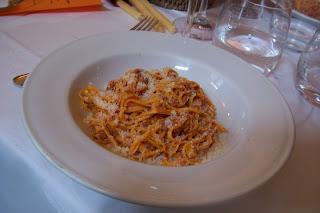
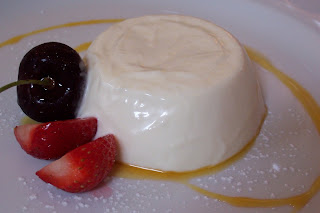
Then some pasta, followed by the best panna cotta in the world? Maybe, surely in the running, lots more research needed. It was sweet, soft, delicate. Creamy but not too rich. And very pretty.
Back on the bus, after a shuffle round the hot, closed-for-lunch town, and away we sped towards our final Italian winery in San Martino Alfieri. Not sure what was ahead, we strolled up the path…
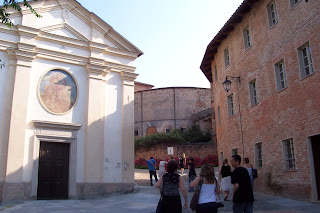
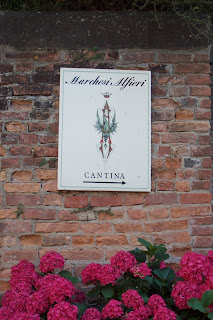
Heading in the right direction for Marchesi Alfieri winery…
A very old grapevine (for table grapes)
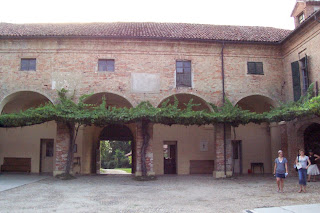
And hey presto there we were in a castle with beautiful grounds, meeting our winemaker Mario Olivero, who gave us another talk about my beloved Barbera, which is the main one of the several varieties of red wines they produce. A neglected grape, it was dismissed as fit only for table wine until about fifteen years ago, when a few and then many Piemonte winemakers began to take it seriously for its fruit and body and capacity for ageing. Now there are some 50 million bottles produced in the region, and it’s the area’s second most important variety. We sampled a couple of different years each of Marchesi Alfieri’s Alfiera and La Tota wines, and yes they were very good indeed.
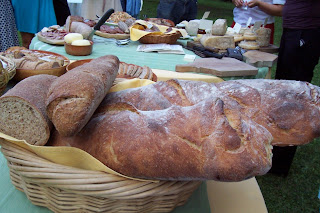
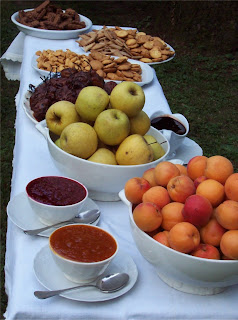
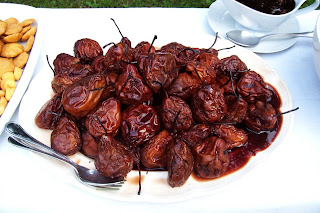
After the cellar tour, Marco introduced Elena Rovera, from Cascina del Cornale, the organic cooperative that is an agriturismo, restaurant and seller of organic products, situated in Magliano Alfieri, between Alba and Asti. And what a spread she put on for us…

-
Piemonte Tuesday
Read Full Post: Piemonte Tuesday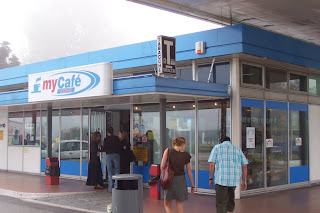
Breakfast on the road. Only at the best eateries in Italy? Surprised us all by having what might be the best croissants we’d ever tasted.
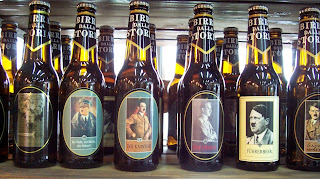
Unfortunately good taste did not extend to their selection of Hitler beer and dictator wines…
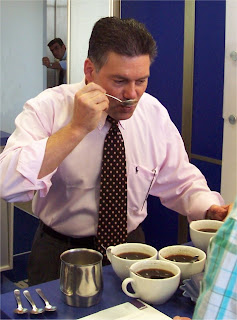
We arrived in Torino ready for our day of coffee at the Lavazza Training Centre, and sure enough we were coaxed into our seats after lashings of freshly made Lavazza espresso. After a morning learning about the ins and outs of Italian coffee production and marketing, and a bit of the bean’s history and geography, we went for a tasting session of a dozen different coffees, both robusta and arabica varieties.
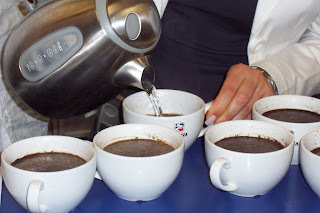
There was a dramatic difference between all of them, tasted side by side like that. Under the natty tutelage of the company’s Golden Palate, we learned the sniff ‘n slurp method of coffee tasting, and heard about the differences between wet and dry processing: washed and unwashed beans, and the various ways of preparing them for roasting. We got a whole new tasting vocabulary, learning new defects like quakery, grassy, woody and fermented.
Lavazza has the biggest roasting operation in Italy and the lion’s share of the domestic market, and so it’s important to keep pressing forward to stay ahead of the competitors (…can I resist saying: in the poisonous growth economy we find ourselves in?) and we heard about a few of the new product lines, which ranged from worthy to silly. Many of them were spawned (and as you will shortly see I use the word advisedly) through the company’s partnership with Spanish foam-meister, chef Ferran Adria.
Here we see the Coffeesphere, a bit of complicated nonsense to create a hit of sweet, gooey coffee substance that has the shape and texture of a soft-boiled egg yolk.
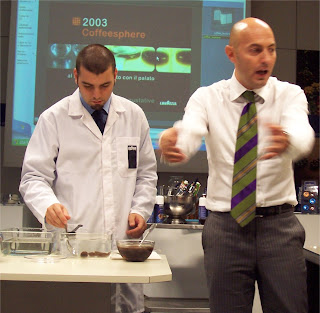
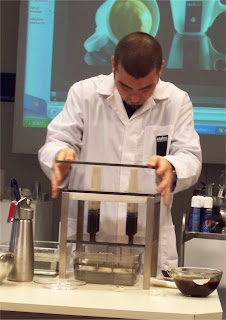
And syringes, perforated plexiglass slabs and a snappy lab coat are required to make the same thing, only smaller, so they can call it coffee caviare.
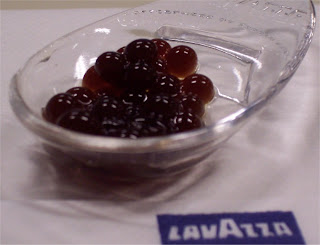
There was also a sweet, sticky foam coffee that came out of a nitrogen canister, like the ones restaurants use for whipped cream, making something called Espesso that, being foam, is the coffee that doesn’t spill. They’ve even designed a special coffee spoon with a hole in the middle as if to prove to skeptics that it really isn’t a liquid anymore. Well, maybe in a market that finds Italian television watchable it could work, I don’t know.
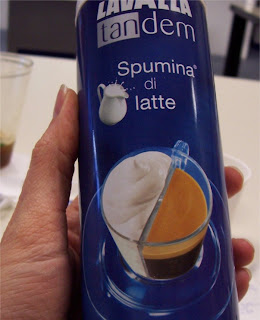
And this miracle of twentieth century necessity: your very own tube of UHT milk foam for those moments of crisis when you must have spuma (foamed milk) now now now. If that’s the sort of thing that amuses you, you might want to invest in a special plastic cup with a divider in the middle to drink it from. I guess what I found most disturbing about the innovation section was the amount of packaging and plastic and all round waste it was generating for the sake of stimulating a saturated market. We’re a long way from a simple coffee bean here.
The company has other promotional devices, like their vamped up girlie calendar (shades of Italian television with its partially dressed presenters) that made me feel less and less Italian by the minute. But produces some excellent print publications. And there’s its worthy sustainability project, Tierra, which lets the company pump a bit of money and development aid back into coffee-growing economies. Long may that project last.
We finished our day with a tour of the highly automated factory, dodging unmanned forklifts and miles of conveyor belts, and pondered the acres of warehouse with its robotic shelf-stockers gliding silently up and down the towers of packaged coffee, reading bar codes and pulling pallets out and putting pallets in. Surreal and strange and not a little overwhelming.
And then we were turned out for a free hour or so in the hot streets of Torino – everything having just shut for the evening – until it was time for supper at Pizzeria Le Rondini, with its decidedly, and thankfully, manual production methods.
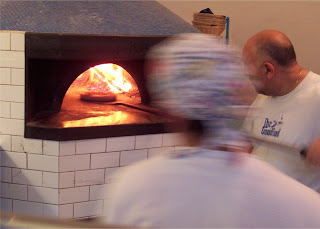
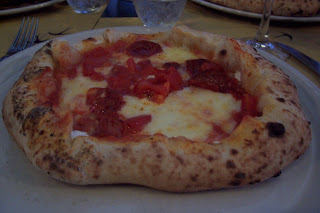
Many of us had the house specialty, which had a thick, chewy crust filled with fresh ricotta, and topped with buffalo mozzarella, fresh tomatoes and salami.
We dined with Piero Rondolino, owner of Tenuta Colombara, a farm which produces the estimable Acquerello Rice, whose business we sadly didn’t get to visit. He grows the prestige risotto rice variety, Carnaroli, and ages it to give it better flavour and texture. It’s an organic business, and he uses a number of creative methods to manage it; he told us about the dragonflies they introduce to the fields to eat the mosquitoes that breed there.
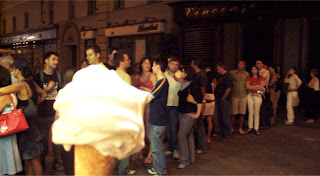
After supper, a few of us slipped away to bide our time in the neverending summer evening queue at Grom‘s mother ship.
-
Piemonte Monday
Read Full Post: Piemonte MondayWe had four busy days exploring Piemonte (Piedmont), in north-western Italy. We made an early start from Parma and lunched in Pollenzo, at the campus cafeteria of the first and other campus of our university, and were able to exchange notes with a couple of students on the degree course, which lasts three years and has a much higher enrollment (60) than our master’s program. The first group of students in this program is due to graduate this year, after many travels and many experiences. It’s an expensive proposition, but even so the tuition only covers half the expenses: with tours stretching as far afield as India, Australia and Scotland, it can be pricey and complicated to administer.
After lunch we met the first of two winemakers from the region. Michele Chiarlo specialises in two famous Piemonte grapes: nebbiolo and barbera. I had fallen in love with Barbera wine this year so was thrilled to taste a couple of excellent examples, and some excellent Barolo, while hearing about the winery’s operations from oenologist Stefano Chiarlo. The interesting details he explained included setting the corks (only natural ones – like others we’d met, he maintained that artificial materials don’t work in wines that need to age in the bottle more than three years) with the bottles upright; after two weeks, the bottles are all turned by hand into the horizontal position. He feels this keeps the cork in better condition for aging.

After the tour and the tasting, we had a particular treat when he took us up into the hills to see a barbera vineyard. He told us about the green harvest, which is the pruning, over the summer, of excess grapes, so that the plants can pour their energies into producing more concentrated flavours in the remaining bunches. He also explained that the vineyard had originally been owned by Tuscans, who brought the cypress trees in the background, which are now about 250 years old.
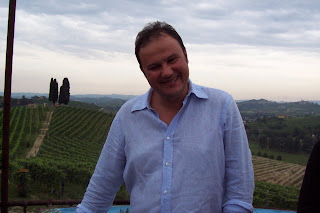
His family are art lovers, and there were some very cool things to see alongside the grapes.

New takes on an old tradition which posted heads on every road, as protection against malady. Note the ubiquitous rose bushes which here too play their important role in predicting fungal attacks.
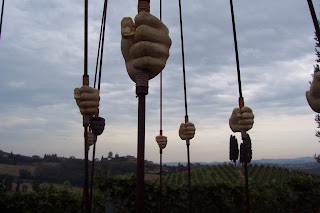
They also host a summer festival in the vineyard, with music and wine.
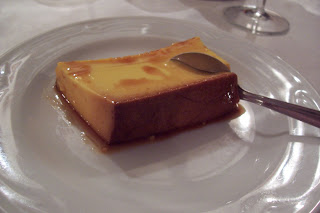
That evening we were treated to dinner in a special osteria, the Ristorante ‘Belbo Da Bardon’ where we had some excellent meat-filled pasta, some very tender veal with broad beans, and a lovely slab of creme caramel.




Latest Posts
- Writers at Word!
- Sublime and Twisted Readings coming up!
- Sublime
- Good weather for reading
- The world, the world
- Sublime launch!
Aldeburgh Poetry Festival Barny Haughton BBC BC poets Berkswell blackberries Black Stilt Bologna book launch Borough Market Carlo Petrini Catalonia Cyrus Todiwala dairy Daunt's Books Dijon Edinburgh Fanny Bay Feast of Fields Food and Morality food history food journalism Jenna Butler lardo Malahat Review Michael Pollan Okanagan olive oil tasting olive trees Omnivore's Dilemma Our Food Our Future Oxford Parmigiano-Reggiano Planet Earth Poetry poetry poetry readings Poetry videos prosciutto salumi Sean O'Brien Suffolk ticks Wendy Morton Wired Writing Yvonne Blomer
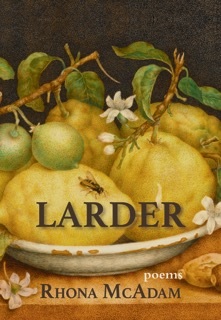
In her latest collection, Rhona McAdam navigates the dark places of human movement through the earth and the exquisite intricacies lingering in backyard gardens and farmlands populated by insects and pollinators, all the while returning to the body, to the tune of staccato beats and the newly discovered symmetries within the human heart.
“…A beautiful, filling collection, Larder is a set of poems to read at the change of the seasons, to appreciate alongside a good meal, and to remind yourself of the beauty in everything, even the things you may not appreciate before opening McAdam’s collection….”
Rhona McAdam is a writer, poet, editor, and Registered Holistic Nutritionist with a Master’s in Food Culture from Italy and a deep-rooted passion for ecology and urban agriculture. Her work spans corporate and technical writing to poetry and creative nonfiction, often exploring the vital links between what we eat and how we live. Based in Victoria, BC, and available via Zoom, Rhona is always open to new writing commissions, readings, or workshops on nutrition and the culinary arts.