-
GM food labelling in Canada – no, no, and no
Read Full Post: GM food labelling in Canada – no, no, and noAccording to the note I received from my MP today, Bill C-517, which proposed mandatory labelling of genetically modified foods in Canada, did not pass second reading on May 7th 2008. I suppose this gives us a fair sense of which interests are running our country, and the public interest is not being considered. Now would be the time to write to your MPs and tell them to try again. I don’t think they heard us the first time. Or the second.
-
Still crawling
Read Full Post: Still crawlingThis feels like about my fourth springtime this year; where I am today, the Qu’Appelle Valley is starting to green.


Last night being chef’s night off, we went to Regina, to the Mediterranean Bistro where the 4-cheese tortellini looked somewhat better than it tasted (seriously overwhelmed by smoked salmon and dill, and using pretty ordinary tortellini; the asparagus was the best thing in it..)

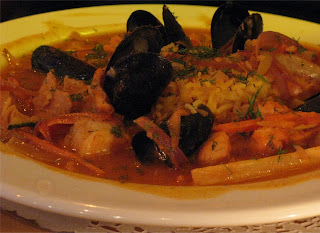
I couldn’t see much to choose from if you have issues about industrial food: a lot of chicken on the menu with nothing to defends its origins. Maybe next time I’ll try the bouillabaisse, which had a pretty nice fennel broth to commend it… setting aside for one evening my many questions about the origins of the prawns.
This morning I picked up a couple of books of poetry from the Sage Hill library, and found a (now deceased) female American Dog Tick (Dermacentor variabilis)


hanging onto a corner of Worn Thresholds, by Julie Berry.
-
Some words from literary editors
Read Full Post: Some words from literary editorsOne of my co-colloquiists brought along the latest issue of Poets & Writers, in which is a topical article for all of us here, called Putting Your Poetry into Order. And an even more irresistible (to me) feature: Through the Eyes of the Editors, in which three literary magazine editors speak to us.
Stephanie Fiorelli discusses a fairly new magazine she co-founded, Avery, going for three years; unusually for a literary journal, it’s independent, non-profit and publishing nothing but short stories. She and her fellow editors also maintain a blog to open up some of what goes on to produce such a publication.
Essayist and poet David Hamilton, who’s been editing the Iowa Review for thirty years, talks about general changes and the impact of university-isation of literary journals over the years: escalating numbers of submissions (10,000 poems received each year of which 120-150 can be published); ‘go-team’ competitive sensibilities between academic-run journals.
Most interesting to me was the piece by poet Stephen Corey, who edits the Georgia Review (and who co-edited an anthology I highly recommend, Spreading the Word: Editors on Poetry) who said a number of thoughtful things. He estimates having received something like 200,000 poems, 50,000 short stories and 15-20,000 essays during his 25 year involvement with the magazine. He goes on to say
“that these statistics are misleading and unnecessarily intimidating, because the bulk of what we receive is not very good at all. The competitive pool is very small, and across the past 25 years I have not seen any appreciable increase in its relative size, despite burgeoning creative writing programs, spell-check and rudimentary grammar-check software, summertime writers conferences, private writing mentors, and online writing workshops.”
He says the number of non-fiction submissions has massively increased,
“except that most of the pieces we receive are not essays anymore, but autobiographical narratives and reminiscences that read more like sentimental journal entries than thoughtful and rigorous considerations of experiences”
And that although the number of poems submitted hasn’t changed much, the number of short stories has dropped, but perhaps this is because
“I think the publishing industry has worked over-time of late to eradicate the short story form, and I think some of the writing programs may have been helping too. Story cycles, linked stories, novels-in-stories – all these au courant designations are attempted end-arounds in the pro-novel, anti-short story game of book marketing.”
His advice to writers is in tune with the overall tone of our time: to slow down.
“Any person who writes one great poem or story or essay per year for twenty years will take his or her place on the short list of the finest writers of all time. Slow down. Read voluminously, year after year, both for pleasure and to be reminded of all that you must not do, and all that you must exceed, in order to make your own special, indelible mark… Never to be forgotten once read – isn’t that what we must seek?”


Latest Posts
- (no title)
- Sublime and Twisted Readings coming up!
- Sublime
- Good weather for reading
- The world, the world
- Sublime launch!
Aldeburgh Poetry Festival Barny Haughton BBC BC poets Berkswell blackberries Black Stilt Bologna book launch Borough Market Carlo Petrini Catalonia Cyrus Todiwala dairy Daunt's Books Dijon Edinburgh Fanny Bay Feast of Fields Food and Morality food history food journalism Jenna Butler lardo Malahat Review Michael Pollan Okanagan olive oil tasting olive trees Omnivore's Dilemma Our Food Our Future Oxford Parmigiano-Reggiano Planet Earth Poetry poetry poetry readings Poetry videos prosciutto salumi Sean O'Brien Suffolk ticks Wendy Morton Wired Writing Yvonne Blomer
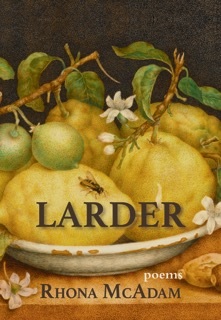
In her latest collection, Rhona McAdam navigates the dark places of human movement through the earth and the exquisite intricacies lingering in backyard gardens and farmlands populated by insects and pollinators, all the while returning to the body, to the tune of staccato beats and the newly discovered symmetries within the human heart.
“…A beautiful, filling collection, Larder is a set of poems to read at the change of the seasons, to appreciate alongside a good meal, and to remind yourself of the beauty in everything, even the things you may not appreciate before opening McAdam’s collection….”
Rhona McAdam is a writer, poet, editor, and Registered Holistic Nutritionist with a Master’s in Food Culture from Italy and a deep-rooted passion for ecology and urban agriculture. Her work spans corporate and technical writing to poetry and creative nonfiction, often exploring the vital links between what we eat and how we live. Based in Victoria, BC, and available via Zoom, Rhona is always open to new writing commissions, readings, or workshops on nutrition and the culinary arts.