-
GM food labelling – the debate
Read Full Post: GM food labelling – the debateAt last, I thought, some coverage of the bill c-517 debate on national radio! But no, I later realised I was tuned to Village 900 which was broadcasting a May 22 episode of an excellent program from Kootenay Co-op Radio called Deconstructing Dinner.
It was fascinating to hear the politicians who voted down the bill try to explain why they had done so. Listen for yourself; despite numerous polls which show Canadians want to know what they’re eating, too many politicians doggedly maintain they think it would be harmful to Canadians to be able to distinguish between GM and non GM foods.
You can read the debates in the Hansard: April 3 and May 5. See for yourself who said what, and who said nothing. Pretty interesting reading. As was the email I received from my MP who assures me he believes “in using a precautionary principle with regards to genetic engineering”. Apparently this precaution does not extend to labelling those precaution-worthy food items, since he voted against the bill.
Anyone in the neighbourhood wanting to talk more about this issue should come to the Slow Food Vancouver Island discussion on July 9.
-
Clam spotting
Read Full Post: Clam spottingA pleasant afternoon in Maple Bay today.


Had an enlightening walk on the beach at low tide revisiting some of the bivalves of my youth, and a newcomer.
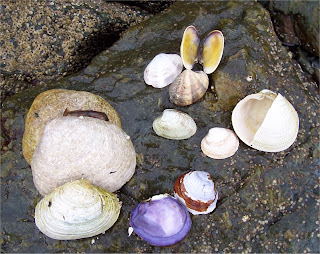
When I were a lass, the Manila clam (Venerupis philippinarum) was everywhere we poked our shovels; I remember chasing their spouts to gather a bucketful. They are colourful, with gradations of colour on the outside of their shells, and a line of purple on the inside. Gloriously tender when fresh, but not really that native: accidental immigrants from Japan in the 1930s who hitched a ride into our waters on oyster seed.
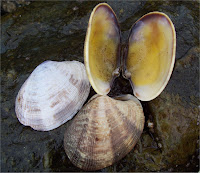
The unimaginatively named and rather pale cousin to the Manila, the good and hefty Native clam (aka Littleneck or Steamer or Protothaca staminea) has a healthy presence in ‘my’ bay.


Another you don’t see much is the Cockle, Clinocardium nuttallii.
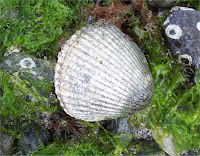
Butter clams – surprisingly large, their size reflected in their Latin name: Saxidomus giganteus – tend to live deeper than Native and Manilas.
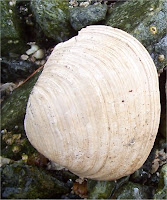
A newcomer from Japan, another freeloader (arriving in BC in the 1980s, in the ballast water of ships), the Mahogany (aka Purple Varnish or Nuttallia obscurata) is more fragile and therefore takes a beating in winter storms. The purple of the inner shell is more prominent the more freshly departed the clam. Lots of shells on the beach.


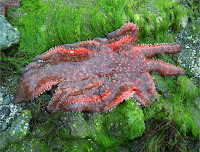
And then there were the starfish,

the sunfish,
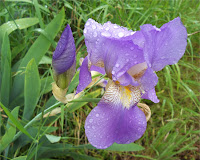
and the flowers.


-
More bees
Read Full Post: More beesNancy sent me this excellent article about the danger bees are in in this world of industrial farming, dependent on pesticides and monocultures. Several of the points were already made in Michael Pollan’s December article in the New York Times, and it was discussed in some detail on 60 Minutes last October as well, but I liked the links on this one, like the “10 things you can do to help honeybees” piece. I also came across this excellent site which has some interesting photos of varroa mites and what they can do to a hive.
Our bee-keeping class met one last time at the farm of our instructors. It was a good chance for the novice bee-keepers to ask some questions, and we got to see and do a number of things before sitting down to tea and cookies.
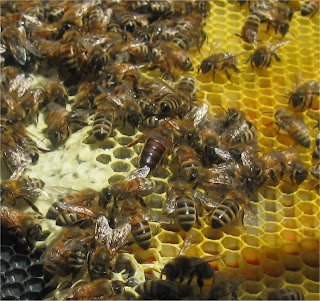
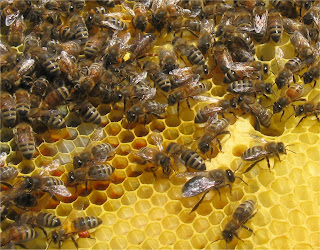
There was another lesson in marking queens. This picture shows why marking a queen is a good idea; this is a close-up of one side of a frame. Imagine hunting through both sides of 18-20 frames to find your queen. She can prove elusive, particularly if she is busy laying when you look, so she might be waist-deep in a cell and not all that conspicuous. Here you can probably spot her: she is in the centre of the picture with a longer darker abdomen than the others. It takes some practice to find her, particularly when drones are around as they are darker and longer, but have blunt back ends. This queen is surrounded by workers who are shorter and resemble her less.
Pick up your bee (these are drones, used for practice, and sent back to a life of humiliation and teasing by the other bees)…
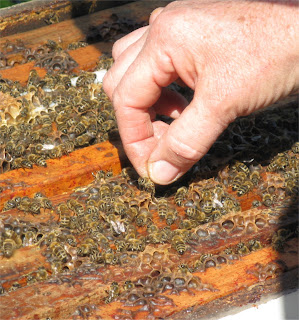
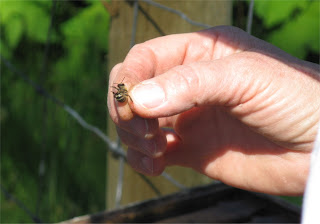
Transfer it to your other hand, holding its legs, and mark with a marker (different colours for different years: yellow queens, here, are ones that were born last year; this year we’re using red).
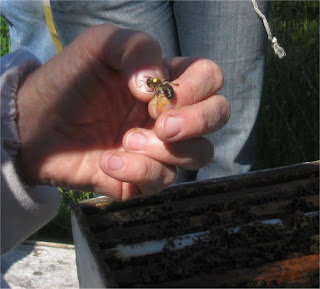
Eeeee, lemme go!
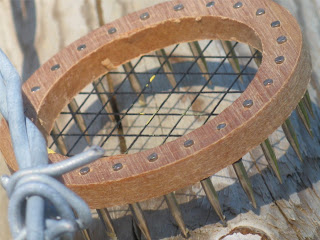
A clever device to trap and mark a queen without having to pick her up.
The marked queen – see the dot of yellow – is a little easier to spot in a crowd.
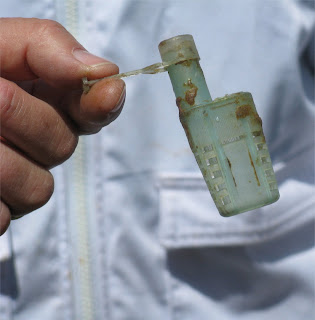
A couple of variations of queen cages: in both cases the cages allow transport or safe introduction of a queen to a new hive.

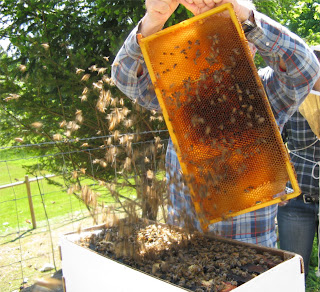
Larry thumps some bees. “They drop like jellybeans” he says.
Some very keen bees felt this half frame was too short, and built an extension on the bottom.

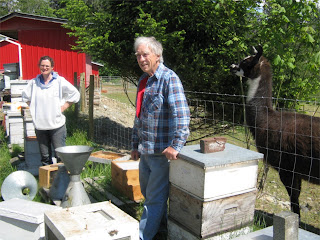
When Larry speaks, we all listen.
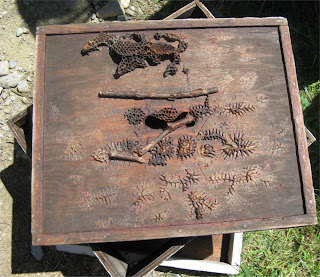
Bee art.
Eggs in situ: tiny but visible, like short bits of thread.
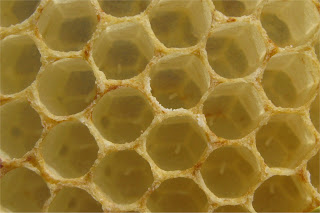
…and then they become larvae. More like shrimp at this stage.


Latest Posts
- (no title)
- Sublime and Twisted Readings coming up!
- Sublime
- Good weather for reading
- The world, the world
- Sublime launch!
Aldeburgh Poetry Festival Barny Haughton BBC BC poets Berkswell blackberries Black Stilt Bologna book launch Borough Market Carlo Petrini Catalonia Cyrus Todiwala dairy Daunt's Books Dijon Edinburgh Fanny Bay Feast of Fields Food and Morality food history food journalism Jenna Butler lardo Malahat Review Michael Pollan Okanagan olive oil tasting olive trees Omnivore's Dilemma Our Food Our Future Oxford Parmigiano-Reggiano Planet Earth Poetry poetry poetry readings Poetry videos prosciutto salumi Sean O'Brien Suffolk ticks Wendy Morton Wired Writing Yvonne Blomer
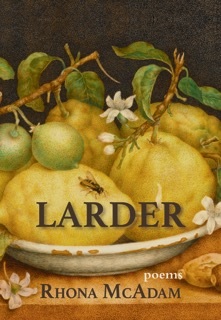
In her latest collection, Rhona McAdam navigates the dark places of human movement through the earth and the exquisite intricacies lingering in backyard gardens and farmlands populated by insects and pollinators, all the while returning to the body, to the tune of staccato beats and the newly discovered symmetries within the human heart.
“…A beautiful, filling collection, Larder is a set of poems to read at the change of the seasons, to appreciate alongside a good meal, and to remind yourself of the beauty in everything, even the things you may not appreciate before opening McAdam’s collection….”
Rhona McAdam is a writer, poet, editor, and Registered Holistic Nutritionist with a Master’s in Food Culture from Italy and a deep-rooted passion for ecology and urban agriculture. Her work spans corporate and technical writing to poetry and creative nonfiction, often exploring the vital links between what we eat and how we live. Based in Victoria, BC, and available via Zoom, Rhona is always open to new writing commissions, readings, or workshops on nutrition and the culinary arts.