-
Berries ‘n Cherries
Read Full Post: Berries ‘n CherriesI think while the fruit’s still with us, we should go on celebrating National Cherry Day in England! Read all about it at CherryBites, or join the CherryAid group on Facebook.
Over here, we too love cherries. Some of us might be lucky enough to be in Bruno for some sour cherries ‘n poetry… But if you can’t make that, how about heading to bing country in Kelowna for their festival?
A happy discovery on my walk the other day: it’s native (Rubus ursinus) blackberry season and I found a bowlful’s worth in a secret location.
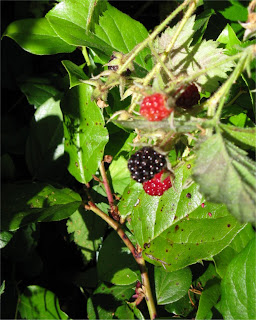
Smaller, sweeter and much less numerous than the Himalayan blackberries, which have overrun the Island, they pack an aromatic punch and flavour. After gorging on them (well paired with Udder Guy’s vanilla bean ice cream)
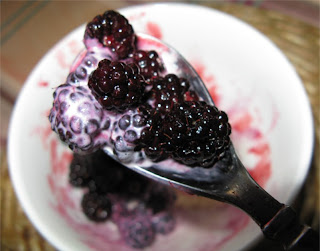
I’ve frozen a precious handful to wait for my Yellow Transparent crop to ripen, which won’t be long now. That will be one fine pie.
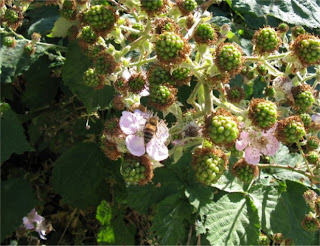
The Himalayans are still feeding the bees, and won’t be ready till later in August from the looks of things.
-
Bread and dirt
Read Full Post: Bread and dirtIt’s been a pleasant summer here at the Iambic Cafe. I’ve recently been on a bread binge, using the nearly no-knead bread recipe
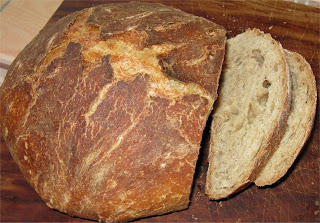
that was featured recently in Cook’s Illustrated – which I always pick up to read on the plane. The bread is refreshingly easy to make, as long as you plan a day ahead (it takes 18 hours resting time plus another couple of hours rising). And this one from the New York Times sounds very easy and convenient. I might start experimenting with levain breads; this blog entry gave me some inspiration.
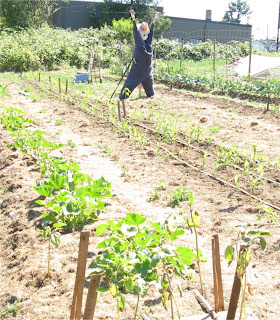
I also visited a couple of organic farms this week. Local Yokels is a group which provides an acre of cultivation, a cluck of chickens and a well-cleared blackberry trail to groups of children and adults with disabilities for use in therapeutic gardening. It’s a great example of how much can be achieved with very little: there’s a lot of innovation and re-use of building materials, augmented with organic growing practices like micro-drip watering and companion planting. The scarecrow, built by visiting children, is rather splendid.
Haliburton Farm is, thanks to citizen action, city-owned and volunteer operated. I took up tools for the cause
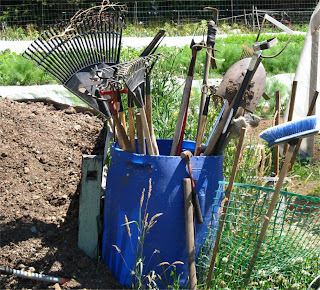
and weeded a patch of golden beets one sunny day. Nasturtiums dressed up one of the fields…
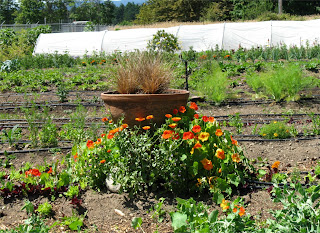
some laying ducks another.

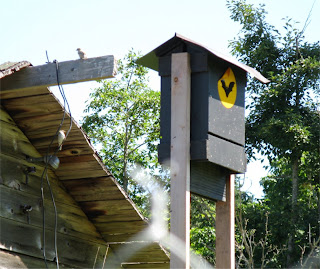
The university has been tending the wetlands area and installed a bat house
and a mason bee house.
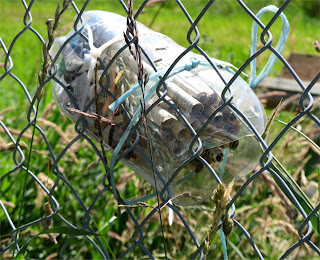
Only one of the tubes appeared to be filled when I peered in. The bees lay their eggs in the tubes, separated by their own mini-concrete walls, and when they fill a row they wall up the end, so you can easily see which ones are occupied.
-
Scared of our food
Read Full Post: Scared of our foodListening to the periodic updates on the salmonella in your fast food tomato (or is it the peppers or is it the salsa or what the heck is it anyway) made me run back to Michael Pollan for comforting words. His 2006 article (remember the spinach E. coli scare?), the Vegetable-Industrial Complex, has a lot to say to today’s issues and is worth revisiting, or just plain visiting if you missed it the first time.
If you don’t want to read the whole article, I like this bit in particular:
Wendell Berry once wrote that when we took animals off farms and put them onto feedlots, we had, in effect, taken an old solution–the one where crops feed animals and animals’ waste feeds crops–and neatly divided it into two new problems: a fertility problem on the farm, and a pollution problem on the feedlot.
Timely thoughts, now that we’re in the season of growing and farmers marketing. The trust that Pollan talks about with respect to produce he buys from stallholders he’s known and patronised for years is missing from what you pick up off a supermarket shelf, or from a fast food counter. And he makes another important point, one that small BC meat producers will recognise, about governments punishing small farmers in their efforts to impose safety measures on industrial-scale farming.
On that very topic, I happened upon a recent podcast of the always interesting Kootenay Coop Radio program, Deconstructing Dinner, which was about The Culture of Meat and features an interview with Susan Bourette, the author of Carnivore Chic: From Pasture to Plate, A Search for the Perfect Meat.


Latest Posts
- (no title)
- Sublime and Twisted Readings coming up!
- Sublime
- Good weather for reading
- The world, the world
- Sublime launch!
Aldeburgh Poetry Festival Barny Haughton BBC BC poets Berkswell blackberries Black Stilt Bologna book launch Borough Market Carlo Petrini Catalonia Cyrus Todiwala dairy Daunt's Books Dijon Edinburgh Fanny Bay Feast of Fields Food and Morality food history food journalism Jenna Butler lardo Malahat Review Michael Pollan Okanagan olive oil tasting olive trees Omnivore's Dilemma Our Food Our Future Oxford Parmigiano-Reggiano Planet Earth Poetry poetry poetry readings Poetry videos prosciutto salumi Sean O'Brien Suffolk ticks Wendy Morton Wired Writing Yvonne Blomer
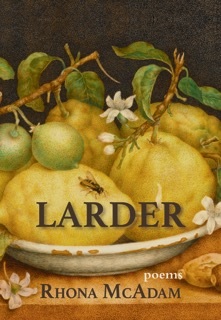
In her latest collection, Rhona McAdam navigates the dark places of human movement through the earth and the exquisite intricacies lingering in backyard gardens and farmlands populated by insects and pollinators, all the while returning to the body, to the tune of staccato beats and the newly discovered symmetries within the human heart.
“…A beautiful, filling collection, Larder is a set of poems to read at the change of the seasons, to appreciate alongside a good meal, and to remind yourself of the beauty in everything, even the things you may not appreciate before opening McAdam’s collection….”
Rhona McAdam is a writer, poet, editor, and Registered Holistic Nutritionist with a Master’s in Food Culture from Italy and a deep-rooted passion for ecology and urban agriculture. Her work spans corporate and technical writing to poetry and creative nonfiction, often exploring the vital links between what we eat and how we live. Based in Victoria, BC, and available via Zoom, Rhona is always open to new writing commissions, readings, or workshops on nutrition and the culinary arts.