-
Laureates, Bohemians and how do you like them onions
Read Full Post: Laureates, Bohemians and how do you like them onionsThe City of Victoria has appointed its first Poet Laureate: she is Carla Funk, Vanderhoof’s most famous daughter. In a city crawling with poets, I found it a little surprising that only eight threw their names in the ring (no, I did not). Perhaps the $1500 a year stipend dampened their passion.
According to a city development planner quoted in the article, Victoria stands at number 3 in North America on the Bohemian Index which ranks artistic and creative occupations of our residents. Actually that’s not entirely correct: in the information I found, we rank number 3 in a list adjusted for size – i.e. cities of 250,000 to 500,000 – behind Santa Barbara CA and Sarasota FL, and just above Madison WI and Albuquerque NM.
One of my favourite magazines is BBC Good Food, which I always pick up when I’m in England, or occasionally when I’m feeling flush in Canada. An issue from April 2005 surfaced in the magazine basket, and I read all about onions. We are told that we tear up when cutting onions because of allicin, although I found conflicting advice and more conflicting advice that the problem substance is actually a sulfide that breaks down into a volatile gas called syn-propanethial-S-oxide.
Whichever it is, the sulphuric compound produced when you slice the onion reacts with the moisture in your eyes to produce trace amounts of sulphuric acid, and the tears we produce to wash it away simply aggravate the problem.
The good news from plant chemistry is that “Allicin and syn-propanethial S-oxide have strong feeding deterrent activity toward herbivores such as insects.” Unfortunate that it doesn’t deter the feeding effects of carnivorous insects, but at least it supports folk wisdom about the benefits of planting garlic and onions around your rose bushes.
You can reduce the tearing effects by chilling onions before cutting. Alternatively, the Onion-USA site advises that the cells that release the sulfuric compounds are concentrated at the base of the onion, so you should cut the top and peel down without trimming off the root end until the last possible moment.
Or, like me, you could make sure nobody is around when you’re cutting and use a pair of safety goggles. I used to have a handy onion chopper that was no more than a jar with a chopping blade, and that worked well too. Looks like there are lots of variations of these devices on the market these days.
-
Fast food and dead metaphors
Read Full Post: Fast food and dead metaphorsWell, he talks so much that inevitably some of what he says is going to be rubbish. But bless him he works hard and has fired up a lot of people about food and eating well. Here’s my quote of the week, from Anthony Bourdain: “Fast food institutionalizes low expectations.” From an interview last January in Tyee Books. (He continues, “I said once that McDonald’s is like crack for children. And eating in proximity to clowns is never a good thing.” True words.)
I heard a radio program a couple of years ago where a Vancouver chef tried to do a Jamie Oliver and show kids how much better freshly prepared food was, by making macaroni and cheese from scratch and then letting them do a taste test. Just as Jamie found, many (most?) of the kids preferred what they were used to, namely Kraft Dinner.
Obviously. If your taste buds have been fine tuned by processed cheese powders and high levels of salt, why – indeed how? – would you be able to address the subtleties of real cheese? An authentic macaroni and cheese certainly won’t have the neon colouring or the gluey consistency these kids are used to either. They were trained to like this stuff by the people who bought and served it to them, without regard to the long term implications to their palates or health.
Just as we’ve been trained to expect cheap food, no matter the consequences. We have spawned and nurtured the Costco-Walmart generation, demanding bargains without regard to the quality of the cheap food, the environmental cost of shipping it from the cheapest markets, the crippling effects on local food production in poor countries, and the damage to local food production, processing and distribution industries in our own countries. I wonder what it is we buy with the money we save buying cheap food?
One thing I bought myself was a ticket to England for the writing retreat in Yorkshire, where I happened upon the second issue of The Poetry Paper, published by The Poetry Trust. In it, Donald Hall meditates at some length on dead metaphors, tagging his own with [DM] as he writes:
When we speak, when we write letters or newspaper headlines, we use dead metaphors and we understand each other. The dead metaphor is not a criminal activity – but it is an activity at odds with poetry. If a poem is to alter us, or to please us extravagantly, it requires close attention from both poet and reader. Close attention to language is the contract [DM] that writer and reader sign. The terms of the contract require that each word be fully used – so that its signification, implication, association and import may impinge upon us, move us, and reward intelligent attention.
He is evidently on the side of the fence [DM] (yikes it’s infectious!) that says poems cannot be translated into other languages – because their art lies in their multiple meanings and freshness.
Translation is a useful scam, so that languageless readers may gather notions of what Cavafy or Tu Fu are up to, but Frost’s ‘poetry is what gets lost in translation’ is a definition of poetry. Poetry lies in the minute shades [DM] that distinguish among words commonly known as synonyms. Poetry happens in the differences between the words listed together in Roget: ‘chaste, virtuous; pure, purehearted, pure in heart; clean, cleanly; immaculate, spotless, blotless, stainless, taintless, white, snowy; unsoiled, unsullied, undefiled, untarnished, unstained…’
He gives the nod [DM] to writing groups or at least friendly poem exchanges during the editing process.
Illness provides ten thousand wounds [DM] to the language, which Hall’s Index would nurse back to health [DM]. The dead metaphor is a cancer [DM] in the poem’s language which only revisionary scrutiny can cut out [DM]. We are crippled [DM] when we use ‘crippled’ except in its literal sense… It’s only in revision that we uproot [DM] the dead metaphors that inspiration provides – or we may need the help of friends… The brain notoriously overlooks its own errors while it discerns the errors of others.
-
Soho Square, June 2006
Read Full Post: Soho Square, June 2006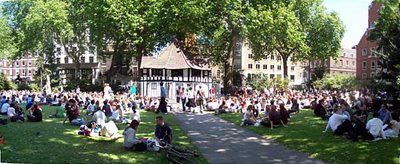
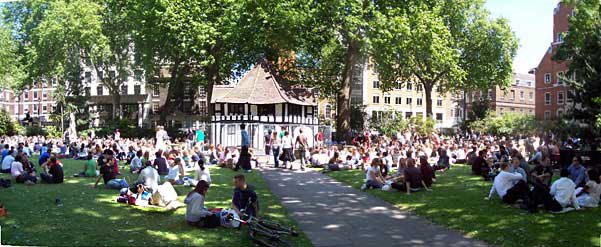
What it looked like on a sunny lunchtime in early June. (And what it looks like the rest of the time.)
Nineteenth try lucky — finally it posted! Why?? Why?? I don’t understand. As you see I tried everything. I guess Blogger just gets cranky with image files every so often and calls a halt.
My previous unedited posting read as follows: I have had to admit defeat: photo posting on Blogger no longer works for me, so I’m having to go through Flickr (which worked after several tries). On Blogger, I’ve tried everything I can think of – tweaking internet options, clearing cookies and temporary internet files, rebooting, uploading from files and urls, adding the url in the Edit Html box. Nothing works. Searched the help files and googled the problem. We must put it down to bad blogger photo karma. Any other suggestions for cures would be more than welcome.



Latest Posts
- (no title)
- Sublime and Twisted Readings coming up!
- Sublime
- Good weather for reading
- The world, the world
- Sublime launch!
Aldeburgh Poetry Festival Barny Haughton BBC BC poets Berkswell blackberries Black Stilt Bologna book launch Borough Market Carlo Petrini Catalonia Cyrus Todiwala dairy Daunt's Books Dijon Edinburgh Fanny Bay Feast of Fields Food and Morality food history food journalism Jenna Butler lardo Malahat Review Michael Pollan Okanagan olive oil tasting olive trees Omnivore's Dilemma Our Food Our Future Oxford Parmigiano-Reggiano Planet Earth Poetry poetry poetry readings Poetry videos prosciutto salumi Sean O'Brien Suffolk ticks Wendy Morton Wired Writing Yvonne Blomer
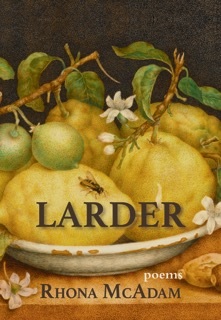
In her latest collection, Rhona McAdam navigates the dark places of human movement through the earth and the exquisite intricacies lingering in backyard gardens and farmlands populated by insects and pollinators, all the while returning to the body, to the tune of staccato beats and the newly discovered symmetries within the human heart.
“…A beautiful, filling collection, Larder is a set of poems to read at the change of the seasons, to appreciate alongside a good meal, and to remind yourself of the beauty in everything, even the things you may not appreciate before opening McAdam’s collection….”
Rhona McAdam is a writer, poet, editor, and Registered Holistic Nutritionist with a Master’s in Food Culture from Italy and a deep-rooted passion for ecology and urban agriculture. Her work spans corporate and technical writing to poetry and creative nonfiction, often exploring the vital links between what we eat and how we live. Based in Victoria, BC, and available via Zoom, Rhona is always open to new writing commissions, readings, or workshops on nutrition and the culinary arts.