-
Raspberries and Bakewell Tarts
Read Full Post: Raspberries and Bakewell TartsHaven’t had much time for poetry lately, but a poet still needs to eat, and I’m still trying to empty my cupboards and freezer of perishables.
I had a little lost jar of ground almonds begging to be used, and ditto a bag of frozen raspberries, so I conferred with Nigella who suggested a Bakewell Tart with Fresh Raspberries (from How to Eat). Bakewell tarts are usually a kind of jam tart with ground almond batter (frangipane) on top; they are equally nice as pies or individual tarts or plumped into cakes, and often to be found in English bakeries. Haven’t seen them in Canada, but maybe it’s because I don’t frequent bakeries so much.
Being surrounded by boxes and chaos I dispensed with Nigella’s home made pastry and pulled out a frozen pie shell which worked perfectly well, although because the shells are smaller than what the recipe called for, there was about a cup of batter left over. And since I was using frozen raspberries, they were quite juicy, so I drained off some of the juice (to save for my morning yogurt of course!) and mixed them with a dollop of jam rather than putting, as the instructions said, a layer of jam on the base. I managed to scorch the topping by adding the flaked almonds from the start of baking as instructed, but other recipes suggest adding the flaked almonds later on and I hope that will work better. So here’s my easy version with North American measurements.
Raspberry Bakewell Tart
1 frozen pie shell
1 cup frozen raspberries, thawed
2 tbsp (or to taste) raspberry or blackberry jam
1/2 cup butter
2 eggs
1 cup ground almonds
1/2 cup sugar
3-4 tbsp flaked almonds- Heat the oven to 400f.
- Mix the raspberries and jam together and partially drain, so it’s a jam-like consistency. Prick the pie shell.
- Melt the butter and set aside. Beat the eggs and almonds together and add the melted butter.
- Spread the raspberry mixture in the pie shell. Pour almond mixture over the berries.
- Bake 20 minutes, and then sprinkle the flaked almonds on top and bake for 15-20 minutes longer, until puffed and golden.
- Cool and serve either warm or at room temperature.
-
Pumpkin season
Read Full Post: Pumpkin seasonFor pottage and puddings and custards and pies,
Our pumpkins and parsnips are common supplies,
We have pumpkins at morning and pumpkins at noon,
If it were not for pumpkins we should be undoon.–Pilgrim verse, circa 1630
Please please please don’t waste your pumpkin by just using it for a candle holder: it is an edible and excellent food! I weep annually in this country for the pumpkins rotting in the fields on November 1st, when, as we must still repeat and repeat, there are people starving elsewhere in the world. Instead of meditating on such bad behaviour, why not reward yourself with a good meal of pumpkins? Such cheap food at this time of year, and easy to freeze as a puree.
Make your own equivalent to canned pumpkin from scratch, by baking it (like most squash it’s watery, so needs to be baked: boiling or steaming it will get you into trouble). Seed and cut the pumpkin in half or big chunks, without peeling, and bake it cut side down on a lightly oiled baking sheet at 350 F for about 30-40 minutes, until the flesh is tender when poked with a fork. Cool until just warm. Scrape the pumpkin flesh from the peel. Either mash, or puree in small batches in a blender. Freeze it in 1 cup containers if you can’t cope with anything more after all that effort.
- Make Pumpkin Soup with Toasted Sweetcorn from the blessed Delia.
- Serve it with some Banana Pumpkin Muffins or Curried Pumpkin Bread.
- Then have a Pumpkin-Pork Stew or a Lamb and Pumpkin Stew (or even a Vegan Pumpkin Stew) and/or maybe a Pumpkin Gratin,
- followed by some Pumpkin-Streusel Apple Cake or a Pumpkin Cheesecake on a ginger base or the amazing sounding Pumpkin Bread Pudding Brulee.
-
Edmonton’s Olive
Read Full Post: Edmonton’s OliveHere I am in the place it all began for me, poetry-wise, reading last night at a series run in part by my first poetry teacher, Doug Barbour. I’ve had a great few days here catching up with old friends and eating well. My ritual visit to the Bul-Go-Gi House took place on my first night, on a table groaning under the weight of excellent bulgalbi (bbq ribs), delightfully garlicky wonton soup with rice cakes, a lavish serving of jap-chae noodles, and more. The second night’s good eating was the Sunday buffet at Maurya Palace: everything was good right down to the kheer. I had a wonderful and very beautiful Mimosa Salad (butter lettuce, shrimp and a few other things) at the Ninth Street Bistro, around the corner from one of my many former homes in this town and next door to Laurie Blakeman’s constituency office. Not to mention sharing a wall with my evening reading venue, Martini’s Bar & Grill.
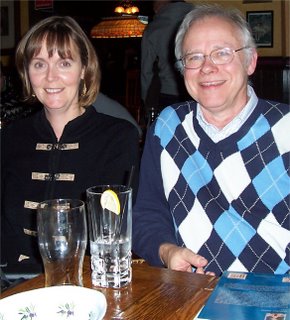
With Bert Almon, one of my two poetry profs – both great mentors and supporters for many years – at the University of Alberta, who currently teaches a whole new generation of poets at the U of A.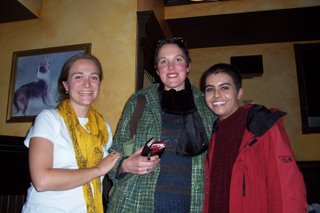
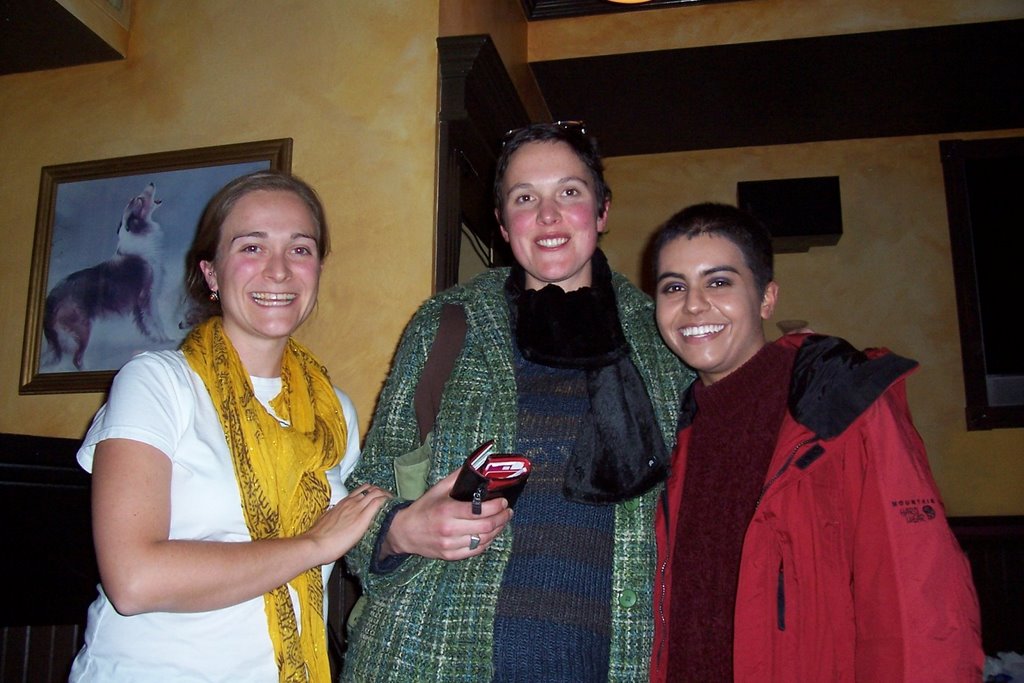
Three of the Olives: K.L. McKay, T.L. Cowan, Jenna Butler.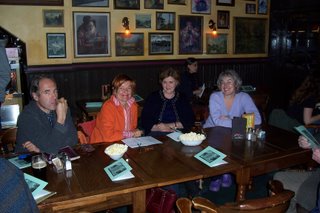
Edmonton luminaries: Ben, Laurie, Merna and Shirley.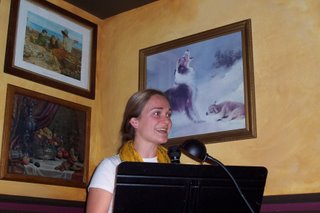
K.L. McKay reads (in front of a picture that looks a lot like my dear old dog Sara) as the Olive wraps up another night at Martini’s Bar & Grill. In addition to working in the Olive Editorial Group, she publishes a broadsheet series, Spire which offers a subscription that will deliver 12 hand-stamped and numbered issues to your door.




Latest Posts
- (no title)
- Sublime and Twisted Readings coming up!
- Sublime
- Good weather for reading
- The world, the world
- Sublime launch!
Aldeburgh Poetry Festival Barny Haughton BBC BC poets Berkswell blackberries Black Stilt Bologna book launch Borough Market Carlo Petrini Catalonia Cyrus Todiwala dairy Daunt's Books Dijon Edinburgh Fanny Bay Feast of Fields Food and Morality food history food journalism Jenna Butler lardo Malahat Review Michael Pollan Okanagan olive oil tasting olive trees Omnivore's Dilemma Our Food Our Future Oxford Parmigiano-Reggiano Planet Earth Poetry poetry poetry readings Poetry videos prosciutto salumi Sean O'Brien Suffolk ticks Wendy Morton Wired Writing Yvonne Blomer
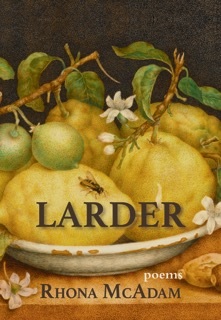
In her latest collection, Rhona McAdam navigates the dark places of human movement through the earth and the exquisite intricacies lingering in backyard gardens and farmlands populated by insects and pollinators, all the while returning to the body, to the tune of staccato beats and the newly discovered symmetries within the human heart.
“…A beautiful, filling collection, Larder is a set of poems to read at the change of the seasons, to appreciate alongside a good meal, and to remind yourself of the beauty in everything, even the things you may not appreciate before opening McAdam’s collection….”
Rhona McAdam is a writer, poet, editor, and Registered Holistic Nutritionist with a Master’s in Food Culture from Italy and a deep-rooted passion for ecology and urban agriculture. Her work spans corporate and technical writing to poetry and creative nonfiction, often exploring the vital links between what we eat and how we live. Based in Victoria, BC, and available via Zoom, Rhona is always open to new writing commissions, readings, or workshops on nutrition and the culinary arts.