-
Tasty week – olive oil, wine technology and the physiology of taste
Read Full Post: Tasty week – olive oil, wine technology and the physiology of tasteWe’ve had a lovely oily tasty sniffy week, with our first oil tastings and some coaching on olfaction and taste thresholds.
Our oil guy, Alessandro Bosticco, is an inspired teacher, a sommelier as well as an olive oil expert, and I was happy to hear he’ll be steering us through some wine tastings as well. I particularly warmed to him when he dodged a question about his favourite olive oil by saying that he simply loved tasting new things, and if he were offered the choice between his current favourite and one he’d never tried, he’d take the one he’d never tried.
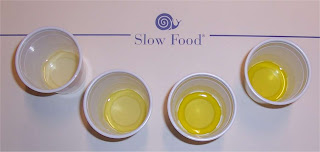
He said oil tastings were rare, even in Italy, and to do them as we were, by tasting oil from cups (rather than by dipping bread) was still fairly unusual. We tried four different kinds on each of the two days. Oil is what carries flavour to our tastebuds, and it does its job well; so, being oil, its flavour is hard to purge from the palate. We had to allow more time between tastings than we would for wine, and take sips of bottled water and slices of apple – granny smith being the apple of choice for oil tastings because it is the most acidic.We heard about the craze for fresh, unfiltered oils in Bosticco’s own local oil-producing region (Tuscany): cloudy and bright-coloured, these oils are not, he said, good for the long run, because the particles in them are fibres that have not been extracted during filtration, and which will trap water which can in its turn trap bacteria. So murk or sediment will affect the oil’s flavour adversely over time, and he advised that if you intend to keep your oil more than a few weeks, to get a clearer one. Even then it’s not going to last more than about 18 months, with a steady decline in colour and flavour as time goes by. More than once he remarked that the oil you taste today is as good as it’s going to get: it is not a product that improves with aging. Rather it is a living thing that changes over its lifetime. And it’s vulnerable to heat and light, so store it accordingly
We got some pointers on reading labels, and learned about the legal designations of “olive oil”, “virgin olive oil” and “extra virgin olive oil”, as well as a few others, defined by the International Olive Oil Council.
Basically the big deal with extra Virgin Olive Oil is that it must be produced by mechanical means (which is always and inevitably cold pressing, so that phrase added to labels is just hyper marketing). This distinguishes it from the processes used to produce all other kinds of oils (except for specialised niche versions of course), which involve heat and chemicals. Extra virgin oil has to pass a chemical test (it can’t contain more than .8% oleic acid) and it then has to pass a taste test by a panel of experts. This doesn’t guarantee it will taste ‘good’ to everyone, but it gives a basic measure of quality. It may also be the result of blending more than one crop, including crops of different years, but is tested at bottling, so no new blending can taste place once it’s had its testing.
There’s a statement which for 2 years now must appear on bottles of Extra Virgin Olive Oil: it must be described as “superior quality oil obtained straight from olives using only mechanical means of production.” That again is no guarantee of flavour (which is subjective anyway) or origin. Most of the olive oil in Europe is produced in Spain, but Italy has the highest consumption, ergo much of what we describe as Italian olive oil is imported and only bottled in Italy.
So for those who want Italian and only Italian olive oil, there is a fairly recent DOP designation (Denominazione di Origine Protetta, or Protected Denomination of Origin) – a high falutin’ version of extra virgin, which is subject to standards governing where and how the olives may be grown, pressed and bottled as oil. This oil of course sells at a considerable premium. It would be one instance where the bottler will note the date of harvest on the bottle, giving you an indication of the freshness and therefore the power of the oil’s aroma and flavour.
Farther down the scale, what is sold simply as Olio d’Oliva, or Olive Oil, is a blend of refined (by chemical means) olive oil and virgin olive oils. Virgin Olive Oil is produced by mechanical means and has a higher measure of oleic acid than Extra Virgin.
Olive oil is used in its traditional market – Mediterranean, for example – for traditional reasons such as taste. In the newer and ever expanding world-wide markets, it’s been picked up for its health benefits, as it’s a pure unsaturated oil containing fat-soluble vitamins (A and E) and antioxidants. Among the many other advantages it has over other oils, as enumerated by the Oil Council, when you use it for frying, it adds less fat to fried foods because it forms a crust on the surface of the food that impedes the penetration of oil and improves the food’s flavour.
There are different taste preferences for olive oil that are partly cultural: people raised on animal fats tend to prefer milder olive oils to more pungent peppery ones with their bitter after-bite. We had a reinforcement of the advice about becoming a good taster: to taste and smell many different things in order to build an olfactory library, so you have a more comprehensive memory of tastes and flavours to compare.
Due to some weird global synergy, BBC Food Programme and NPR both had programs on olive oil this month.
We also had a first lesson on wine technology… ack – more chemistry. Still, we are paddling around in the sea of knowledge and one day it will all make sense.
We finished the week with a lesson on the physiology of taste from Mirco Marconi. We’d heard already about the classification of taste – sweet, salty, bitter and acid (plus the newcomer, umami, which reflects ‘meaty’ tastes). We learned that the position of taste buds on the tongue is not as static as had originally been supposed, with fixed areas for each taste, but that they are in fact in an overlapping range of regions with the central area of the tongue the least sensitive.
Bitter tastes linger longest because of their placement on the sides of the papillae where the flavour gets ‘stuck’ until it is washed out. We heard that there are varying proportions of the world’s population who are unable to taste bitter (3% in West Africa, 40% in India, 30% of white people in North America; 37% of Italians).
We heard about two theories of taste, which are called either molecular shape theory vs molecular vibrational theory, or docking criteria vs swipe card model. The first supposes that there is a ‘lock and key’ relationship between odorant and receptor: odorous molecules have shapes and sizes that “fit into” the shape and size of corresponding olfactory receptors. In the second, it’s supposed that receptors in the olfactory organs recognise molecules by their vibration, so the nose acts as a kind of spectroscope.
We got into hands-on mode for some tastings and sniffings. We sipped our way through nine samples representing sweet, salty, acid, bitter, umami and astringent – substances dissolved in water – comfortingly straightforward. We then finished by attempting to identify thirty different olfactory samples, ranging from smoke to mint, from cloves to coconut and saffron to bergamot. Fiendishly difficult.
And finally, we were welcomed to Parma officially before Christmas, and here’s the official photo!
-
Lodi: mozzarella and ricotta
Read Full Post: Lodi: mozzarella and ricottaWe had a day out today, and watched some small scale mozzarella cheese making in the Istituto Sperimentale Lattiero Caseario/Institute of Dairy Science in Lodi, not far from Milan. The lab is equipped with a cheese making facility and over the course of our day-long visit, the master cheesemaker whipped up a batch of mozzarella and a little ricotta for us.

Mozzarella curd: whole milk from the institute’s dairy farm has been acidified (lowering the pH from 6.8 to 5.85) with citric acid (interesting to see it’s useful for more than cleaning one’s kettle).
Mozzarella curd: cut, drained, cut and then left to drain again.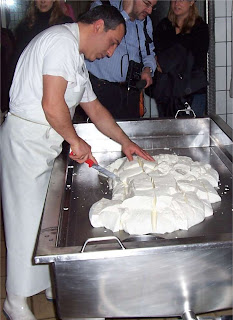
Mozzarella curd: cut, drained, cut, drained and now cut again.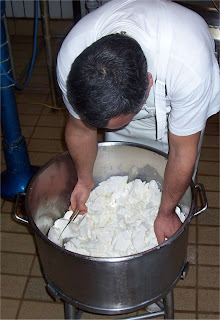
Mozzarella curd: cut, drained, cut, drained, cut, drained and then put into the basin; cut once again. Then some hot water (around 90 degrees c) is added and the stretching begins.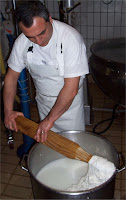
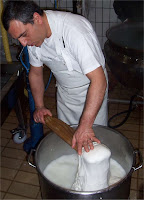
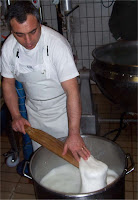
Hand stretching the curd – a slower, lower-yield way to make mozza. The advantages are that any problems with texture can be dealt with right away, so you end up with a better quality cheese. But you’d go bust doing it: the volume of milk you need to process to make mozzarella, together with the greater loss of milk solids into the liquid, and the slower processing (man ain’t no machine) just aren’t cost effective these days.


Stretching the cheese; shaping it into balls. Stretchy stuff with characteristic threads (elongated casein strands, eh?): practical heat and chemistry.
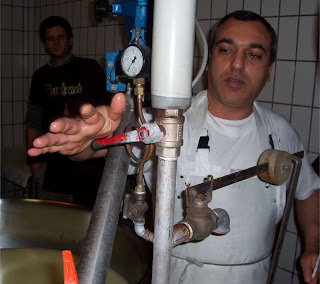
Hand-adjusting the steam-heated vats to start making ricotta from the mozzarella whey. Ricotta, we now know, means ri-cotta, or re-cooked/twice cooked. (Want to make your own? Here’s an illustrated guide.)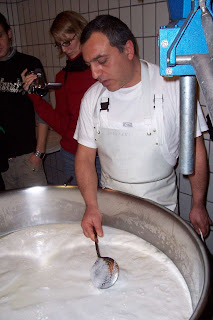
The whey starts off at the same pH as the mozzarella curd (around 5.85 – lowered from milk’s natural pH of 6.8). Sodium hydroxide was added in order to raise the pH to what’s needed for ricotta, between 6 and 6.5; the pH is regulated and if it goes too high, more citric acid can be added to lower it again. In the process we watched, there was a mistake – the pH gauge was too close to the sodium hydroxide when that was added, and gave a faulty reading, so it never quite worked out while we were watching. Which was instructive: we saw the effect of curds that were too small to bind properly for ricotta. However, under optimum conditions, the whey begins to coagulate and – after adding milk (around 6% in this case, although up to 20% might be used) – the foam needs to be skimmed off. The ricotta is then poured into baskets to drain and set, and is used most often in pasta and cake fillings.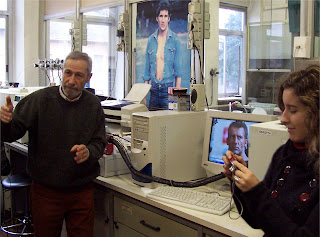
In one of the labs: Roberto Giangiacomo tells us about a piece of equipment called ‘the sniffer’ while Richard Gere and Clive Owen look on. -
Auto-indoctrination at the feet of Petrini
Read Full Post: Auto-indoctrination at the feet of PetriniMonday was our first face to face meeting with Carlo Petrini, founder of Slow Food, and therefore our patron saint, since the University of Gastronomic Science fell out of the folds of the cloak of the Slow Food movement in 2003.
Somewhat unsurprisingly, he arrived late, his excuse being the exquisite tortelli he’d had to stop and sample at an excellent local restaurant. Well, he lives the dream all right. And he lived up to his reputation as a charismatic and passionate speaker.
He talked about the founding of the Slow Food movement, and the university’s role in delivering to its students a thorough education in all aspects of gastronomy. Throwing down some of the catastrophic examples of large scale farming and fishing enterprises driving small, local food producers out of business, he said each time: what is this but gastronomy?
He has a passion for the value of education, and sees, I think, the students of this university as the seeds of an educated future. Teach people what is wrong with the food of today and you initiate the action that will change it for the better. He spoke on the three principles of Slow Food (good, clean and fair = Buono, pulito e giusto, just like the name of his latest book..) and about the movement’s expanding scope, to raise public awareness about issues of biodiversity and the perils of a market-based food economy.
Produce food for profit alone, is the message we’ve been hearing from all three of the Slow Food speakers we’ve had so far, and you sever the social and economic links that allow you to produce food for reasons of hunger, tradition, love, and community — and you destroy the very means of reversing the damage. And so there is a shift in the organisation’s focus now towards community building. The remarkable achievements of the Terra Madre meetings were groundwork for this, but it will be interesting to see how the structure of the organisation changes to accommodate – or not – this wider vision.
Well, I think I was not alone in enjoying our first major indoctrination session. There is something cozy and deeply reassuring about being addressed intimately and respectfully by a leader in a field we all already believe in. This experience I’m in for the next year does feel so validated by the zeitgeist; it feels to me that we are on the crest of a wave of righteous knowledge about the evil being done to what literally feeds our most fundamental human need.
We were invited last night to join Petrini for informal drinks in a local wine bar. And so about a dozen of us descended into a private room in the cellar, picking our way around cases of wine, greeting the owner – hard at work on the meat slicer – to find a full table already of students from another program in our uni, as well as a few uni staff and unidentified (to me anyway) others. So, dodging flaking plaster, we perched on makeshift seats – boxes of wine – and nibbled on excellent salumi and bread and sipped excellent wine, and listened to the mostly Italian banter around the table. Those of my classmates present were mostly unilingual English speakers, so it was not as entirely convivial as it might have been, and as we were more or less at nose level with the table we had the distinct feeling of being literally at the feet of Petrini. But it was pleasant enough, and I made an early exit into the fogbound streets around midnight, leaving the others to enjoy it for a couple more hours.


Latest Posts
- (no title)
- Sublime and Twisted Readings coming up!
- Sublime
- Good weather for reading
- The world, the world
- Sublime launch!
Aldeburgh Poetry Festival Barny Haughton BBC BC poets Berkswell blackberries Black Stilt Bologna book launch Borough Market Carlo Petrini Catalonia Cyrus Todiwala dairy Daunt's Books Dijon Edinburgh Fanny Bay Feast of Fields Food and Morality food history food journalism Jenna Butler lardo Malahat Review Michael Pollan Okanagan olive oil tasting olive trees Omnivore's Dilemma Our Food Our Future Oxford Parmigiano-Reggiano Planet Earth Poetry poetry poetry readings Poetry videos prosciutto salumi Sean O'Brien Suffolk ticks Wendy Morton Wired Writing Yvonne Blomer
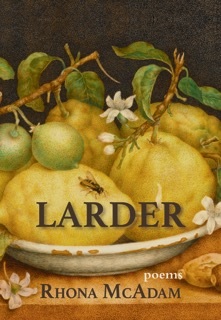
In her latest collection, Rhona McAdam navigates the dark places of human movement through the earth and the exquisite intricacies lingering in backyard gardens and farmlands populated by insects and pollinators, all the while returning to the body, to the tune of staccato beats and the newly discovered symmetries within the human heart.
“…A beautiful, filling collection, Larder is a set of poems to read at the change of the seasons, to appreciate alongside a good meal, and to remind yourself of the beauty in everything, even the things you may not appreciate before opening McAdam’s collection….”
Rhona McAdam is a writer, poet, editor, and Registered Holistic Nutritionist with a Master’s in Food Culture from Italy and a deep-rooted passion for ecology and urban agriculture. Her work spans corporate and technical writing to poetry and creative nonfiction, often exploring the vital links between what we eat and how we live. Based in Victoria, BC, and available via Zoom, Rhona is always open to new writing commissions, readings, or workshops on nutrition and the culinary arts.