-
Shame on Candian Conservatives (again)
Read Full Post: Shame on Candian Conservatives (again)Info and action – www.cban.ca/474
PRESS RELEASE For Immediate Release
Conservatives Shut Down Debate on Biotech Harm to Farmers
Parliamentary hearings cancelled to protect biotechnology corporations
October 28, 2010, Ottawa – Today, House of Commons Agriculture Committee hearings on Private Members Bill C-474 – dealing with the issue of genetic engineering – were cancelled and invited witnesses were turned away because, last night, Conservative Members of Parliament voted down a motion to extend debate on the Bill. The motion to extend the debate by 30 days was defeated by just 4 votes.
Bill C-474 would support farmers by requiring that “an analysis of potential harm to export markets be conducted before the sale of any new genetically engineered seed is permitted.”
“The Conservatives ended the debate in order to protect the biotech industry from any more scrutiny,” said Lucy Sharratt, Coordinator of the Canadian Biotechnology Action Network. “This Bill spurred the first real debate in Parliament over the negative impacts of genetically engineered crops and that’s why Conservatives shut it down.”
“The vote to extend the hearings should have been an uncontroversial procedural matter but the Conservatives made a calculated political move to save biotech corporations like Monsanto from the spotlight,” said Sharratt. “The debate was exposing the reality that some genetically engineered crops can cause serious economic harm to farmers and the Canadian economy, and our government currently has no legislative way to stop economically harmful GE crops.” Farmers are at risk when GE crops are commercialized in Canada without also being first approved in our major export markets.
This morning’s Agriculture Committee hearings were cancelled and National Farmers Union President Terry Boehm, who was invited by the Committee to testify, was turned away. Boehm traveled from Saskatchewan and planned to speak in favour of the Bill. Many more witnesses, including other farm leaders, will now not have a chance to present to the Committee. The Committee has already heard strong testimony in support of Bill C-474 from organizations representing conventional alfalfa growers. The growers are predicting that Monsanto’s GE alfalfa will harm their markets. “The debate was making it increasingly harder to justify a position against the Bill,” said Sharratt.
The final vote on the Bill could be called within weeks. The Bill was introduced by Alex Atamanenko, the NDP Agriculture Critic and MP for British Columbia Southern Interior.
-30-
For more information: Lucy Sharratt, Coordinator, Canadian Biotechnology Action Network, 613 241 2267 ext 6; cell: 613 263 9511 coordinator@cban.ca
-
Terra Madre: GMOs, nutraceuticals, organic/biodynamic farming
Read Full Post: Terra Madre: GMOs, nutraceuticals, organic/biodynamic farmingI paid a fleeting visit to a session on GMOs, functional foods and nutraceuticals, both areas of concern for Slow Food, whose No-GMO campaign was visible during the week.
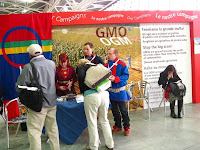
A few snippets:
- more is spent on marketing than researching GMO products;
- GMO is a technology of failure, because only 4 plants have been successfully modified since 1987, and these use the same processing methods as the nineties, so no advancement in the ten years 1997 to 2000;
- plants evolve in ways that GMO do not; there is the same cross contamination between regulatory bodies and biotech firms in Europe as there is in the US, for example the marketing manager for Syngenta came from the European agency responsible for risk analysis and testing of GMOs.
- the “3 sisters” (why the feminization?) Monsanto, DuPont and Syngenta with the other five (including Pioneer, Hasbro, Sogeti) control most of the seed companies in the world, and have made alliances with pharmaceutical companies who develop fungicides;
- and that Monsanto earns more from royalties than it does from plants and seeds.
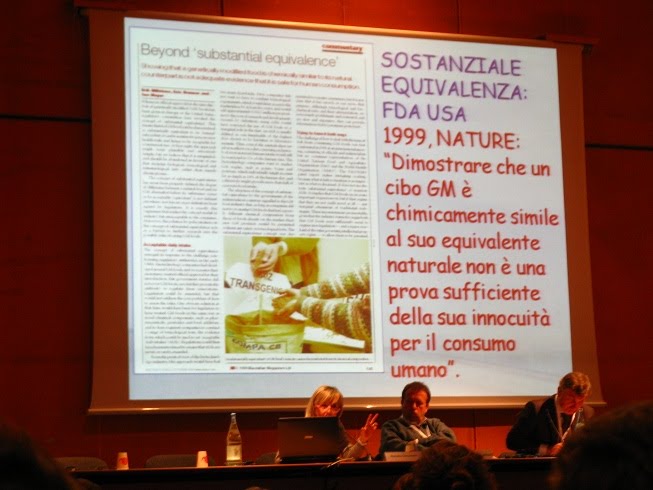
Manuela Giovannetti from the University of Pisa spent some time explaining the “substantial equivalence” myth

which has been contested since the nineties, and yet is still in use to allow GMOs into our countries. There are many other sources of information which call into question the science upon which the policies pursued by governments are based. And with that I had to flee to a tasting, about which more another time.
Paid an even briefer visit to the Earth Workshop on organic and biodynamic farming, which was underway when I arrived.

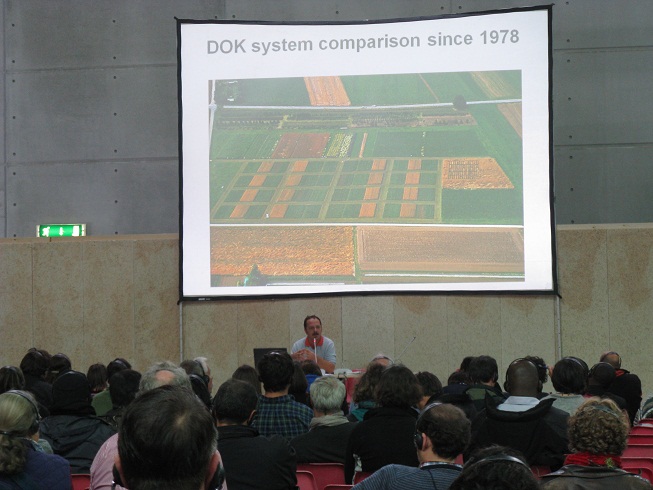
I caught some discussion of a 21-year study (1977-1998) in Switzerland which compared organic, biodynamic and conventional farming methods using 7 year crop rotations. The study was funded by government rather than multinationals, a dangerously rare situation nowadays. According to the speaker, the soil fertility findings were of particular interest because biodynamics came out far ahead of any other method, showing an increase in soil fertility, which he attributed to biodynamic methods of composting. The trials showed organic methods caused a drop in soil fertility of 10% over the 21 years; conventional methods, using chemicals as well as manure, dropped soil fertility 8%, and conventional using only artificial inputs dropped 15% while biodynamics increased soil fertility 1% (after an initial drop of 4%).
-
Terra Madre: Food diversity & safety
Read Full Post: Terra Madre: Food diversity & safetyFriday’s workshop on “Ensuring food diversity and safety in Europe” had some sponsorship from the EU’s Directorate-General for Health & Consumers. If I understood correctly, this was the first year that EU delegates came to join the discussions at Terra Madre, and they were well placed to respond to concerns – long publicised in the media and elsewhere – that EU regulations are out to destroy traditional foods in Europe.
Eric Poudelet was first up, talking about food safety. He cited a figure of about 4000 declared instances of “food intoxications” – estimating the total with undeclared instances could be more like 2 million (for the EU’s 500 million population). The EU’s response to the major food problems of the nineties (BSE, Belgium’s dioxin contamination, etc) was a white paper on food safety in 2000, which proposed some 80 food actions to assure “farm to table” safety, including traceability of feed and food, and risk control measures. (This led to the creation of the European Food Safety Authority, whose mandate includes food and feed safety, nutrition, animal health and welfare, plant protection and plant health.)
He denied that Brussels aims to kill of traditional food products, maintaining that they believe it’s possible to prepare traditional food products while respecting hygiene rules. Member states are responsible for developing and administering appropriate hygiene procedures in line with EU guidelines.
Poudelet said that the EU wanted to stimulate the use of raw milk, one of the most important ingredients of great food in Europe, and the guidelines were adaptable to this and other traditional methods and ingredients. So for example although stainless steel is preferable for mixing foods – including meats – wood or copper can be allowed if these are important to traditional methods of preparation. Protected designation of origin, which protects these exceptions, does not cover all varieties of foods, but it may be extended to cover products that are currently excluded. So that’s hopeful.
Academic Jean-Pierre Poulain, who teaches sociology and anthropology at the University of Toulouse, spoke next about the importance of traditional foods in European culture. He talked about urbanization, and the food traditions that have moved on and off the land with the people moving to cities; he noted that “peasants” are still few but vocal, and they should be heard as we work out how to feed the world.
He went on to discuss some of the shifts in the world of food; how it’s becoming more and more “medical”. Though it’s true we have more treatable medical conditions than ever before, we can view food as one of the factors in both cause and prevention. There are new challenges to improve the quality of our food as we grow older.
Food is also becoming more “legalized”: many laws and regulations try to govern traceability and safety, and lead to prosecutions. We may not all be victims taking our complaints to the courts, but the legal profession is getting actively involved (he gave the example of Erin Brockovich), and this further distances people from food.
Food is also “politicized” through protests against industrial food systems; the north/south divide and dialogue over access to food; climate change and carbon emissions; and the “buycott vs boycott” effect for marketing ethical, fair trade and local foods.
Food heritage is also on the table: in principle at least, the UN is willing to admit culinary traditions to its intangible heritage lists, which register for protection “practices, representations, and expressions, and knowledge and skills which are transmitted from generation to generation and which provide communities and groups with a sense of identity and continuity.” (Although food traditions that relate to the activities that have been approved for the list are often included, no culinary tradition on its own has yet been approved, as far as I’m aware, though France and Mexico have both tried and been rejected twice.)
Poulain ended with a brief analysis of the issues around animals, and the two poles of concern: anthropomorphism (Bambi syndrome) vs idealization of the natural, neither of which is helpful when addressing the full scale of the place of meat animals in a world struggling to feed itself equitably. What planet do we choose to leave to our children, he asked, and what fairness can be found between north-south and urban-rural divides?
One other speaker I’ll mention was Daniele Rossi, the project coordinator for Truefood which has 11 member organizations (Federalimentaire is the Italian one; there is no UK representation) representing some 35,000 small to medium European food and drink businesses. Because most research into food safety and technological innovation is done for large-scale enterprises, Truefood aims to find applicability for smaller ones, and to help them tap into food safety initiatives and technological innovations, as well as better understand consumer perceptions and improve marketing and supply chain development. In other words, it seemed to me, to make small companies act more like big ones. It left me wondering how helpful that really was when the economic might of the multinationals overhangs us all; might it not just prepare the small fish to be more easily digested by the large?
Small-scale traditional food production is a massive segment of the European economy: in Italy alone about two-thirds of the national sales turnover is in traditional foods. Europe-wide, some 300,000 small/medium sized producers, most family-owned, typically with fewer than 20 employees, account for 4.4 million jobs. When you consider the numbers, that’s a lot of clout, but it’s fragmented and dispersed throughout the continent; on the other side of the balance are the 30 large multinationals. And we know what their aims are.
There has been a lot of discussion this week about the skewed reality we’re living, where economics has overwhelmed humanity, and left us a more brutal world to live in. More on that in the next post.




Latest Posts
- (no title)
- Sublime and Twisted Readings coming up!
- Sublime
- Good weather for reading
- The world, the world
- Sublime launch!
Aldeburgh Poetry Festival Barny Haughton BBC BC poets Berkswell blackberries Black Stilt Bologna book launch Borough Market Carlo Petrini Catalonia Cyrus Todiwala dairy Daunt's Books Dijon Edinburgh Fanny Bay Feast of Fields Food and Morality food history food journalism Jenna Butler lardo Malahat Review Michael Pollan Okanagan olive oil tasting olive trees Omnivore's Dilemma Our Food Our Future Oxford Parmigiano-Reggiano Planet Earth Poetry poetry poetry readings Poetry videos prosciutto salumi Sean O'Brien Suffolk ticks Wendy Morton Wired Writing Yvonne Blomer
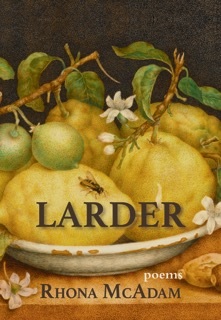
In her latest collection, Rhona McAdam navigates the dark places of human movement through the earth and the exquisite intricacies lingering in backyard gardens and farmlands populated by insects and pollinators, all the while returning to the body, to the tune of staccato beats and the newly discovered symmetries within the human heart.
“…A beautiful, filling collection, Larder is a set of poems to read at the change of the seasons, to appreciate alongside a good meal, and to remind yourself of the beauty in everything, even the things you may not appreciate before opening McAdam’s collection….”
Rhona McAdam is a writer, poet, editor, and Registered Holistic Nutritionist with a Master’s in Food Culture from Italy and a deep-rooted passion for ecology and urban agriculture. Her work spans corporate and technical writing to poetry and creative nonfiction, often exploring the vital links between what we eat and how we live. Based in Victoria, BC, and available via Zoom, Rhona is always open to new writing commissions, readings, or workshops on nutrition and the culinary arts.