-
Meat, protein and human kindness
Read Full Post: Meat, protein and human kindnessI’ve just finished reading a book I started ages ago, The Way We Eat: Why our food choices matter, Peter Singer/Jim Mason. Now I’m cogitating about protein consumption, meat sources and humanitarian practices around meat production. And I listened again to a recent Food Programme episode on quality meat while I was thinking, which – among other things – revealed some ugly truths about how supermarket buyers choose the meat they sell us.
Overwhelmingly, the meat available to Canadian carnivores is from factory farms; I see next to nothing of organic or humanely reared meat in my local markets (in truth, I’ve see none at all, but I want to leave a margin for error in case there is the odd token item somewhere I hadn’t noticed).
Why should this matter? If you read Singer & Mason’s book (or any other piece of writing about factory farming), you’ll learn the following about factory-farmed meat:
“…it inflicts prolonged suffering on sows who spend most of their lives in crates that are too narrow for them to turn around in; on caged hens; on chickens kept in unnaturally large flocks, bred to grow too fast, and transported and killed in appalling conditions; on dairy cows who are regularly made pregnant and separated from their calves; and on beef cattle kept in bare dirt feedlots.”
From a consumption point of view, the meat quality is not good either. Antibiotics fed to meat animals, as well as hormones and inappropriate feed all make the meat we’re sold unhealthy. The people working in Canadian slaughterhouses tend to be poorly trained and badly paid to do a job nobody wants, and to do it for speed rather than with considerations of compassion to a fellow creature. Demand for organic meat and dairy means that there now exists the unlikely enterprise named ‘organic factory farm‘ where the feed is organic but the rearing may be just as brutal as on regular factory farms.
There’s an environmental issue too, of course, identified decades ago by the likes of Frances Moore Lappé, which is that meat production is simply unsustainable on our crowded planet: meat costs the world dear in the excesses it requires of water, land, cereal crops and fossil fuels; the methane produced and the soil erosion and pollution caused by beef farming are a whole other area of concern. Anyone who’s worked in a restaurant or supermarket can attest to the amount of meat our spoiled Western diners simply waste.
In Canada, we have no federal labelling that would identify meat as humanely reared. Small producers, who would be more likely to raise their animals with care and kindness and have them slaughtered by smaller, kinder abattoirs, have been sucker-punched by the BC government who instituted new slaughterhouse regulations aimed at large industrial operations but which are financially insupportable by small scale operators.
Considering the public costs of unhealthy eating (through health care and taxes), and offering a pretty painless and practical solution, Singer & Mason observe:
“The average American today eats 64 pounds more meat, poultry and fish a year than his or her counterpart in the 1950s. That’s almost a 50 percent increase – and Americans were not undernourished then… Choosing an unhealthy diet may seem like a personal choice, but it’s not fair to the people who ultimately have to pay for it. If Americans were to cut back to the meat-eating levels of the 1950s, that would improve health and slash health care costs. It would also reduce the number of animals suffering on factory farms by about the same amount as if roughly 80 million Americans became vegans.” (Emphasis mine)
I found that so encouraging, and so simple! We can have a vegan effect without even being vegan!
Acknowledging that the scale of the wrong we are trying to right in our food choices is simply staggering to most of us, they kindly add: “When we feel overwhelmed, it is important to avoid the mistake of thinking that if you have ethical reasons for doing something, you have to do it all the time, no matter what… Ethical thinking can be sensitive to circumstances.”
They do urge us, though, to make our voices known regardless: what companies and governments don’t know bothers us, they have no reason to change.
Another cheering observation they made is in quoting the position of the American Dietetic Association on vegetarianism, and the specifics of the human need for protein:
“Plant protein can meet requirements when a variety of plant foods is consumed and energy needs are met. Research indicates that an assortment of plant foods eaten over the course of a day can provide all essential amino acids and ensure adequate nitrogen retention and use in healthy adults, thus complementary proteins do not need to be consumed at the same meal.”
So the bottom line is: if factory farming disturbs you for ethical or health or environmental reasons, which I think it should, you can do something about it by making a conscious effort to cut your meat consumption. You don’t have to cut it all, or all at once, but you really can make a difference by cutting it regularly to some degree. You can also pester your supermarket, if that’s where you shop, for some action on organic and humanely reared meat: if we don’t buy it, they can’t sell it.
But if you, he, she, they never say anything to anyone about it, there’s no reason for factory farms to stop doing what they’re doing.
-
Bookishness
Read Full Post: BookishnessHave received a couple of notices now about the Google Book settlement. Anyone who owns a US copyright interest in a book that might be included in Google’s mass digitization enterprise (apparently this is any US author (or heirs) and any author (or heirs) whose country has copyright agreements with the US = so, just about every published person I’d know) is invited to read the settlement notice and get their forms in by the relevant deadline (to opt out and reserve the right to sue Google, it’s May 2009; those wanting cash settlements for digitized works have until January 2010). Members of Access Copyright can sign up for web seminars to learn more.
Thursday night’s Malahat Review reading to celebrate The Green Imagination – the environmental issue – and tribute to former editor Constance Rooke, was exceedingly well attended. Audience members were plied with cake and offered fair trade coffee and Silk Road teas; palms were crossed with chocolate to fortify us in our quest for seats in an overflowing 150-seat theatre.
The event began with a song

and then an intro by the issue’s editor, Jay Ruzesky,
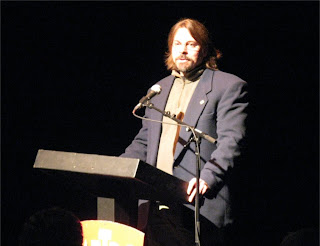
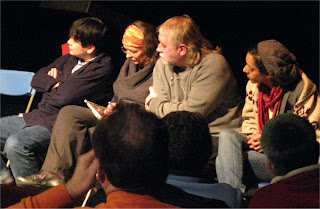
followed by readings of prose and poetry. A question and answer session followed, with all available contributors
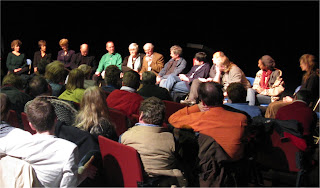
back on stage. Here, Lilburn speaks
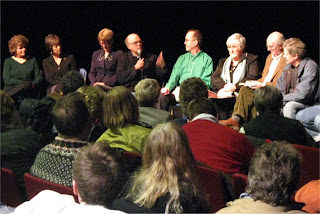
Tim Lilburn; Malahat’s editor supremo, John Barton; Carol Matthews.
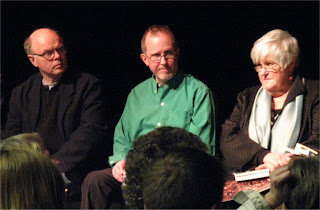
Philip Kevin Paul, Melanie Siebert, John Harley, Sonnet L’Abbé.
-
Obama’s food agenda (not) & grrrl power at the Eliot
Read Full Post: Obama’s food agenda (not) & grrrl power at the EliotIn the wave of optimism surrounding Obamarama, it is sad to discover that he’s not as smart about food as one might hope. His appointment of pro-GM, pro-biofuel former Iowa (the corn state) governor Tom Vilsack for secretary of agriculture doesn’t suggest a mandate that actually addresses food issues (in fact, as Michael Pollan observes, the word ‘food’ wasn’t mentioned at all when the appointment was announced). And what is agriculture but food production? This business seems to push us farther down the road of viewing agriculture as a commodity industry, like bricks or metals, instead of a means of producing our most basic need — and right.
The absence of “food” in the US agricultural discussion leaves unaddressed so many important things — including the use of food for fuel (and how corn-fed biofuel production contributes to world food prices, as well as the waste of fuel involved in producing this environmentally-unfriendly product), and the damage to food production of corn subsidies and genetically modified foods. Though we know how many thankless challenges he’ll be facing, may Obama live and learn and manage to impose some kind of positive action on the situation before he’s done.
Though I managed to be out of town when she visited, UK poet Jen Hadfield made a bit splash among Victoria’s poetry community. And there will be more dancing in our snowless streets now that she’s won the TS Eliot prize, whose manly tendencies were irreversably altered after its first eight years by our own Anne Carson, the first woman to win it since its inception. Others have written their way through the breech since then: Alice Oswald, Carol Ann Duffy, and now Hadfield.


Latest Posts
- (no title)
- Sublime and Twisted Readings coming up!
- Sublime
- Good weather for reading
- The world, the world
- Sublime launch!
Aldeburgh Poetry Festival Barny Haughton BBC BC poets Berkswell blackberries Black Stilt Bologna book launch Borough Market Carlo Petrini Catalonia Cyrus Todiwala dairy Daunt's Books Dijon Edinburgh Fanny Bay Feast of Fields Food and Morality food history food journalism Jenna Butler lardo Malahat Review Michael Pollan Okanagan olive oil tasting olive trees Omnivore's Dilemma Our Food Our Future Oxford Parmigiano-Reggiano Planet Earth Poetry poetry poetry readings Poetry videos prosciutto salumi Sean O'Brien Suffolk ticks Wendy Morton Wired Writing Yvonne Blomer

In her latest collection, Rhona McAdam navigates the dark places of human movement through the earth and the exquisite intricacies lingering in backyard gardens and farmlands populated by insects and pollinators, all the while returning to the body, to the tune of staccato beats and the newly discovered symmetries within the human heart.
“…A beautiful, filling collection, Larder is a set of poems to read at the change of the seasons, to appreciate alongside a good meal, and to remind yourself of the beauty in everything, even the things you may not appreciate before opening McAdam’s collection….”
Rhona McAdam is a writer, poet, editor, and Registered Holistic Nutritionist with a Master’s in Food Culture from Italy and a deep-rooted passion for ecology and urban agriculture. Her work spans corporate and technical writing to poetry and creative nonfiction, often exploring the vital links between what we eat and how we live. Based in Victoria, BC, and available via Zoom, Rhona is always open to new writing commissions, readings, or workshops on nutrition and the culinary arts.
