-
Joel Salatin – Man of many hyphens
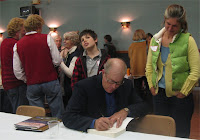
Read Full Post: Joel Salatin – Man of many hyphensThe Cowichan Agriculture Association managed to lure farmer-speaker-activist Joel Salatin (he actually prefers the label Christian-Libertarian-Environmentalist-Capitalist-Farmer) to come and spend the day speaking in Duncan last rainy Saturday. The house was packed – I’d guess around 200 folk, mostly farmers, many of them young – and he put on a good show, commencing with a slideshow talk about Polyface Farm.
From this we learned about his ways with cattle bedding, which were surprisingly complex. He keeps the cattle in a shed, roofed but mostly open, and lays down whatever wood chips (=carbon!) he can get hold of. This absorbs the cowpies and urine so that conditions are reasonably sanitary (any farm that smells bad is a badly managed farm, according to Salatin). He scatters corn into the chips every so often. And keeps layering like that until winter’s over, by which time the bedding could be up to four feet deep. He has devised supports to keep the cows from toppling over, and cantilevers to keep their hay at mouth-level. Once the cattle are out in the fields again, he brings in the pigs, who root for the fermented corn and in the process turn over the compost, aerating it and making it ready to spread on the fields to grow the forage for his cattle. So pigs, cattle and farmer = all happy.
From there we go to the fields where the pasturing is similarly well thought out and involves chickens and a lot of mobile fencing. In fact mobile equipment is big in Salatin’s vision: he doesn’t believe in single-purpose equipment and he really likes to be able to move his animals around the fields – and woods – so that he can manage their feeding and the fertility of his soil at the same time.

He is truly a libertarian, wanting freedom from the shackles of government regulations which, he couldn’t say forcefully enough, are intended for the industrial farming practices that have crippled farmers’ ability to make a living, severed the eaters from knowledge of what they eat, and poisoned our food.
He was generous with his time answering questions and sharing opinions on everything from the timing of hog slaughter to how to cook grass-fed beef to why he likes hobby farms. He recommended many books, including New Rules for the New Economy by Kevin Kelly; Guns, Germs & Steel by Jared Diamond; and City Chicks by Patricia Foreman (whose husband Andy Lee wrote Chicken Tractor). As well, of course, as his own books, most notably Everything I Want to do Is Illegal.
And he described some of the innovations he’s come across – evidently a pleasing sideline for him in his extensive travels – that are helping to save “embedded heritage local food systems from the machinations of large scale industrial food systems.” Some examples: The Urban Farm Store in Portland, Oregon; the New Roots Urban Farm in St Louis, Missouri; and the Local Food Hub in Charlottesville, Virginia.
While he advocates the “just say no” approach to the enforcement of unreasonable regulations wherever possible, he also has a simple suggestion for all of us: learn to cook from scratch. “Opting out of processed food is the ultimate mark of independence.”
And if that ain’t enough, here’s the man himself, talking food safety in Portland Oregon last summer.
http://vimeo.com/moogaloop.swf?clip_id=6168497&server=vimeo.com&show_title=1&show_byline=1&show_portrait=0&color=&fullscreen=1
Farmer Joel Salatin Talks Food Safety in Portland from Mayor Sam Adams on Vimeo.
-
Grains on the island
Read Full Post: Grains on the islandA bit of a pause here while I deal with my recent computer crash (a literal one, onto the floor) and so have delayed reporting on a couple of very interesting talks last week. On Thursday last, I attended a COG-VI meeting to hear a discussion of grain growing on Vancouver Island.
Tom Henry, to many a bit of a guru in this field, spoke first about his experiments with Red Fife wheat, using organic and conventional growing methods. He said that it was, in his experience, almost impossible to grow a flour-grade red fife wheat that was certified organic. The reasons were to do with weed control and nutrients. Organic growing, he said, means a later start than conventional, because you have to leave time for weed control: wait till the ground is workable, let the weeds grow, till them under and plant your seed. In order to gain enough protein to be usable in bread flour, the red fife has to be drought-stressed at the right point in its growing cycle. But a later planting means that the drought period comes earlier for the seedlings.
Prairie growers don’t suffer this problem because of differences in climate, so it’s easier to get organic red fife wheat with appropriate protein content from there. And easier to balance land use: he observed that in a small land base like Vancouver Island, it’s hard to justify digging in a legume crop to prepare the soil for a grain crop; overall it would take four years to set up one crop. That having been said he also observed that until 1949 this was the best grain growing area in BC because of climate (although this was likely grain for animal feed rather than for milling).
Another interesting point that Henry raised was that most home bakers used to conventional flours run into difficulties using flours made from artisanal grains like red fife. This is back to protein: artisanal flours are typically lower in gluten proteins than the ‘bread flour’ we’re used to which is extremely high protein (but lacking in the flavours and nutrients of artisanal grains). But if the proteins are good quality, even if they’re low, you can get good bread with proper handling. In addition, higher protein flours absorb more water and the resulting breads keep longer. These differences can usually, as I understand it, be overcome to some extent by using levain or longer-rising recipes (perhaps like the famous no-knead bread recipes), and of course by mixing artisanal with high protein bread flours.
After Henry, we heard from Brock McLeod and Heather Walker, whose Island Grains project consisted of a very successful grain CSA last year. They invited members of the public – some farmers, some just interested people – to come and learn with them how to grow grains on a small scale and were awestruck at the response. 51 people had signed up in just three weeks. Participants were given a piece of land and shown how to plant, tend and harvest it, by having a series of speakers walk them through the various elements.
They took this on in a spirit of self-sufficiency, and were extremely low-tech about it, harvesting the grain with scythe and scissors; threshing in a pillowcase and blowing the chaff with a hairdryer. They are upbeat about their experience, and said that you could grow enough grain on a very small amount of land – 1,100 square feet – to make 60 lbs. flour, which amounts to a couple of loaves of bread a week for a year.
They’re now using their website to share information about small-scale grain growing.
-
Fish fraud, winter veg and a bit of poetry
Read Full Post: Fish fraud, winter veg and a bit of poetryLong Ago In Italy… we had a splendidly mind-blowing talk from a veterinarian on the subject of fish fraud: how consumers were being sold cheap or endangered fish under the name of popular varieties. The reason was much the same as the one that has plagued most of our food problems nowadays: we are out of touch with our food sources. In the case of fish, we buy fillets and portions instead of the whole, head-on creature, so we are forced to trust commercial interests to tell us the truth.
Which we have been learning over and over is not the actual intention of commercial interests, who exist to make money at any cost. So, whoever’s reaping the rewards of this deceit, here’s an interesting article about fish fraud in Canada. Buyer beware.
The weekend’s entertainments were totally fish-free, although there was enough water falling from the skies to drown a few.
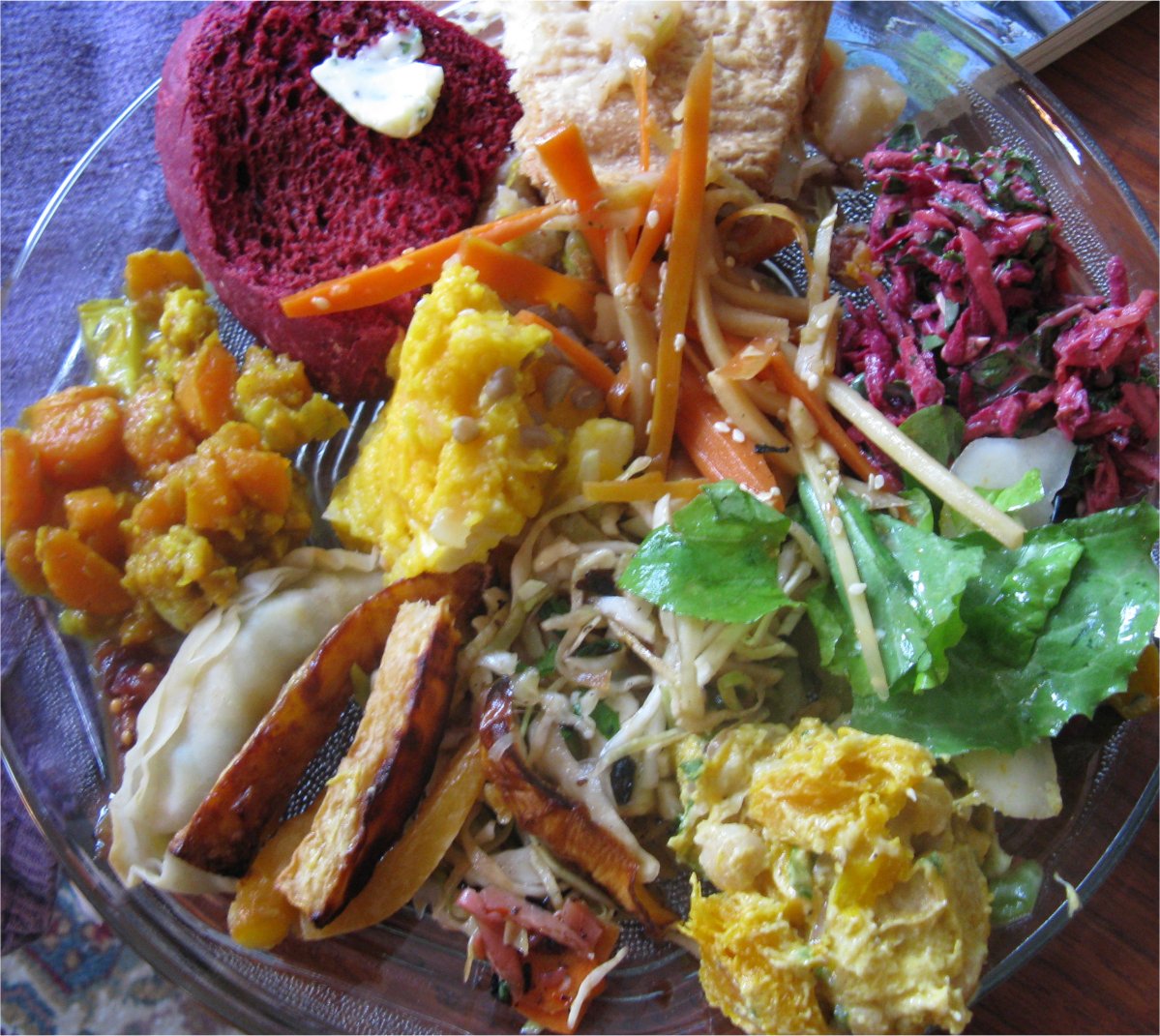
Sunday we had the Winter Vegetable Potluck, generously hosted by Don & Ramona, which featured buckets of colour and flavour. Below, I diligently compare the tint of mulled wine with that of magenta bread (made with roasted beets).
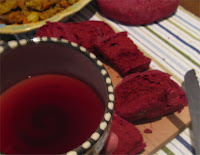
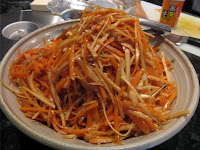
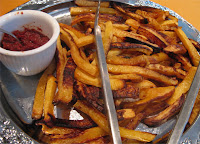
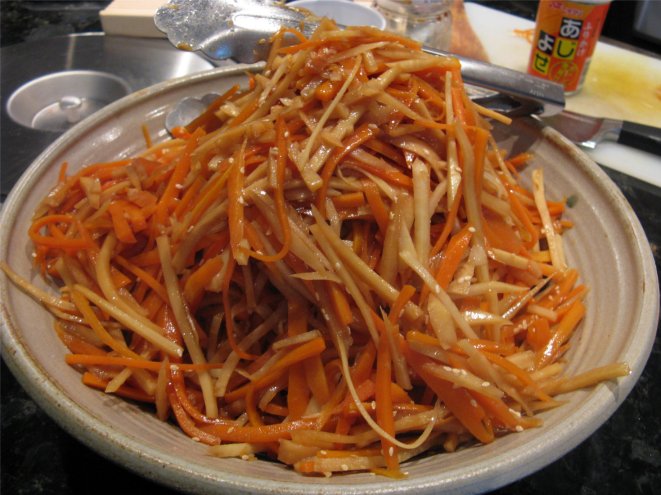
Here’s a healthy sampling of what people brought, including (clockwise from lower left): rutabaga chips; winter veg samosa; winter veg curry; magenta bread; leek, potato & everything tart; kale & beet; winter salad with pears, blue cheese and candied hazelnuts; roasted squash & chickpea salad with tahini; coleslaw; in the middle of the plate is a squash and feta bake with sunflower seeds, and a Japanese-inspired carrot & parsnip appetiser with soya sauce and sesame.

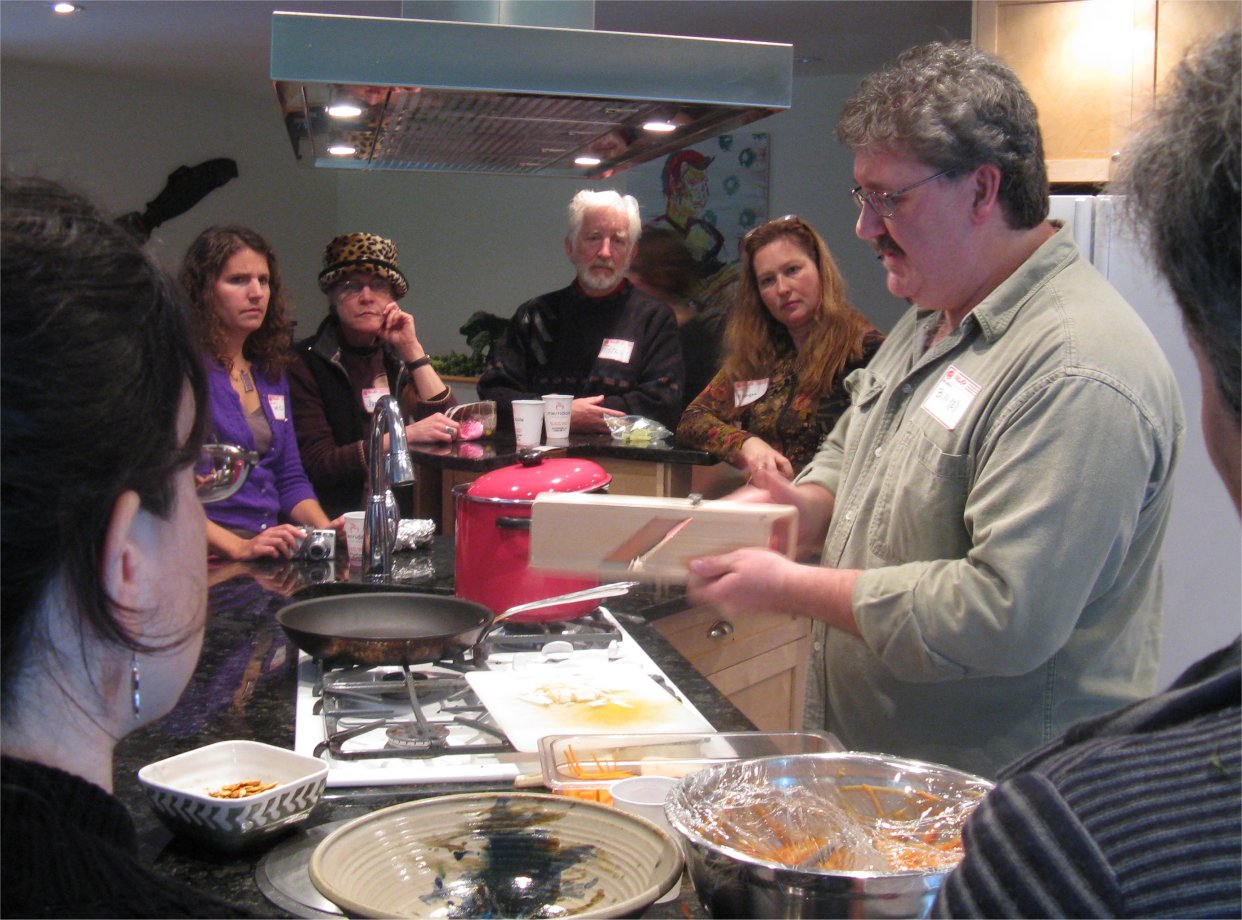
That appetiser was, in fact, the handiwork of Bill Jones, who demonstrated the Japanese mandolin on which his interns ritually lose bits of their fingers (but not he, luckily)
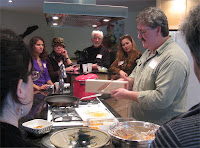
and then whipped up his treat, which he says can be made with burdock root instead of parsnip.
There were about 20 in attendance, which was pretty good considering the rain and fog that those of us from Victoria had braved on our way to Cobble Hill. But some of us will go a long way for a rutabaga chip, especially now that we’ve tried them…
On the poetry side, I was able to spend my Friday 13th doing a star turn – well, a mezzo-star turn – sharing the stage of Planet Earth Poetry with Wendy Donawa and airing a few more poems. Very pleasant time and a lovely crowd, nice to catch up with a few people I managed to persuade out into the literary realm for a couple of hours.




Latest Posts
- (no title)
- Sublime and Twisted Readings coming up!
- Sublime
- Good weather for reading
- The world, the world
- Sublime launch!
Aldeburgh Poetry Festival Barny Haughton BBC BC poets Berkswell blackberries Black Stilt Bologna book launch Borough Market Carlo Petrini Catalonia Cyrus Todiwala dairy Daunt's Books Dijon Edinburgh Fanny Bay Feast of Fields Food and Morality food history food journalism Jenna Butler lardo Malahat Review Michael Pollan Okanagan olive oil tasting olive trees Omnivore's Dilemma Our Food Our Future Oxford Parmigiano-Reggiano Planet Earth Poetry poetry poetry readings Poetry videos prosciutto salumi Sean O'Brien Suffolk ticks Wendy Morton Wired Writing Yvonne Blomer

In her latest collection, Rhona McAdam navigates the dark places of human movement through the earth and the exquisite intricacies lingering in backyard gardens and farmlands populated by insects and pollinators, all the while returning to the body, to the tune of staccato beats and the newly discovered symmetries within the human heart.
“…A beautiful, filling collection, Larder is a set of poems to read at the change of the seasons, to appreciate alongside a good meal, and to remind yourself of the beauty in everything, even the things you may not appreciate before opening McAdam’s collection….”
Rhona McAdam is a writer, poet, editor, and Registered Holistic Nutritionist with a Master’s in Food Culture from Italy and a deep-rooted passion for ecology and urban agriculture. Her work spans corporate and technical writing to poetry and creative nonfiction, often exploring the vital links between what we eat and how we live. Based in Victoria, BC, and available via Zoom, Rhona is always open to new writing commissions, readings, or workshops on nutrition and the culinary arts.
