-
Shriiink-wrapping culture & all about oats
So, the latest word is that the Cultural Section at Canada House is being ‘restructured’; our previous five representatives in performing arts and music, film and television, the visual arts and literature, have all been made redundant. Two new appointments will be made in Public Affairs, with responsibility for the entire cultural program.
On the one hand it’s a relief to know the program is not gone, but on the other hand, five experienced, well-connected and knowledgeable people have been jettisoned in favour of two new generalists. These are not interchangeable bolts that can be plugged in and out of a program, but dedicated employees taking their years of collective experience out the door with them. What a shocking waste.
Taking comfort in food and poetry then.
Madeleine sent me a stunning wee poem by Alden Nowlan, after we talked about the difficulties of making meaningful lives for our aged relatives. It’s called Aunt Jane, and it begins…
Aunt Jane of whom I dreamed the nights it thundered,
was dead at ninety, buried at a hundred.
We kept her corpse a decade, hid upstairs,
where it ate porridge, slept and said its prayers.Speaking of porridge, I was interested to learn when I lived in Britain that there the word is used to mean any hot cereal, almost always oatmeal. But here in Canada, or at least as I understand it, porridge means hot cereal made of rolled oats. Our understanding of oatmeal is different too: what Brits call oatmeal we might mistake for oat bran, as it’s more finely ground than ours. And our distinction over use of the word porridge itself may be because we have so many commercially available hot cereals to choose from: Cream of Wheat, Sunny Boy, and my personal favourite Red River Cereal. Not to mention variations made with cornmeal, semolina and any combination of dried grains.
Continuing in this starchy vein, here’s an easy and simple sauce for pasta or better yet gnocchi, my current favourite comfort food. In a roasting pan, drizzle 3 garlic cloves (not peeled) and 2 large shallots, peeled and halved or quartered, with a tbsp of olive oil and salt and pepper and then roast for 20-25 minutes at 400, turning often, till golden brown. While you’re waiting, pan fry half a diced zucchini in olive oil till golden and set aside. Squeeze out the garlic and pop it with the shallots into a blender or food processor; whizz together with 1 large tin tomatoes with juices, 6 chopped basil leaves or 1/2 tsp dried basil, and 1 tsp balsamic vinegar. Sieve it so it’s smooth, and heat gently in a saucepan for about 10 minutes, until slightly thickened. Add the zucchini; heat through, season to taste, add 1 tbsp olive oil and serve over hot cooked gnocchi or pasta.
-
We don’t want no cultural representation
As I have been making regular visits to the UK since I stopped living there in ’02, I thought I’d let Ruth Petrie, for many years now our esteemed and capable literature officer at Canada House in London, know that I had a new book in print, and see if I could perhaps arrange a reading for next year’s visit. We launched my last collection, Old Habits, at Canada House in 1993.
So, on this the first day of Canada’s new parliamentary session, I was sickened to receive an auto-reply from Ruth, advising correspondents that “We in the Cultural section have, as of 3 April, been given redundancy notice. “
So much for the High Commission’s mandate to represent us in “Canada’s most important cultural export market in Europe and second only to the United States in the world..”
-
Spreading the Word
For more than a year now I’ve been dipping into Spreading the Word: Editors on Poetry which was one of last year’s great finds at the AWP conference in Vancouver. It’s a collection of essays by poetry editors of American literary journals published back in 2001. Though not many of the titles will be familiar to Canadian readers, it is enduring and enlightening reading for anyone submitting poems to literary journals anywhere. The big message that comes through here is the amazing volume of submissions the American editors must plough through to find gold. I’d be interested to know how Canadian submission figures compare: anyone out there know?
For example: the then editor of the (somewhat presumptuously named) North American Review, poet Peter Cooley, said he received about twelve thousand poems a year, all of which he read, before choosing the fifty (yes 50) he could publish per year. And that was at least five years ago, so I’d guess the numbers have been elevating since then. Think on them numbers, folks, while you are gazing bleakly upon yet another photocopied rejection slip, and try to feel a little sympathy for the editors and readers at these publications.
On the editor’s side, he comments bleakly
“…writing the cover letter appears the major creative act for a poet. Yes, life is tough, we know that. But to hear of the author’s abusive parent, recovery through therapy, botched career, tedious job, demanding children, broken dishwasher or car or toilet, dying parent, dead kitten, impotent husband, rat-infested bar, or frigid wife is not to claim my attention…”
Geez. Obviously I have been needlessly terse in my cover letters if this is what other poets have been sending in.
The other thing I’ve enjoyed about reading this collection is the sample poems each editor chooses to illustrate points of taste; none of the poets included is familiar to me, but the poems, which the editors in some cases discuss in light of their selection process, are enlightening and often dazzling.
There’s also mention of editorial meetings where each shortlisted poem is presented and discussed and argued over before being selected. Certainly I had never given much thought to the passion that the selection process can inspire in editorial staff: neither do the rather businesslike form letters that announce most acceptances give us much insight into that realm of things. Anyway, it makes me feel almost privileged to be kept waiting by a journal if I can imagine that the delay is due to my poems being read so closely and passionately (and not just lost in a pile of unread stuff somewhere on someone’s desk).
Most of the editors say that they can tell on first reading if there’s anything there for them, so a swift rejection is much worse in some ways than a long-postponed one, though it’s all the more clear from all the editors that their tastes are subjective, so we still have that to cling to.
For the prose writers out there, there’s a fiction version available too: The Whole Story: Editors on Fiction.
On a rather different note, Mary shared this strange Japanese video the other day, which shows you how to peel a potato, and I think it deserves a wider viewing public. I confess to being rather disturbed, however, by the image of mashing what must be a pretty cold spud after its polar dip.


Latest Posts
- Sublime
- Good weather for reading
- The world, the world
- Sublime launch!
- Planet Earth Poetry – Readings by Volunteers, Victoria 2026
- Poetry at the Goldfinch
Aldeburgh Poetry Festival Barny Haughton BBC BC poets Berkswell blackberries Black Stilt Bologna book launch Borough Market Carlo Petrini Catalonia Cyrus Todiwala dairy Daunt's Books Dijon Erin Mouré Fanny Bay Feast of Fields Food and Morality food journalism food photography Malahat Review Michael Pollan Okanagan olive oil tasting Omnivore's Dilemma Our Food Our Future Oxford Parmigiano-Reggiano persimmons Planet Earth Poetry poetry poetry readings Poetry videos prosciutto salumi Sean O'Brien Suffolk ticks tortelli di zucca Troubadour Wendy Morton Wired Writing Yvonne Blomer
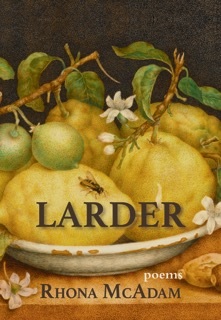
In her latest collection, Rhona McAdam navigates the dark places of human movement through the earth and the exquisite intricacies lingering in backyard gardens and farmlands populated by insects and pollinators, all the while returning to the body, to the tune of staccato beats and the newly discovered symmetries within the human heart.
“…A beautiful, filling collection, Larder is a set of poems to read at the change of the seasons, to appreciate alongside a good meal, and to remind yourself of the beauty in everything, even the things you may not appreciate before opening McAdam’s collection….”
Rhona McAdam is a writer, poet, editor, and Registered Holistic Nutritionist with a Master’s in Food Culture from Italy and a deep-rooted passion for ecology and urban agriculture. Her work spans corporate and technical writing to poetry and creative nonfiction, often exploring the vital links between what we eat and how we live. Based in Victoria, BC, and available via Zoom, Rhona is always open to new writing commissions, readings, or workshops on nutrition and the culinary arts.