-
ALECC 2012 – Space + Memory = Place (days 4&5)
Read Full Post: ALECC 2012 – Space + Memory = Place (days 4&5)Saturday morning we repaired (by schoolbus) to the beautiful spaces at Okanagan College, where the luckiest presenters spoke in the curvy pod at the top of the stairs, but really everything was lovely there, including a fine breakfast of fresh muffins (featuring Okanagan apricots) and lots of fruit.


The best overall session of the conference for me was one called Looking Away, Looking In, Looking Under: Perspectives on the Okanagan on Saturday morning, which featured a lively talk by Kelowna’s own George Grinnell on Patrick Lane’s novel Red Dog, Red Dog which is set in the Okanagan; followed by an entertaining if depressing look at development by another local speaker, Daniel Keyes (White + Green Space Invader: The Rhetoric of Development in the Okanagan) – check out the toe-curling promotional video. Poet, blogger and essayist Harold Rhenisch finished things off with Caraway & Pippins, a luscious essay that circled around the Newtown Apple (each “a tiny earth, a green planet”) as an emblem of the cultural and agrarian changes wrought by commerce and industrialization on the Okanagan.
The Saturday junket to the farmers market was a brilliant idea, but much too short a visit. No sooner had I downed my black bean-chickpea quesadilla than I was sprinting up and down the aisles, power-shopping for produce – a giant fennel bulb, a jar of local salsa, a box of sweet yellow cherry tomatoes – the latter from Curtis Stone, who had mentored another SPIN farmer at the market, Janice Elliott – and trying to find an organic peach grower.


I had come to the Okanagan with a mission: organic peaches were on my mind. As you may know, dear reader, peaches are right near the top of the Dirty Dozen, a couple of fruits below apples, and so one of the best places to put your money when buying organic produce. I’d been warned that I might have to make a side trip to Cawston or Keremeos to find organic growers, as most of the Okanagan fruit in the Kelowna area is chemically produced. At the 11th hour (12:58 in fact, since the stallholders start packing up at 1pm) I was pointed to the Fruit Guy, Michael Welsh, who grows without pesticides and sold me a 20lb case of beauties (he also writes very fine poetry, according to Nancy Holmes, but I didn’t know that at the time.) The catch was I had to drag it back on the bus and get it back to our residence so I could pack it into the car for the morrow’s trip back to Victoria.
Mission accomplished, fruit in hand, grateful to be back in the cool of the building, I settled into an easy chair in the pod for the last Saturday session, Unmemoried Heights? Thinking In/With the Rockies, starring Gyorgyi Voros who took us on an excellent adventure: Wallace Stevens‘ hunting trip to BC; Tempest Emery who talked about landscape and memory in Sid Marty‘s work; and Benedict Fullalove who invoked a host of odd characters, from Rupert Brooke to Viscount Milton & WB Cheadle and Howard O’Hagan before the clock ran out on his Unmemoried Heights: Historicizing the Rockies.
Sunday morning began with probably the best yoga session I’ve ever attended, at 7am on a sunny, dewy lawn overlooking the valley. After that, temperatures already starting to climb, came a blur of packing and vacating and hanging about waiting for the most welcome coffee, fruit and pastries which arrived mid-session: our saintly panel chair released us to seek refreshment mid-panel, while being entertained on the subject of Generation A by Richard Pickard, Cate Sandilands and Jenny Kerber.
I had to depart after that session in order to get to the ferry with reasonable confidence of getting home before midnight; the traffic was horrendous, stop and go for an hour or two on the baking highway beyon
 d Hope, until I got nearer Tsawwassen and those welcome sea breezes. Ironically, given the last session of the conference, the saddest news awaiting me when I returned to my garden later that night was the death of my bumblebee colony. My local entomologist can’t be sure what the cause was, just disease of some kind he thinks.
 -
ALECC 2012 – Space + Memory = Place (day 3)
Read Full Post: ALECC 2012 – Space + Memory = Place (day 3)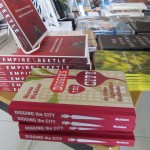 We began our Friday in a state of suspended animation, awaiting the arrival of various participants and speakers who were caught in a spectacular traffic snarl caused by a 3am accident that took down power lines in central Kelowna and led to the complete closure of the city’s main artery, highway 97, in both directions.
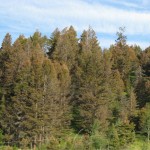
For my part I was grateful and delighted both to see my beautiful new book on the book table, my first glimpse of it, and to have a chance to hear Andrew Nikiforuk – who by some miracle had arrived on time – give what must be a well travelled talk by now, on the impact of the bark beetle on the forests of Canada and many other parts of North America – extending in fact from Alaska to Belize. I’d read about these beetles in The Insatiable Bark Beetle, an informative and particularly charmingly designed fellow filly in my publisher’s Manifesto stable. Nikiforuk’s book, Empire of the Beetle, has the space to go into much more detail about the pros – there are some – and cons of the beetles that are literally changing the face of our planet.
As Nikiforuk pointed, out, beetles make up one third of all animal life on the planet; there
 are over 7,000 species of bark beetles alone. No other living creature can change landscape as quickly as we can except for bark beetles. But they have a crucial environmental role to play in managing the forest, by removing old, sick or drought-stressed trees in order to encourage regrowth. Humans have messed with that role by imposing monoculture on our forests and by interfering with the role that forest fires also play in forest revitalization, not to mention altering the climate so that winters are no longer cold enough to slow the beetles down. In an old tale about man against nature, not to mention man in pursuit of financial profit, humans have tried to destroy the beetles using a range of futile weapons, from poisons (injecting arsenic into the trees), to clearcutting, to explosives and even electrocution. The bark beetles have not only survived every human attempt to eradicate them but adapted to changing conditions of habitat and thwarted all the predictions of scientists, travelling over mountains and switching from lodgepole to jackpine as circumstances required.
 Nikiforuk concluded with some sobering insights. We have taken out all the redundancy in our global forest, and made it highly vulnerable. We have imposed a false stability on the landscape through our use of hydrocarbons. With the effects already occurring to our landscape due to climate change, forests are rapidly changing, and we may be left with grasslands where forests can no longer grow.
As these changes progress, we need to reconnect with the natural world in a way we have not been connected for at least 100 years. In Canada, we make so much money as a resource economy, he said, we forget that 40% of our population is illiterate (why would you fi
 nish school when you can make good money without it in the oilpatch?).
Canada needs to get over its reluctance to address the core of the problem, he told us: who are we as a culture? Do we really want to dig a hole the size of Rhode Island or Delaware in order to keep cars on the road in the United States or China?
Having slipped into the programs of ASLE conferences past by reading poetry, on Friday I made my ALECC debut as a paper presenter, holding the first spot in the first session following the plenary (and following a luscious coffee break in which we were supplied with good quality baked goods and condiments) with my paper Reaping the Past: Gardens as Repositories of Local Food Memory. I reflected on the aspects of memory to be found in soil, seed, plant and gardener, and the impact of our cultural amnesia around food production, drawing on some interesting reading I’d done (I was particularly taken with The Secret Life of Dust). One of my fellow presenters, Jennifer Wheat, took us later for a ramble round lost gardens and the possibilities of guerrilla and community gardening.
For the rest of the conference, technology ruled the sessions I went to, and it was not a benign dictatorship. PowerPoint slides that ran ahead and out of control, papers read off iPads without having been timed, speakers seating themselves squarely in front of their screens, presentations delivered off websites that had to be manually dragged into frame, disappearing pictures, and the irritating Apple-shrinkage of screens at the hands of PC users. It is hard to think of a way we could prevent all these diverse problems in today’s technological ocean, whose tides travel in both positive and negative directions. Bringing a child along to these conferences as technology adviser might be a start.
I had certainly been grateful,earlier in the day, for the tweeted and emailed updates to the traffic situation and the location of key participants. But I also had ample time to reflect, as I have over the years in which technology has overtaken the simplicity of the spoken word in lectures everywhere, on just how many wasted learner-years must have accrued in the endless waiting for technological problems to be righted.
-
ALECC 2012 – Space + Memory = Place (day 2)
Read Full Post: ALECC 2012 – Space + Memory = Place (day 2) The conference got properly underway on Thursday, commencing with an afternoon reading by Cornelia Hoogland, who offered us her essay “Sea Level” which had been finalist in the CBC Nonfiction contest this year, and which opened things up with thought and discussion around wilderness, technology and human-animal boundaries.
We then had the opportunity to take a midday stroll down to Preservation Farm, an organic farming project at UBC Okanagan, where ALECC had thoughtfully purchased the harvest for our lunch: all we had to do was go and pick (or pull) it.


We returned with our bounty and enjoyed a lush and lovely salad before returning to the conference, with papers that touched on issues to do with the forced evacuation in Fukushima following the tsunami, and the forced relocation of some 90 Inuit people to the high Arctic in the 1950s.
There followed a superb reception, featuring extremely good food and entertainment in the form of sound art, which was visible (and audible) enough to be provocative while not dampening conversation. I slipped away to pick up some breakfast and lunch supplies (summer campus food outlets are not really set up for conference guests) and missed the gas leak that I gather forced people outside for a while.


Things were pretty much back on track by the time we returned to take in a generous and entertaining talk and slide show by Newfoundland artist Marlene Creates. (Dim lighting meant she accepted the offer of a headlamp from one of the audience for part of her talk…)
Latest Posts
- Sublime
- Good weather for reading
- The world, the world
- Sublime launch!
- Planet Earth Poetry – Readings by Volunteers, Victoria 2026
- Poetry at the Goldfinch
Aldeburgh Poetry Festival Barny Haughton BBC BC poets Berkswell blackberries Black Stilt Bologna book launch Borough Market Carlo Petrini Catalonia Cyrus Todiwala dairy Daunt's Books Dijon Edinburgh Fanny Bay Feast of Fields Food and Morality food history food journalism Jenna Butler lardo Malahat Review Michael Pollan Okanagan olive oil tasting olive trees Omnivore's Dilemma Our Food Our Future Oxford Parmigiano-Reggiano Planet Earth Poetry poetry poetry readings Poetry videos prosciutto salumi Sean O'Brien Suffolk ticks Wendy Morton Wired Writing Yvonne Blomer
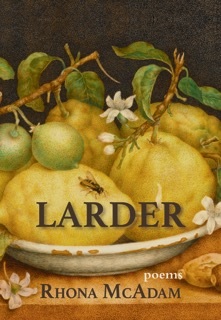
In her latest collection, Rhona McAdam navigates the dark places of human movement through the earth and the exquisite intricacies lingering in backyard gardens and farmlands populated by insects and pollinators, all the while returning to the body, to the tune of staccato beats and the newly discovered symmetries within the human heart.
“…A beautiful, filling collection, Larder is a set of poems to read at the change of the seasons, to appreciate alongside a good meal, and to remind yourself of the beauty in everything, even the things you may not appreciate before opening McAdam’s collection….”
Rhona McAdam is a writer, poet, editor, and Registered Holistic Nutritionist with a Master’s in Food Culture from Italy and a deep-rooted passion for ecology and urban agriculture. Her work spans corporate and technical writing to poetry and creative nonfiction, often exploring the vital links between what we eat and how we live. Based in Victoria, BC, and available via Zoom, Rhona is always open to new writing commissions, readings, or workshops on nutrition and the culinary arts.