-
Jazz et cuisine
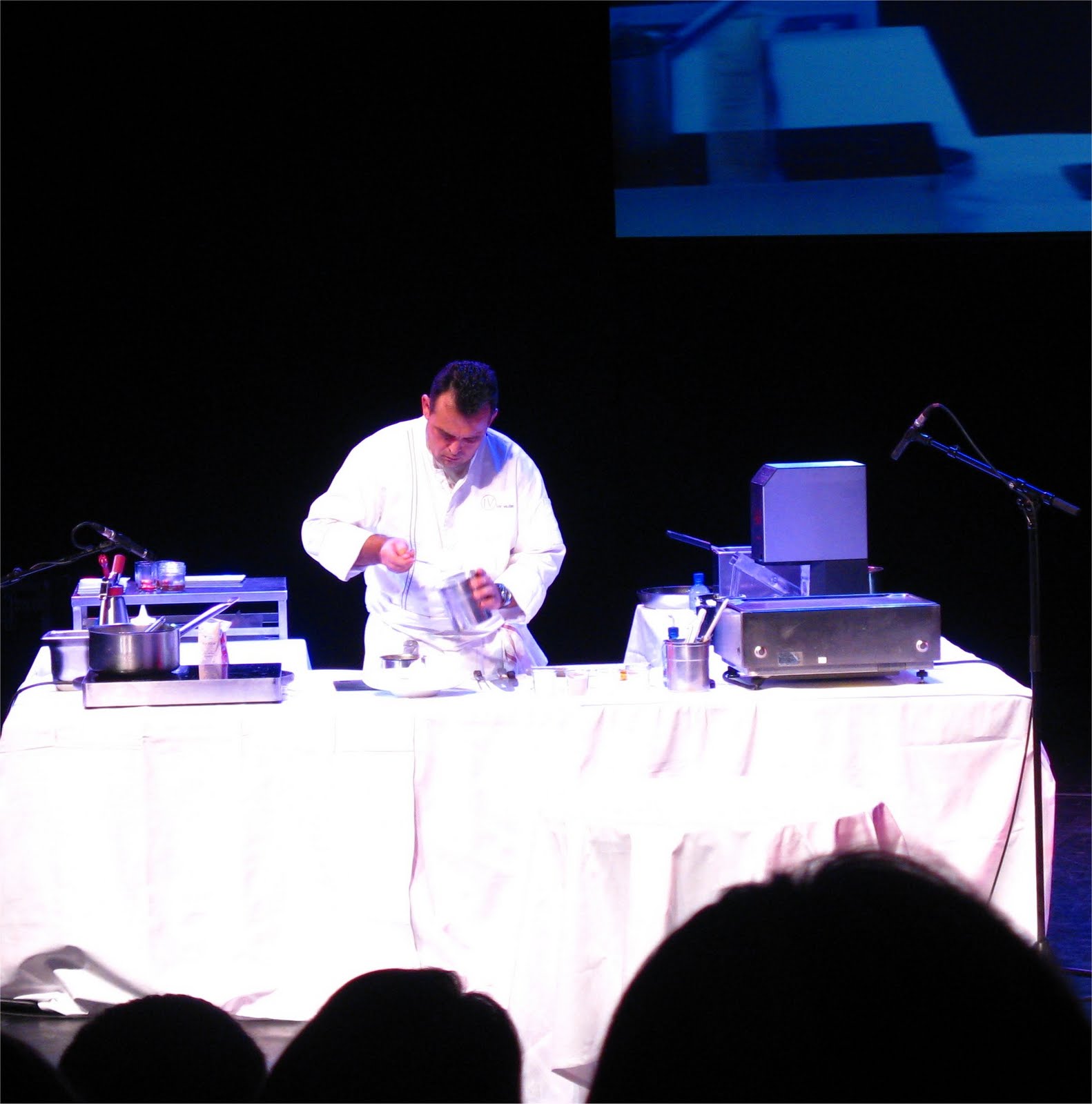
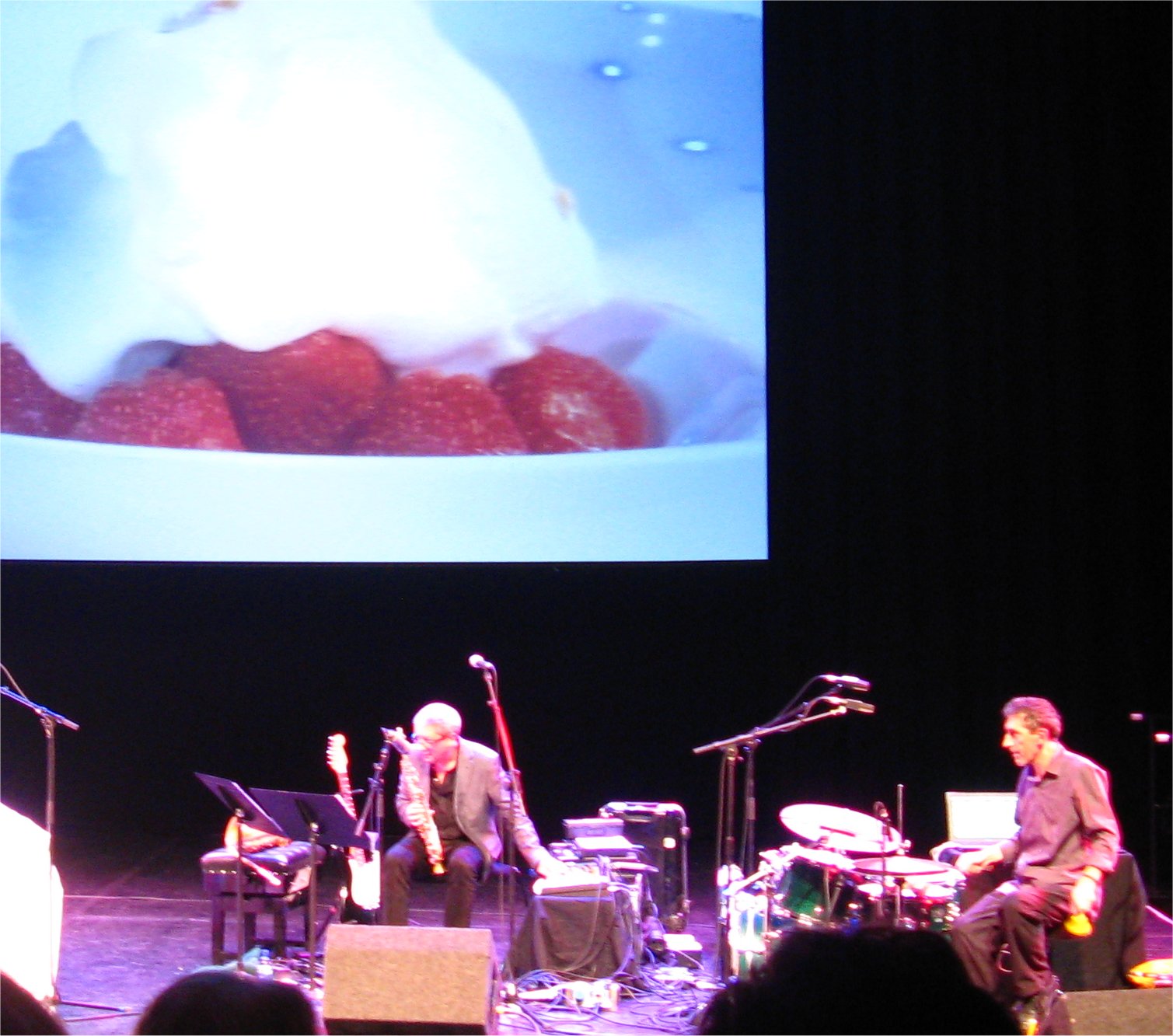
The one concert I went to in the London Jazz Festival was a pretty obvious choice: Jazz et Cuisine promised a “tasty fusion of food and music.”
What we got was a treat for the ears and nose: British musician Andy Sheppard playing clarinet and guitar, and wonderfully imaginative Italian percussionist Michele Rabbia playing just about anything – tinfoil, marbles, shopping bags, his face
– as they improvised around the Gallic bustlings of Ivan Vautier
as he whipped up oddities like Pan-fried foie gras with green asparagus, topped with an egg soft-cooked inside a pastry wrapper and served with raspberry butter,
or Fine pastry onion tart served with lobster, onion sorbet and crispy bacon pieces with sharp cider butter.
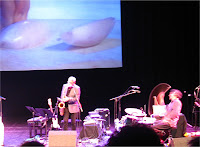
He made nothing I’d particularly care to eat or attempt to cook myself (even if I had some of the molecular gastronomy kit he was using), but it smelled wonderful and was engaging to watch.
And just as well it wasn’t to my taste since the curious British obsession with Health & Safety meant we weren’t allowed so much as a nibble, since the stage of the Queen Elizabeth Hall isn’t a licensed kitchen, and is therefore presumably considered toxic.

What we did get was a “special offer” to show our tickets at the cafe, and receive the opportunity to buy a plate of French cheese and a glass of Merlot for “just £7.50”. I passed, in favour of a nice piece of orange & lavender cake and a mineral water for about half the price. Hmph.
-
Skating around sustainable seafood
We have good fish in BC – as long as you limit your desires pretty much to salmon, halibut, salmon, oysters, salmon, spot prawns and clams. But Britain is, I think, a fish-lover’s paradise, for variety and freshness. Well, Suffolk certainly is. In London the price is such that many of the offerings are for special occasions only: the price of quality in an expensive city. And a fishmonger’s view of sustainability is, like that of any vested interest, fraught with contradiction and self-protection.
So it’s interesting to look at what’s on offer, and consider what ethical repercussions there are for fish consumption, here in the land of End of the Line, whose seafood widget is actually a link to information from the Monterey Bay Seafood Watch – so most relevant to American consumers. Though fish are poor respecters of national boundaries, you can cross-check your choices using the Greenpeace Red List, or the Marine Conservation Society‘s Fishonline Purchasing Guide. Canadians can consult the SeaChoice database.
Here’s an example of what kind of information you’ll get if you ask your fishmonger (which you should, anyway, so they know you’re interested in where your food comes from). I was at a farm shop in Suffolk last week, where a new sustainable seafood shop had opened earlier in the year, which promises to stock only fish supplied by skippers who catch in a sustainable way.
I noticed skate on sale and asked about it, because I had an idea it was endangered.Yes, the woman told me, it is endangered, but this is not skate, it’s ray. We just label it as skate because people know it as such. The catch is controlled, she added. So I asked the fishmonger in London, on Turnham Green Terrace, who also had skate on sale. Rubbish, he told me: skates are from the ray family (Rajidae), so there’s no distinction. And not in the least endangered; plenty of them about, especially this time of year.
Consult the sustainable seafood guides, and you find a much more complicated story. Greenpeace has skate on its red list because its numbers are threatened (they breed and mature very slowly), they are caught by unsustainable fishing methods (most are bycatch in otter or bottom trawling), and are subject to pirate (illegal, unregulated and unreported) fishing. They do not appear at all on the FishOnline purchasing guide, and when you search for information on skate, you find that common skate (Dipturus batis) is considered critically endangered; the number of remaining stocks is unknown; and since January 2009 it has been illegal for fishermen to retain and land common skate caught in EU waters.
FishOnline does allow that other faster-growing varieties of ray are considered sustainable at the moment: but only if you deal with a reputable fishmonger, whom you can completely trust to know the source of the fish he’s selling. But look at the age of the fish considered as fast-growing (common skate takes 10 years to mature):
Avoid eating skates and rays unless you are certain they are one of the smaller, more sustainable species such as spotted, cuckoo, or starry rays from the North Sea and Celtic Seas. Avoid eating these species below the size at which they mature: spotted ray males mature at a length of about 54 cm and females at about 57 cm (both between 3 to 8 years old); cuckoo ray males and females mature at between 54 to 59 cm in length when approximately 4 years old; starry ray males and females mature at a length of about 40 cm (between 4 and 5 years old)
(Source: FishOnline)SeaChoice puts seven species of Atlantic skate – including those very subspecies spotted and starry skate – on its Avoid list (a High concern rather than Critical at this point), adding other common names: raja fish, imitation scallop, briar skate, common skate, summer skate, hedgehog skate, tobacco-box skate, leopard skate, smooth-tailed skate, prickly skate, eyed skate, big skate (and in Latin: Dipturus laevis, Raja eglanteria, Leucoraja erinacea, Leucoraja garmanii, Malacoraja senta, Amblyraja radiata, Leucoraja ocellata).
Though it used to be routinely discarded, nowadays skate is used for food (skate wings or imitation scallops) as well as bait, mainly for the lobster industry. If obtained as bycatch from trawling (which accounts for 97%+ of skate on the market), you run the risk of buying a fish that is undersized and/or was harvested dead, and may be subject to ammonia taint.
-
Poetry v. poultry
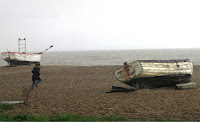
Aldeburgh ended with a lecture and a reading. At the crack of noon-thirty, our English comprehension was sorely tested by Don Paterson‘s speed-readings of a selected few of Robert Frost’s poems (West-Running Brook; Design; and To Earthward). He peppered his talk with a few high-falutin’ bits of terminology (autopoiesis, domain theory, thematic domain, emergence) which seemed to be summable as: Frost’s poems are highly crafted and admirably self-contained with imagery so integrated the poems are unimaginable in any other form. Well, quite: but much better said in a talk which we can only hope will soon appear on Paterson’s website where we can enjoy it at a slower speed.
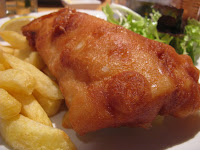
We sprinted out for some fish and chips
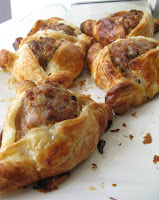
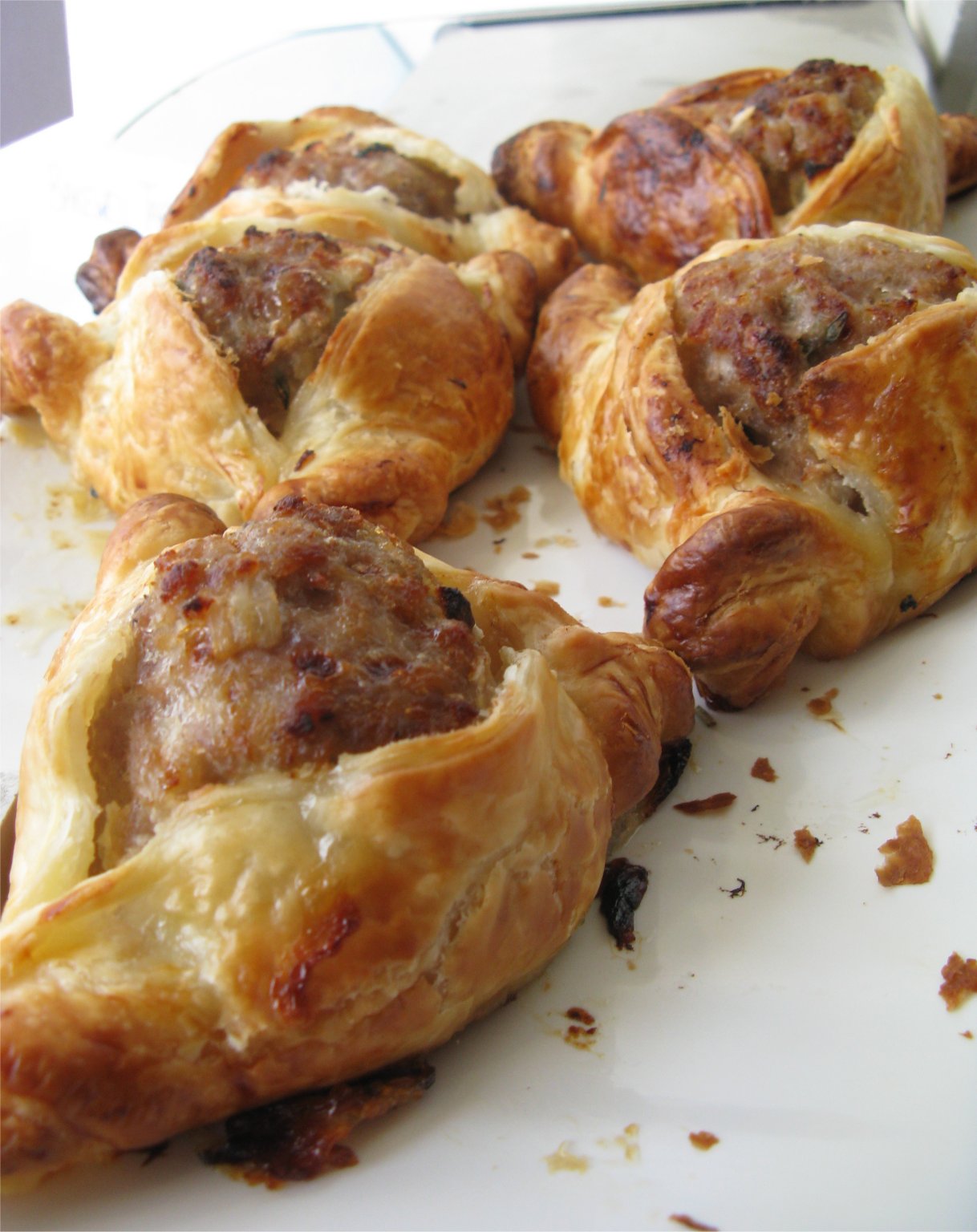
and were back in our seats – after a quick and admiring visit to Lawson’s Deli
and a sudden drenching by the changeable weather – in time for the final reading. We heard from Lars Gustafsson (Sweden), Marie Howe (USA) and Bill Manhire (New Zealand).
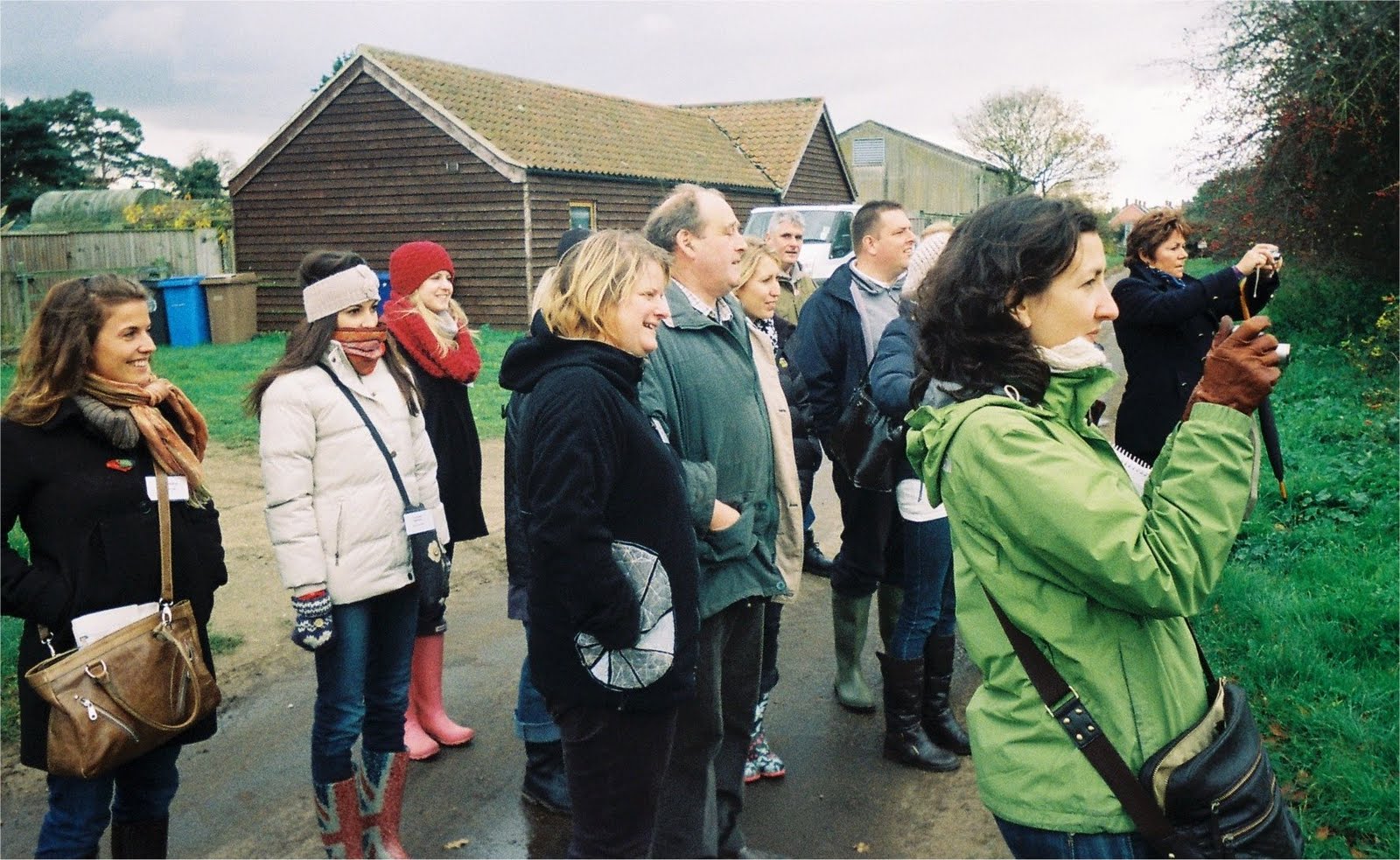
A couple of days’ rest and fasting in London ensued. Yesterday I roused myself and joined a small throng of sustainable foodies
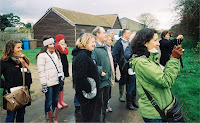
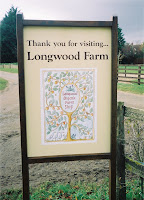
to travel to a different part of Suffolk for an Ethical Eats farm visit to Longwood Farm, run by Matthew and Louise Unwin. We were accompanied by Alison Mood from Compassion in World Farming, who gave a short presentation – somewhat hampered by technological glitches during the showing of this video on the treatment of farm animals.
After the talk, we were fed an enormous lunch featuring chicken and vegetables raised on Longwood Farm. We hoisted ourselves to our feet and with organic farmer and butcher Matthew Unwin
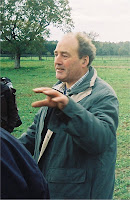
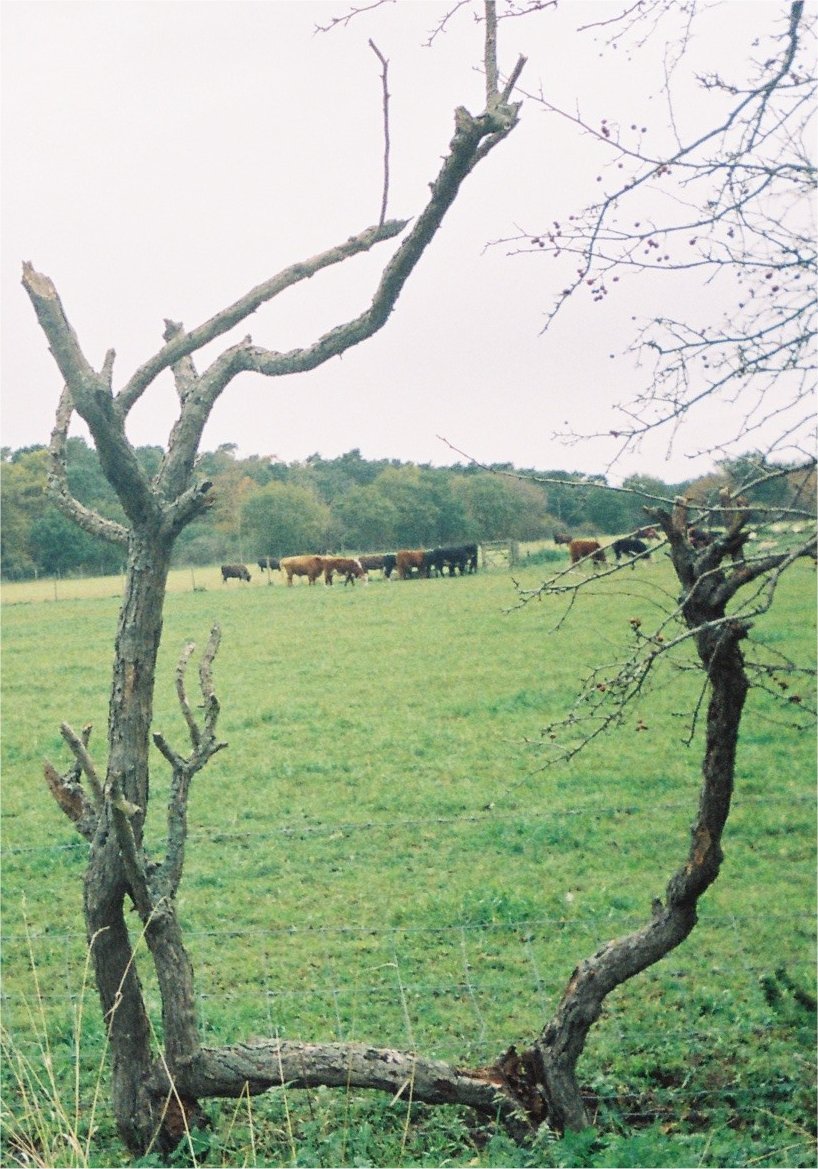
as guide, set off on a tour of the farm, which includes beef,
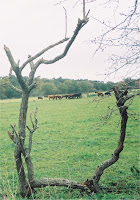
turkeys, chickens, sheep and geese (and an excellent farm shop stuffed with organic vegetables and grocery staples).
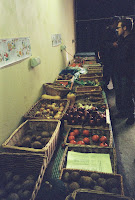
An organic pig farmer leases land on Longwood Farm as well, operating on a four-year rotation. This encourages soil fertility and the growth of forage crops for the other animals. The pigs are moved onto new ground as they’re weaned, so the process takes about six months each year.
A warm interlude in the chick barn, where week-old fluffballs were basking under a heat lamp and listening (no lie!) to The Archers. Where chicks are reared like these ones, without the medications routinely administered in conventional animal farming, organic farmers expect to lose a small percentage, particularly in the first week or so (he’d lost 14 of the 400 we saw). They are kept indoors and warm until they are about 3-4 weeks old, and given some heat until they are about 6 weeks old, after which they can spend the rest of their lives freely ranging (to meet regulations, two-thirds of their life must be lived free range). They live in sheds on runners, so they can be moved around the property, and at their earliest age can fall victim to a surprising list of predators: seagulls are the worst offenders, but rats and crows can also go after them.
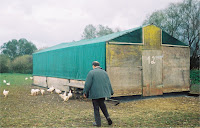
We had a sobering lesson in fowl behaviour and the gruesomely literal imposition of the pecking order when we reached the farthest chicken barn. Most free range chickens like this are happy and peaceful enough, but every few years, says Unwin, there’s a savage lot – probably only one or two troublemakers who manage to rile the whole flock. They start fights that end up with one of their number killed, and then eaten (like pigs, chickens are not vegetarians – which we witness less queasily in their fondness for insects). He has been trying to identify the perpetrator but so far hasn’t found it, and in the meantime regularly finds corpses. These chickens are being reared for the Christmas market so will be slaughtered at 16 weeks when they are good and plump, so the problem won’t go on much longer for this group.
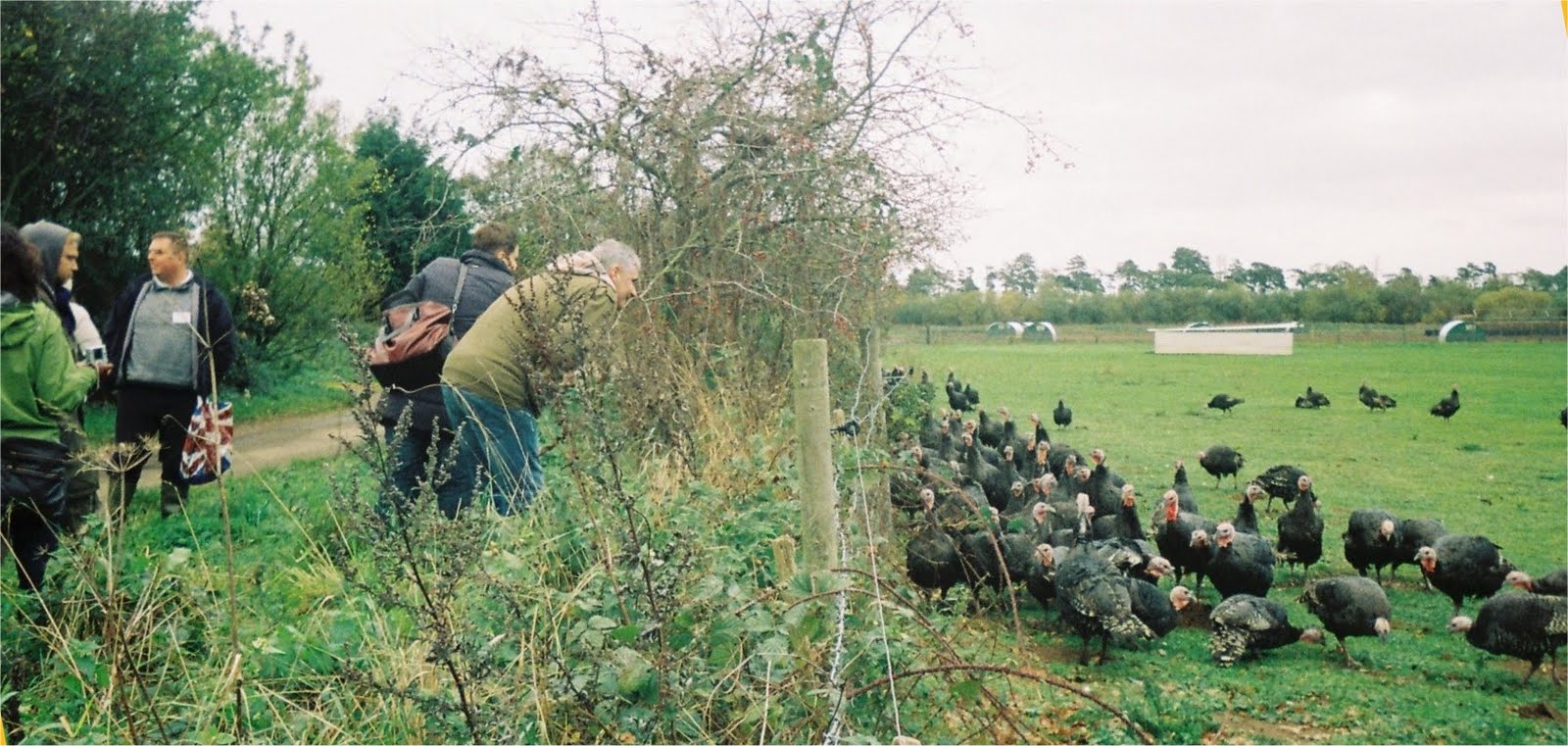
The turkeys were numerous and curious. Organic pasture-raised Kelly Bronze turkeys like these command about £12.50 a kilo. They take 6 months to rear and are then hung for 3 weeks. Their flavour, of course, is excellent as a result, and they are free of the medications that intensively farmed turkeys are administered from day one.
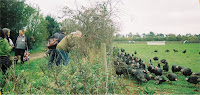
Unwin has a lot to say about the differences between organic and intensive farming. When discussing the price of his turkeys, he drew what I thought was a very apt comparison: while people are willing to pay a premium for quality in cars, acknowledging for example that there are good reasons why a Rolls-Royce or Ferrari should cost so much more than an everyday beater: but when food-shopping by price alone as we’ve been taught to do, consumers don’t recognise the comparable difference worth paying for in food. Which is endlessly ironic in this one consumable that we so literally consume.
(In comparison: intensively-farmed Broad-Breasted White turkeys – bred, as we all surely know now, to be so top-heavy they’re unable to breed naturally – are typically brought to slaughter weight at 4 months. Having legs too weak to support their weight, and being reared in overcrowded conditions, they do not develop a normal muscle structure, so the flesh of the Broad-Breasted White is soft and watery (partly due to processing which means they are soaked in a water bath, and may absorb up to 5% water as a result) and heavily oriented to white meat.)










Latest Posts
- Sublime
- Good weather for reading
- The world, the world
- Sublime launch!
- Planet Earth Poetry – Readings by Volunteers, Victoria 2026
- Poetry at the Goldfinch
Aldeburgh Poetry Festival Barny Haughton BBC BC poets Berkswell blackberries Black Stilt Bologna book launch Borough Market Caerphilly Carlo Petrini Catalonia culatello Cyrus Todiwala dairy Dijon Edinburgh Fanny Bay Feast of Fields ferries Food and Morality food journalism Michael Pollan olive oil tasting Omnivore's Dilemma Our Food Our Future Oxford Parmigiano-Reggiano persimmons Planet Earth Poetry poetry poetry readings Poetry videos prosciutto salumi Sean O'Brien sensory analysis Suffolk ticks tortelli di zucca Troubadour Wendell Berry Wendy Morton Yvonne Blomer
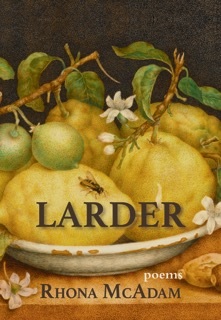
In her latest collection, Rhona McAdam navigates the dark places of human movement through the earth and the exquisite intricacies lingering in backyard gardens and farmlands populated by insects and pollinators, all the while returning to the body, to the tune of staccato beats and the newly discovered symmetries within the human heart.
“…A beautiful, filling collection, Larder is a set of poems to read at the change of the seasons, to appreciate alongside a good meal, and to remind yourself of the beauty in everything, even the things you may not appreciate before opening McAdam’s collection….”
Rhona McAdam is a writer, poet, editor, and Registered Holistic Nutritionist with a Master’s in Food Culture from Italy and a deep-rooted passion for ecology and urban agriculture. Her work spans corporate and technical writing to poetry and creative nonfiction, often exploring the vital links between what we eat and how we live. Based in Victoria, BC, and available via Zoom, Rhona is always open to new writing commissions, readings, or workshops on nutrition and the culinary arts.