-
Cheesy farewell to Toronto
Read Full Post: Cheesy farewell to Toronto
I was thinking it would be nice to take some Eastern cheeses back west with me, and when I asked about cheese shops, Sandra suggested Nancy’s Cheese on Dupont at Spadina. I duly sweltered along there in the late morning heat of departure day, and was able to take a good long look at the current offerings while Nancy set up an order for someone’s cheese tasting party.
I was pleased to see the cheese selection was relatively modest

– decision-making is hard enough – and Nancy

was generous with the samples and her knowledge.
It was mostly Ontario and Quebec cheese – just what I was after – plus a few well-chosen foreigners (Parmigiano-Reggiano, Gruyère, Brie de Meaux (raw milk brie), Aged Beemster).
Here’s some Bleu Bénédictin

which I didn’t buy, but I came away with a good and interesting selection:

Bleu D’Elizabeth (Quebec); Avonlea Cloth Bound Cheddar (PEI); Le 1608 (Quebec); Île-aux-Grues 2 Year Old Cheddar (Quebec); Cape Vessey (Ontario – washed-rind aged goat cheese which I encountered at its orgins in Picton County last year); Paradiso (Ontario – sheep’s milk cheese).
I like the informative labels and look forward to sharing…
-
Wychwood & more TWUC
Read Full Post: Wychwood & more TWUCManaged to fit a flying visit to the Wychwood BarnsFarmers Market in before the Writers Union meeting plenary on Saturday. It opens at 8 for the summer season. Another misty morning

but enough vendors and a steady stream of custom that showed it to be a healthy neighbourhood market. Lots of variety: local honey, wool, assorted wild foods from around the country – including maple syrup, dried wild mushrooms (from BC), saskatoons (from Saskatchewan), wild rice, ocal fresh ramps (wild leeks)
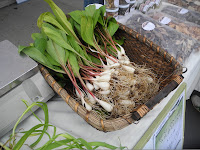
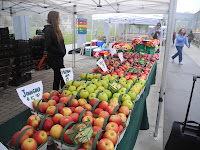
and exotic pickles (like spruce tips and cattail hearts). And produce of course, including some spectacular Ontario apples,
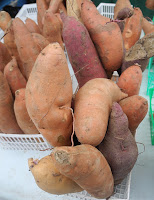
sweet potatoes (I think he said the variety was Bordeaux, not the Georgia Jet I’m growing in 5 gallon pails this year),
asparagus,

and some fine vegetables
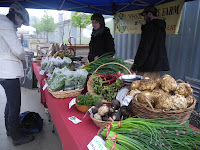
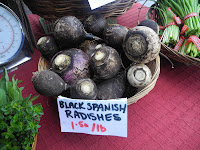
including a couple of beautiful winter roots, both of which I’ll be planting again this year myself:

It’s a well organized market, which operates year round thanks to the shelter of the barns. There’s a sensible scheme for the bakers, which keeps them well under cover while the other vendors are under tents:

Then I sprinted off to catch a streetcar and a subway and settle in to a good day’s politicking with the writers. Copyright was the most active topic. Passion on both sides of the discussion, which had to do with the manner in which copyright fees are distributed to creative artists. It could have been a long-winded and ugly discussion, but chair Alan Cumyn managed to guide the concise and respectful speakers through to the vote with a firm and friendly hand. It was a great meeting, after which the writers passed a couple of free hours gearing up for the banquet and short readings and presentation of the Danuta Gleed award (to Billie Livingston for Greedy Little Eyes). And then it was time for 3 Chord Johnny
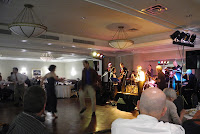
to bring it on home: great stuff, not least because the musicians are all writers. We danced our feets off and then were regaled for an hour or so by a rogue fire alarm which attracted a swarm of fire engines and slowed the ascent to the after party.
Today’s meeting, in which the gavel was handed over to incoming chair Greg Hollingshead,
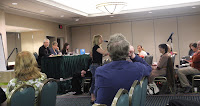
was a peaceable wrap-up with elections and farewells.. until next year in Vancouver.
-
TWUC 2011
Read Full Post: TWUC 2011Like anyone with that ominous birthday on the horizon, I’d say the Writers Union of Canada approaches its fortieth (2012) with a year-before do in Toronto that combines about the right mix of congeniality, information overload, anxiety and a drop or a bite too much to drink or eat.
Today was the day of workshops, also known of the day of impossible choices. The sessions were recorded, so it should be possible to catch up later with what I missed. We had the relative novelty of a book table this year
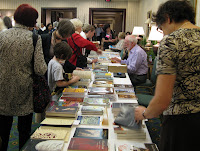
for the first time in several years. It seems to be going well.
The Public Lending Right session offered some ominous rumblings about the fate of this 25 year old institution that’s put a few bucks in the pockets of Canadian writers whose books are in the holdings of Canadian libraries. It’s at risk now because of digital publishing – which could drain the system dry if it tries to compensate authors of with new or repurposed electronic titles (not currently included) at a time when PLR funds have already ebbed away to half the per capita amounts enjoyed 25 years ago, due to lack of new moneys to meet the influx of new print titles to the funding pool. Though its cheques are shrinking, they’re incredibly valuable to writers living on marginal incomes; but its future, like other federal spending initiatives, could well be at risk with promised funding cuts coming from a government whose commitment to culture is, shall we say, unclear. And the whole digital rights question is, in the words of panelist Michael Elcock, the “kind of thing that turns your brain to porridge”.
We replenished ours with a break and then returned to porridge country in the New Gatekeepers session, which was more about epublishing and emarketing. Much of the discussion batted around the relevance of publishers (which pay about 10% in conventional royalties, or if you’re lucky some 25% in erights) versus self-publishing or self-representation through the likes of Kobo or Smashwords (where you’d get as much as 70% – but potentially then have to shell out for the kinds of services publishers usually handle: editorial and marketing and administrative). Mention was made of interesting innovations like Cellstories, which publishes short fiction, or Kickstarter, which allows artists to pitch ideas and raise money to carry their projects out; and publisher ECW was there talking about its digital arm, Joyland, which takes only erights, leaving writers free to seek out print publishers separately (or not at all) and is looking into subscription publishing which would allow it to publish up to three such titles a year.
Thus boggled, we briefly emerged to lunch on bi-bim-bap and returned to hear about The New Realities of Book Publishing, which were – you guessed it – largely about epublishing and emarketing. One independent bookseller held out against the flow of chat about blogging and tweeting and social networking to argue that there was still a place for a good bookstore owned and staffed by people who read and love books and can serve customers who do likewise. In support of this, one of the few under-forties writers at the meeting -a teacher – described bibliomania days where her grade 5 and 6 students wore pyjamas to school and lay around reading books all day – a wildly popular program!
Some seriously calorific treats helped us leap the mid-afternoon slump and make it through The Writer as Promoter (Or, Who Has Time to Write) (or, as a panelist quipped, Shouldn’t My Publisher Be Doing This). Wherein there was more chat about blogging and tweeting and social networks. Cassandra Sadek, the director of online marketing for Random House, said that publishers should be guiding authors in building their online presence, and using that to allow readers to be their “brand ambassadors”. Author Cathy Marie Buchanan features a little tutorial about skyping on her website so that she can use it to speak virtually to book club meetings, and also gives live chats on GoodReads (a good place for fiction writers, apparently). Resident curmudgeon Russell Smith was left to object to the idea of thinking like a marketer which he said would mean commoditizing one’s own writing and aiming it to please a target audience rather than writing for writing’s sake: “I also don’t like the idea of “brand”” he said: “I don’t want ‘brand ambassadors for a product’ I want ‘readers for my novel’.”
Then after a swift round of regional meetings it was time to forage for supper. The Pilot pub

may have literary cred, but it was full and noisy on a Friday night so we opted for the quieter confines of the Coffee Mill, which Myrna says is a long-lived Hungarian restaurant, which offered a fair spinach pie

that fueled me for the Margaret Laurence Lecture, introduced by outgoing union chair Alan Cumyn

in which Graeme Gibson
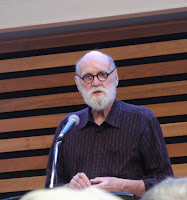
spoke on A Writer’s Life. It was an entertaining tour through his travels in Europe and his beginnings as a novelist, which were as bumbling as any, but distinguished by dedication that still sees him writing some 40 years after his first novel was published. He was also one of the founders of the union, so a description of its humble beginnings rounded out his talk.
And more there will be tomorrow.


Latest Posts
- Writers at Word!
- Sublime and Twisted Readings coming up!
- Sublime
- Good weather for reading
- The world, the world
- Sublime launch!
Aldeburgh Poetry Festival Barny Haughton BBC BC poets Berkswell blackberries Black Stilt Bologna book launch Borough Market Carlo Petrini Catalonia Cyrus Todiwala dairy Daunt's Books Dijon Edinburgh Fanny Bay Feast of Fields Food and Morality food history food journalism Jenna Butler lardo Malahat Review Michael Pollan Okanagan olive oil tasting olive trees Omnivore's Dilemma Our Food Our Future Oxford Parmigiano-Reggiano Planet Earth Poetry poetry poetry readings Poetry videos prosciutto salumi Sean O'Brien Suffolk ticks Wendy Morton Wired Writing Yvonne Blomer
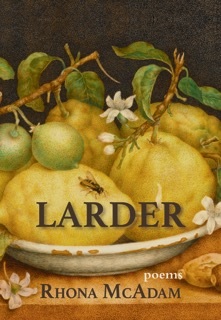
In her latest collection, Rhona McAdam navigates the dark places of human movement through the earth and the exquisite intricacies lingering in backyard gardens and farmlands populated by insects and pollinators, all the while returning to the body, to the tune of staccato beats and the newly discovered symmetries within the human heart.
“…A beautiful, filling collection, Larder is a set of poems to read at the change of the seasons, to appreciate alongside a good meal, and to remind yourself of the beauty in everything, even the things you may not appreciate before opening McAdam’s collection….”
Rhona McAdam is a writer, poet, editor, and Registered Holistic Nutritionist with a Master’s in Food Culture from Italy and a deep-rooted passion for ecology and urban agriculture. Her work spans corporate and technical writing to poetry and creative nonfiction, often exploring the vital links between what we eat and how we live. Based in Victoria, BC, and available via Zoom, Rhona is always open to new writing commissions, readings, or workshops on nutrition and the culinary arts.