-
ASLE 3: food
There were 15 thematic streams running through the conference (though no stream was water, ha ha) and of course my interests leaned most heavily on stream 6: Food production, food consumption, and waste.
Which calls for some mention of foods consumed since arrival.
We wandered over to the nearby pub for a bite the first
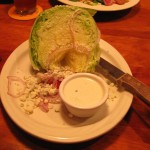 night, for a lesson in portions and the semiotics of Indiana menus. This is what “lettuce wedge” denotes in Bloomington:
while P’s tuna salad with plantain and
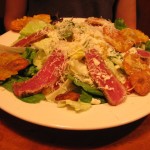 vegetative miscellany was similarly scaled for prairie sized appetites, and, one suspects, not targeted at locavores.
And speaking of size, check out this guy’s paws! I was not in a squirrel-eating mood, but later that evening I did enjoy the Ethiopian meal which was all the more delightful for having been served at a restaurant which also had an Italian menu, as the owner is Italian-Ethiopian, which with the Persian chef, makes for some interesting food.
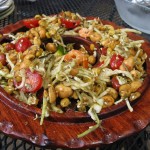
The other favourite was the Burmese restaurant which offered a Tea Leaf Salad and some excellent eggplant.
But. Turning back to the conference.
In Thursday’s session on Food Aesthetics: from Modernism to Postmodernism, Jesse Oak Taylor – in Nose to Tail Modernism – addressed the foods of Ulysses as presented by Fergus Henderson in St John Restaurant and his cookbook Nose to Tail Eating: the ‘everything but the squeal’ menu (Upton Sinclair, The Jungle); concluding that Henderson was aiming to teach readers how to eat as much as how to cook; that respect for the animal was often seen as part of this (not wasting edible parts) but that of course from the animal’s point of view this was irrelevant (“dinner doesn’t care about the sauce”).
On the same panel, I also enjoyed Dan Philippon‘s talk Little House on the Foodshed, which looked at the idea of the Little House books as models of sustainable consumption and noted that modern day locavores Alisa Smith/J.B. MacKinnon, Barbara Kingsolver and Bill McKibben had referenced Wilder.
There were a couple of panels on food, film and ecocriticism. In one, Robert Boschman spoke on E.coli 0157: H7 poisoning – a personal look based on the life-threatening experience of his two pre-school children that led him to explore food safety from many angles, including the recent appearance of Cargill on the Oprah show; Dominique Laporte’s well known work from the 1970s; Marion Nestle; and the curious repression of drug treatments (that saved his daughters) developed to fight E.coli poisoning. His concluding words were that the experience – and ensuing research – changed his family’s eating patterns forever: although he lives in the heart of cattle country, he will not allow beef of any kind in his home.
Joseph K. Heumann followed, showing Our Daily Bread while speaking on Eco-Food Films: The Documentary Tradition; a little too interesting a film for a backdrop. And at that point I had to flee to prepare for my own reading, on the Creative Approaches to Food and Farming panel where I read food poetry and was thereafter most interested in Stella Capek‘s essay about cheese and bacteria, called A Fine Line.
-
ASLE 2: gardens
One of the features of ASLE conferences most beloved by attendees
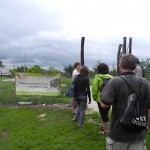 is the choice of activities slotted in to highlight the environmental features of the host region. My Friday afternoon pick was a tour of the Bloomington Community Orchard. The 44-variety organic orchard was planted last October, so it will be a couple of years before it’s bearing fruit (although there are berry bushes which will keep volunteers interested until then, perhaps).
It’s adminis
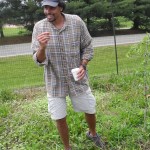 tered by a volunteer board and has received grants already from Toms of Maine and Edys Ice Cream. Our guide, board member Ross Gay, said the grants were helpful as they gave the orchard focus through its beginnings, since the requirements – to carry out educational projects and the like – had to be satisfied within a strict time period.
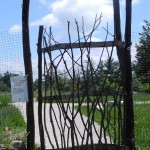 Situated at one end of land that was a former pig farm, the orchard is ringed by deer fencing and punctuated with handmade gates and posts of local locust wood.
They try to use local materials wherever possible: the paths are made from local limestone which, compacted for use, are firm and even enough for wheelchair access. The garden shed was built with reclaimed wood, recycled materials and volunteer labour; the compost included
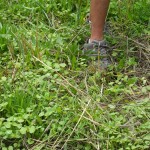 donated leavings from a local brewery (until the eau de organic matter put a halt to that ingredient).
Though water – and nutrients – are being carefully nurtured in the soil (groundcovers like rye and buckwheat are planted, and levelled with sickles), water will be an issue to be faced in the future because the cost of extending the water p
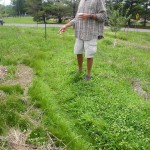 ipes is prohibitive for a nonprofit. So there are plans for a cistern and water harvesting in the works; meanwhile, in keeping with the permaculture principles being used in its design, the orchard boasts this swale which holds water along the contour of the orchard.
Efficient use of resources means improvising and using sustainable gardening methods. Permaculturalists love comfrey as a dynamic accumulator, its use as a green manure, and its size which kee
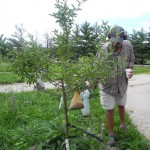 ps down weeds, so it’s been planted around all the trees. The bagged decorations are actually weights intended to train the tree limbs into a horizontal or downward growth; and most of the trunks are protected with wrapping (rabbits and other rodents would be the chief culprits here, I suppose, as the fencing should keep the deer out).
We had time to have a nose round the nearby community gardens
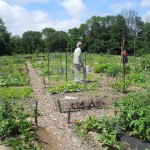 as well, where a few people were pottering around on a Friday afternoon. Things were looking pretty healthy, despite a lot of Japanese beetles sunning themselves on corn leaves; a reminder that community includes shared pests… like this potato beetle in its striped pyjamas.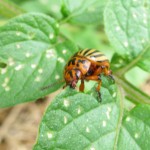
-
ASLE 1: water
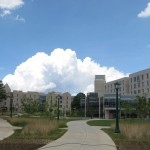 Every so often I end up temporarily on a new university campus, struggling to locate oddly-situated and randomly-numbered rooms in unmarked buildings. While I retrace miles of wasted footsteps, I have ample time to reflect on the importance of signposting and the absence of an inner compass which would allow me to make intended use of the maps and directional notes with which we start these journeys. The friendly young man who checked me into my dorm the other night, one of a clutch of sustainable buildings named for trees (by his hand mine was spelled ceader) told me that I’d find most of the ASLE sessions by following a sort of path alo
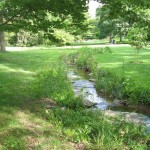 ng a creek – “it’s kind of hard to explain,” he concluded.
I did eventually find that elusive path, and the buildings are starting to look more familiar. Somehow I’ve found my way to a few sessions over the past couple of days.
Aquatic Intelligence: A Panel to Explore Relationships with Water has been about the best panel I’ve been to so far (aside from my own, ahem). Gyorgyi Voros started us off with an overview of the watery module in the Earth Sustainability course she taught, and particularly the role of the “Gathering of the waters” exercise, inspired by Basia Irland‘s similarly named 5-year project along the Rio Grande.
Kate Berry then stepped in to say a few words on Basia Irland’s behalf – as she’d had to cancel – about her Waterborne Micro-Pathogens project: she’s created “scrolls” from sari silk (because this is used in India to filter drinking water) with images of some of “the waterborne diseases that kill a child every eight seconds somewhere in the world.” They’re floated in rivers and hung in wells and other appropriate locations.
Berry, a geographer from the U of Nevada, then carried on with her own paper, The Rhetoric of Water Crises and Metrics of Drought, in which she deplored the shoe-horning of the term “crisis” into every contemporary environmental issue we face, and argued that while engagement is needed, crisis is not. Using this rhetoric pits those who acknowledge the crisis against those who don’t; and entangles it in bigger issues, making it something that endlessly changes and therefore becomes fundamentally unsolvable; and it tends to puts us in a position of having to master a crisis rather than adapting to a changing environment. Later a questioner commented on humanity’s search for stasis in a constantly changing world; although it was also agreed there’s a difference between evolving features and imposed/rapid change of the kind that does get labelled “crisis.”
Finally, Jennifer Wheat, from the U of Hawaii, spoke, in part from her own experience, on Never Turn Your Back on the Ocean: Wild Swimming and Eco-Activism, which touched on such aspects as the difficulty of engaging with something you can’t see – water can look clear but carry contaminants that can affect us by ingestion, immersion or accidental contact; she talked about the deliberate, Monsanto-funded poisoning of mangrove swamps that – though not native to Hawaii – do harbour native fish nurseries and protect against tsunamis; and the difficulties of ownership and custody of shared water.
Latest Posts
- Sublime
- Good weather for reading
- The world, the world
- Sublime launch!
- Planet Earth Poetry – Readings by Volunteers, Victoria 2026
- Poetry at the Goldfinch
Aldeburgh Poetry Festival Barny Haughton BBC BC poets Berkswell blackberries Black Stilt Bologna book launch Borough Market Caerphilly Carlo Petrini Catalonia culatello Cyrus Todiwala dairy Dijon Edinburgh Fanny Bay Feast of Fields ferries Food and Morality food journalism Michael Pollan olive oil tasting Omnivore's Dilemma Our Food Our Future Oxford Parmigiano-Reggiano persimmons Planet Earth Poetry poetry poetry readings Poetry videos prosciutto salumi Sean O'Brien sensory analysis Suffolk ticks tortelli di zucca Troubadour Wendell Berry Wendy Morton Yvonne Blomer

In her latest collection, Rhona McAdam navigates the dark places of human movement through the earth and the exquisite intricacies lingering in backyard gardens and farmlands populated by insects and pollinators, all the while returning to the body, to the tune of staccato beats and the newly discovered symmetries within the human heart.
“…A beautiful, filling collection, Larder is a set of poems to read at the change of the seasons, to appreciate alongside a good meal, and to remind yourself of the beauty in everything, even the things you may not appreciate before opening McAdam’s collection….”
Rhona McAdam is a writer, poet, editor, and Registered Holistic Nutritionist with a Master’s in Food Culture from Italy and a deep-rooted passion for ecology and urban agriculture. Her work spans corporate and technical writing to poetry and creative nonfiction, often exploring the vital links between what we eat and how we live. Based in Victoria, BC, and available via Zoom, Rhona is always open to new writing commissions, readings, or workshops on nutrition and the culinary arts.
