-
Oysters, Abattoir, perennial food crops and Eco-Fair
Read Full Post: Oysters, Abattoir, perennial food crops and Eco-Fair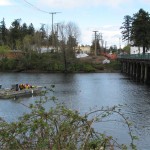 All blissfully quiet at my end of the Gorge these days, now that Craigflower Bridge has been closed for rebuilding and traffic re-routed. I was gratified to learn that not only were there viable
 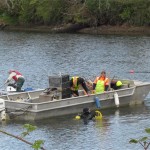 oyster beds in the Gorge, but the planners had taken steps to relocate and preserve them so that the construction does not do away with this rare species (for the next eight months or so). These are our native Olympia oysters, not the Pacific upstarts introduced from Japan that now dominate the West Coast’s shoreline and oyster farming operations. I happened to pass what I assume to be the relocation action as it was unfolding and snapped them at it.
Meanwhile, I’ve been spreading myself thin in recent weeks, trying to keep up with different social media (Twitter, Facebook and most recently Pinterest), working on some of my own writing, and going nose to grindstone with my holistic nutrition studies. We’re deep into preventive nutrition this month, studying up on nutritional approaches to digestive, blood sugar, cardiovascular and arthritic conditions. Quite a ride.
 On Friday I returned from Nanaimo via Salt Spring Island where the community abattoir was officially launched with an open house in the drizzly rain. I’d visited earlier this year but was interested to have a look at the finished structure. There is more work to be done if larger animals (cattle) are to be slaughtered here, but it’s up and running for poultry, rabbit, goat and lamb. It’s going very well so far: an arrangement with a local farmer has meant all the offal and skins are being composted, which has taken one of the main economic headaches for an abattoir out of the picture, and has solid community support – no small achievement for this kind of business.
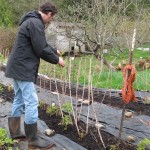 Saturday I took in a workshop on perennial fruit crops at ALM Farm in Sooke, in which farmer Jordan took us for a tour of the farm’s apple, pear, fig and plum trees, kiwi vines, strawberries, raspberries, rhubarb, Jerusalem artichokes, hazelnuts, gooseberries, herbs and asparagus before I had to whistle off to take my place behind my books, alongside the Haliburton farmers at the Reynolds School Eco-Fair
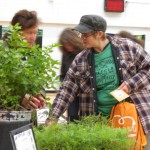 . It was a lively and well-attended event with speakers including Green Party leader Elizabeth May and Brandy Gallagher from O.U.R. Ecovillage, and lots of well-chosen information tables, including Pedal to Petal, LifeCycles, Growing Young Farmers, Organic Gardeners Pantry, BC Sustainable Energy Association and more. The Hali stand was peddling organic food boxes (CSA subscriptions), seeds, plants and good advice.
 -
Save seeds, save the world
Read Full Post: Save seeds, save the world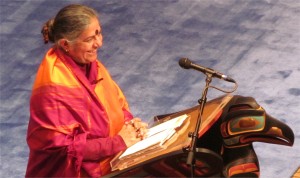 Last night’s talk by Vandana Shiva left a sold out auditorium at the University of Victoria humming with righteous energy.
She reported with eloquent passion on the state of food in the world today, leading with the unfortunate news of the “Monsanto protection act” which Obama signed only a couple of days ago, and which protects the biotech industry from any liability for the harm it may cause.
And biotech is causing great harm. It has not increased yields or fed more people or reduced the use of chemicals in agriculture. The yields are the same, for it is the nature of the seed, not the pesticide technology that governs yield; 90% of the GM soy and corn crops grown are not grown for human consumption, but for animal feed or fuel; and now that Roundup has created Roundup-resistant weeds, the biotech crops need to be doused in Agent Orange to keep the weeds down. The fact remains that the vast majority of people, globally, are being fed by small farms, and this remains the only hope for feeding the world in the future.
She acknowledged that we are living in tyrannical times, but said there was still much we
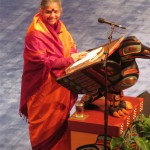 can do. The small rebellions can be the most satisfying. When the British tried to place a monopoly on salt in India, Gandhi’s response was to wade into the ocean and show that nature provides what we need. Similarly, when multinationals inject genetic material into plants and claim ownership, they are playing god. Our individual response should be to save seeds, she says. Even something in a flowerpot on your balcony will do it.
And there was much more, of course. Watch for a video record of her talk which I’m told will be posted on UVic’s website next week.
-
Full steam ahead: a week of talks!
Read Full Post: Full steam ahead: a week of talks! Lots going on this week. If you’re in town I hope you can make it to one or more of these different events!
On Tuesday evening, March 19, look for me in Fernwood, where I’m talking urban agriculture at Fernwood U. Cornerstone Cafe, 1301 Gladstone Avenue, Victoria, at 7pm. (Free!)
Friday night, March 22, I’ll be reading at Planet Earth Poetry alongside Rosemary Griebel. Moka House Cafe, #103-1633 Hillside Avenue, Victoria, at 7:30pm. (Nearly free – just $3)
Saturday afternoon, March 23, I’m on the Food Writing panel at the WordsThaw Spring Writing Symposium, hosted by the Malahat Review, an all day affair that runs 10am until 10pm at the University of Victoria, Human & Social Development Building, Room A240. ($40-50, but you get a whole day of literary fun for your money)


Latest Posts
- Writers at Word!
- Sublime and Twisted Readings coming up!
- Sublime
- Good weather for reading
- The world, the world
- Sublime launch!
Aldeburgh Poetry Festival Barny Haughton BBC BC poets Berkswell blackberries Black Stilt Bologna book launch Borough Market Carlo Petrini Catalonia Cyrus Todiwala dairy Daunt's Books Dijon Edinburgh Fanny Bay Feast of Fields Food and Morality food history food journalism Jenna Butler lardo Malahat Review Michael Pollan Okanagan olive oil tasting olive trees Omnivore's Dilemma Our Food Our Future Oxford Parmigiano-Reggiano Planet Earth Poetry poetry poetry readings Poetry videos prosciutto salumi Sean O'Brien Suffolk ticks Wendy Morton Wired Writing Yvonne Blomer
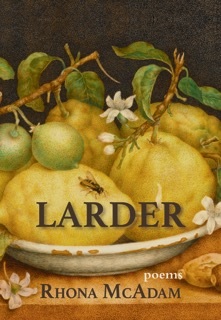
In her latest collection, Rhona McAdam navigates the dark places of human movement through the earth and the exquisite intricacies lingering in backyard gardens and farmlands populated by insects and pollinators, all the while returning to the body, to the tune of staccato beats and the newly discovered symmetries within the human heart.
“…A beautiful, filling collection, Larder is a set of poems to read at the change of the seasons, to appreciate alongside a good meal, and to remind yourself of the beauty in everything, even the things you may not appreciate before opening McAdam’s collection….”
Rhona McAdam is a writer, poet, editor, and Registered Holistic Nutritionist with a Master’s in Food Culture from Italy and a deep-rooted passion for ecology and urban agriculture. Her work spans corporate and technical writing to poetry and creative nonfiction, often exploring the vital links between what we eat and how we live. Based in Victoria, BC, and available via Zoom, Rhona is always open to new writing commissions, readings, or workshops on nutrition and the culinary arts.