-
Bread and summer
Read Full Post: Bread and summer
Denman Island Strawberry Shortcake Things have gone into summer drift here at the Iambic Cafe. I’ve been jolted into action by my friends at the Kneading Conference West, who’d like me to share with you news of their upcoming gathering, September 12-14, to be held once again in the exquisitely perfect setting of the experimental orchard at the Mount Vernon Research Station. If you love bread and/or grain and want to spend a delicious weekend with farmers, millers, bakers and foodies in the gorgeous Skagit County countryside for a paltry $300 (meals included) you should register now! Keynote speakers this year include renowned New York grain grower/flour producer Thor Oechsner and Gastronomica founding editor Darra Goldstein and there will be workshops in artisan bread baking, pastry baking, grain growing, milling and wood-fired oven construction.
In other news, here’s a taste of my summer so far:

Reading in Bellingham 
Denman Isl.Garden Tour 
CSF seafood share 
Solstice Moon on the Gorge 
Oddly shaped fruit 
Canada Day on the Gorge 
GTUF garden tour 
Nettie Wiebe at CAFS 
Lots of farmers markets 
Haliburton Farm chicks -
ASLE 2013 – plenaries, poetry & medicinal plants
Read Full Post: ASLE 2013 – plenaries, poetry & medicinal plants
I managed to get a long overdue poetry reading into my ASLE week, attending the plenary reading by Maine poet Jeffrey Thomson and Colombian writer Juan Carlos Galeano, who teaches in Florida. I had first encountered Galeano at my first ASLE at UVic in 2009, where he read some of his translated poems from Amazonia, a charming collection that draws its inspiration from Amazonian folk tales. This time he read from that, accompanied by projected translations, as well as from a new work just published (in Spanish) in Peru, Special Report on the Wind. Thomson read from several works, notably his 2009 collection Birdwatching in Wartime; his anecdote about hanging back while the sounds of a group of students he was with faded and observing the way the forest animated after the humans had left stayed with me as a good metaphor for what a lot of presentations touched on.
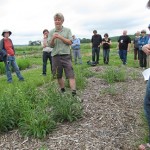 The Friday afternoon field trip I chose was a trip to the Native Medicinal Plant Research garden, which also houses the university’s community gardens. We were led down the garden path by the excellent Kelly Kindscher, a highly knowledgeable prairie ethnobotanist and wetlands advocate, who explained a bit about the program and let us pick, crush, sniff and ponder over many of the garden’s plants. The program’s main aim is to examine native plants for cancer-healing and antioxidant properties, and Kindscher made some interesting observations about the narrowness of that kind of research: what else might we be missing by focusing on molecules? As if to prove the point I caught myself asking which part of the immune-boosting Topeka Purple Coneflower (echinacea atrorubens) was used for tea. How locked we all are in our modes of thinking: had I not just heard Karin Kilpatrick say that one Western medicine’s many mistakes is failing to use the entire plant as native cultures do? Below, we look at Rattlesnake Master (Eryngium yuccifolium), Kelly demonstrates the invasive power of Milkweed (Asclepias syriaca. a good food – if cooked) ironically invading a patch of mint; and the star plant of the moment, the Long-Leafed Ground Cherry (Physalis longifolia) which is showing some powerful antioxidant properties, offering 14 new compounds that reduce tumour size in breast and pancreatic cancer.


Finally, my day came first thing on Saturday morning when I read my personal essay in the company of two quite different academic papers. I had not expected more than a couple of people to attend, since it was 8:30 in the morning and the room was murderously difficult to find, but we had a healthy gathering of 15 or so which was gratifying, and the discussion was interesting and friendly. The sessions I went to in the Species & Food subject stream were all pretty well attended; I understand it was the first time ASLE had had a food theme, so I expect it will continue. Since I have the floor, here is the panel in its entirety: Shamim Us-Saher Ansari, St. Louis Community College-Meramec: ‘You are What You Eat and How You Eat’: The Ethics and Aesthetics of Eating in French Canadian Culture as Dramatized in Willa Cather’s Shadows on the Rock; Bethany Ober, Penn State University: Expanding the Limits of Gender and Domesticity in Contemporary Ecofeminist Memoir; and Rhona McAdam, In your own backyard: Food sovereignty & the urban garden.
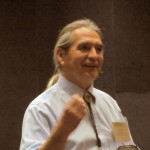 After that there was only time for one more session before I had to leave for the airport, and fortunately for me it was Daniel Wildcat. The title of his topic, After progress: Enacting systems of life-enhancement frankly put me off but I went anyway and was very glad I did, as he was an entertaining and persuasive speaker. Describing himself as a recovering academic, he spoke about how to respond to a damaged world, using “indigenous realism.” This is not, he stressed, naive romanticism: that label is better represented by the idea that humans are in charge of the balance of life on the planet. What we need, he said, is a cultural climate change, one that bridges the gap from knowing to doing and does not include a division between nature and culture. Storytelling is lost: the stories our children hear now are not the wisdom transmitted by their elders, but 30 second soundbites developed by corporations in order to teach kids to be consumers. We need to get from a sense of inalienable rights to one of inalienable responsibility, in a world of relationships not resources. The least each of us can do, if we can’t fix the planet, is to become a better relative and make the world a better place for nonhuman relatives.
 -
ASLE 2013 – been & gone
Read Full Post: ASLE 2013 – been & gone
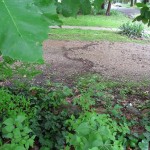
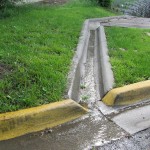
Water could have been the theme at ASLE 2013. At the opening reception, the Provost of KU promised us that Kansas is a great place when it’s not raining or snowing… but life does end up being a lot about water management when you get, as Lawrence did, five inches of rain in three days. Lots of impermeable surfaces on the hilltop campus mean lots of extra drainage. I guess it all ends up in the Kansas River, which ends up in the Missouri River, which ends up in the Mississippi and on into the Gulf of Mexico, instead of back in the groundwater. Although as we heard from Kelly Kindscher, the impassioned ethnobotanist who led our Friday afternoon tour of the university’s Native Medicinal Herb Garden, some of the topsoil is very deep and there are clay deposits of such depth that may be separating groundwater from deeper water deposits.
My first conference appearance was on Wednesday when I chaired a panel called Race, Gender, Garden, Region which rambled across Leslie Marmon Silko’s novel Gardens in the Dunes, gendered landscapes in early 20th century New England Ballads and an analysis of “
 A French Garden in England: A record of the successes & failures of a first year of intensive culture” by Helen Nussey and Olive J. Cockerell, a garden memoir from 1909, which sounded fascinating. It is charmingly illustrated by Cockerell – who had made a name illustrating fairytales – and faithfully records instructions, successes and failures. I’ll have to have a look next time I’m at the British Library.
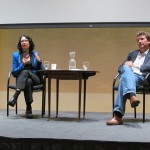 The first plenary I attended featured Stacy Alaimo and Cary Wolfe. Alaimo kicked off her discussion of deep sea environmentalism with an apt New Yorker cartoon, and then took us through some of the decade’s worth of work from the Census of Marine Life. Wolfe, referring to his recent book Before the Law: Humans and Other Animals in a Biopolitical Frame, riffed on such thoughts as what kinds of creatures is it ok to do what to; and whose lives count as lives and whose life counts as a “grievable life”.
Picking a couple of favourite presentations from favourite sessions – hundreds? thousands? to choose from – I was particularly moved by a paper by Hillary J Fogerty, from Missouri Southern State University, the irresistably-titled Why she can`t stop talking about the farmers market: Considering the role of activism and Advocacy in Food Studies Pedagogy and Curriculum. She described a research course for English students which she rewrote to allow students – largely from disadvantaged socio-economic groups – to study their own food security, developing research and writing skills while keeping food diaries, analyzing food advertising and ultimately in many cases changing the way they ate. She described students three years later shouting across parking lots at her to share weight loss, dietary changes and other improvements which were all the more remarkable for taking place in a town that is the headquarters for Tyson Foods, with Walmart down the road and in the looming shadow of Monsanto. Those students were likely directly dependent on those companies by direct or indirect family ties.
My other favourite, a no-brainer, was the personal essay by Dan Philippon describing a visit to Italy where he guest-lectured at the University of Gastronomic Sciences and spent time with his family visiting food producers in the Piemonte region. His talk, Slow Food or Small Food? Learning from Italian Producers, hinged on his visit to a small flour and polenta mill, Mulino Marino, and what he learned there about perceptions of quality, marketing, tradition and technology. He summed up his findings – what the producers he spoke to believed – as:
1. quality matters
2. organic and natural do not equal quality
3. history and tradition matter, but so do technology and innovation
4. local cannot be untangled from global
5. small food good; big food badI will finish in my next posting to mention my own paper, two different but inspiring plenaries and a field trip.


Latest Posts
- Writers at Word!
- Sublime and Twisted Readings coming up!
- Sublime
- Good weather for reading
- The world, the world
- Sublime launch!
Aldeburgh Poetry Festival Barny Haughton BBC BC poets Berkswell blackberries Black Stilt Bologna book launch Borough Market Carlo Petrini Catalonia Cyrus Todiwala dairy Daunt's Books Dijon Edinburgh Fanny Bay Feast of Fields Food and Morality food history food journalism Jenna Butler lardo Malahat Review Michael Pollan Okanagan olive oil tasting olive trees Omnivore's Dilemma Our Food Our Future Oxford Parmigiano-Reggiano Planet Earth Poetry poetry poetry readings Poetry videos prosciutto salumi Sean O'Brien Suffolk ticks Wendy Morton Wired Writing Yvonne Blomer
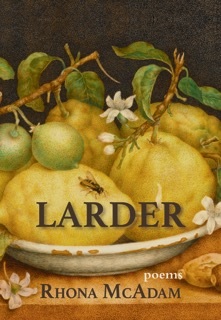
In her latest collection, Rhona McAdam navigates the dark places of human movement through the earth and the exquisite intricacies lingering in backyard gardens and farmlands populated by insects and pollinators, all the while returning to the body, to the tune of staccato beats and the newly discovered symmetries within the human heart.
“…A beautiful, filling collection, Larder is a set of poems to read at the change of the seasons, to appreciate alongside a good meal, and to remind yourself of the beauty in everything, even the things you may not appreciate before opening McAdam’s collection….”
Rhona McAdam is a writer, poet, editor, and Registered Holistic Nutritionist with a Master’s in Food Culture from Italy and a deep-rooted passion for ecology and urban agriculture. Her work spans corporate and technical writing to poetry and creative nonfiction, often exploring the vital links between what we eat and how we live. Based in Victoria, BC, and available via Zoom, Rhona is always open to new writing commissions, readings, or workshops on nutrition and the culinary arts.