-
Yogurt of the gods
Read Full Post: Yogurt of the godsWhile living in England I once said, only half in jest, that I would not return to Canada until they started selling Greek yogurt. Circumstances beyond my control made me break my vow, but I still think it was a good one to aim for. There is nothing like Greek yogurt. It is smooth and luscious and may be partly cream; the ewe’s milk version is far milder and creamier than anything made of goat’s milk. Traditionally it was made in porous ceramic pots which allowed the whey to leak out, leaving a thick yogurt, something between other yogurt and cream cheese. Greek varieties made with ewe’s milk contain about 5% milkfat, and cow’s milk yogurts contain 9% (as opposed to whole-milk yogurts in this country which have around 3.5%). You can try to make your own with this recipe. Fage Total Greek yogurt is my gold standard.
There is a legendary restaurant in London called Moro, serving Spanish and North African cuisine, and which has produced a couple of excellent cookbooks, first Moro: The Cookbook and then Casa Moro, which is mostly Spanish food. I have the first one, and in it I found a fabulous recipe for Leek and yogurt soup with dried mint. Lacking the Greek yogurt the recipe calls for, I used Jersey Farms 5% yogurt. Whatever you do, don’t use skim milk yogurt if you’re making this as it won’t have the right silky texture. The egg and flour mixed with the yogurt stabilise it and keep it from curdling, but it will separate if you over-heat it. The caramelised butter (a lot like the black butter in my skate recipe) is important too, as it really adds something to the flavour, which is mild and elusive. Don’t use fresh mint as it would be too.. minty. Here’s a slightly modified version of the Moro recipe (to serve four):
1-1/2 tbsp butter
3 tbsp olive oil
2 large or 4 medium leeks, trimmed, washed and sliced thinly
1 tsp paprika
1 tsp dried mint
1 egg
1 tsp flour
1-1/2 cups (350g) good thick full-fat yogurt
2 cups vegetable or chicken stock
caramelised butter (2 tbsp butter heated slowly just until the white bits turn golden)
Salt and pepper to taste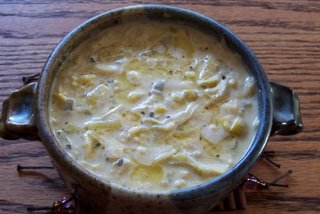 Over medium heat, melt butter in olive oil. Stir in the leeks and cook for 10 minutes. Add the paprika and dried mint and continue cooking gently, stirring occasionally, until the leeks are soft and sweet. Meanwhile, whisk the egg with the flour until a smooth paste is formed. Add the yogurt and thin with the water or stock. Pour over the leeks and heat gently until nearly bubbling. When hot, remove from heat and drizzle with caramelised butter.
 -
Better than a sandwich
Read Full Post: Better than a sandwich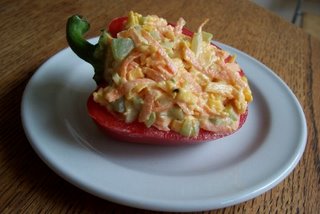
Stuffed peppers are usually cooked, but a long time ago I had a relative of this excellent raw lunch/snack and here is my version, which will stuff two small/medium bell peppers. I recommend red or orange as I prefer the sweetness. Gets a bit gooey if it has to travel, but will survive reasonably well till lunchtime if you refrigerate it. Or you can pack the stuffing separately from the pepper and stuff it when you are ready to eat. It makes a good sandwich filling or spread for toasted English muffins too.
1 medium carrot (about 3/4 cup) grated
3-4 oz cheddar cheese (about 1 cup) grated
1 small green onion, minced (optional)
1/2 rib of celery (about 1/3 cup) diced
1/3 cup mayonnaise, or to taste: just enough to glue everything together
Salt and pepper to tasteAn interesting side note about peppers. Bell peppers contain a recessive gene which eliminates capsaisin, the compound responsible for the ‘hotness’ found in other peppers. Capsaisin is the active ingredient in some topical analgesics used for arthritis treatment, such as Capzasin-P.
Caryl Churchill’s play, A Number, is playing at the Belfry in Victoria at the moment. Her most famous play, Top Girls, is being broadcast on Saturday as the BBC Saturday Play. Worth a listen, and available for a week after broadcast.
-
Mslexia, Kathleen Jamie and the University of Gastronomic Sciences
Read Full Post: Mslexia, Kathleen Jamie and the University of Gastronomic SciencesJust got my copy of the Apr/May/Jun issue of Mslexia. The annual poetry competition closes April 28, so you might squeeze in if you hurry. The theme for the next issue is Travellers’ Tales, and the one after that I’m sure will speak to a lot of us here on the Wet Coast this year: Rain. The Making a Poem column this issue features the Scottish poet Kathleen Jamie:
“I don’t believe in writer’s block. I think you write the things that are given to you to write and then you wait for the next thing that is given to you to write. In between are what we must call fallow periods. That’s the only word for it. I hate the idea of flogging yourself in production, producing stuff for the sake of it.”
Meanwhile, I’ve been thinking about going back to school and getting another master’s degree. The University of Gastronomic Sciences offers one in Food Culture: Communicating Quality Products. Based in Italy, the program includes rigorous field seminars to learn about the production of the best foods and wines of Italy, France, Spain and Northern Europe. Sounds like a worthy academic goal, no? The price tag, room, lunches and travel abroad included, is a trifling 21,000 Euros, or just a sliver of prosciutto under $30,000 Canadian. Well, we have till July to stew on it.




Latest Posts
- Writers at Word!
- Sublime and Twisted Readings coming up!
- Sublime
- Good weather for reading
- The world, the world
- Sublime launch!
Aldeburgh Poetry Festival Barny Haughton BBC BC poets Berkswell blackberries Black Stilt Bologna book launch Borough Market Carlo Petrini Catalonia Cyrus Todiwala dairy Daunt's Books Dijon Edinburgh Fanny Bay Feast of Fields Food and Morality food history food journalism Jenna Butler lardo Malahat Review Michael Pollan Okanagan olive oil tasting olive trees Omnivore's Dilemma Our Food Our Future Oxford Parmigiano-Reggiano Planet Earth Poetry poetry poetry readings Poetry videos prosciutto salumi Sean O'Brien Suffolk ticks Wendy Morton Wired Writing Yvonne Blomer
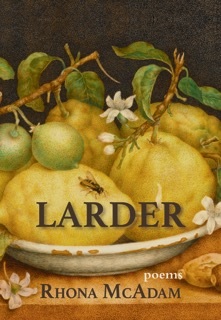
In her latest collection, Rhona McAdam navigates the dark places of human movement through the earth and the exquisite intricacies lingering in backyard gardens and farmlands populated by insects and pollinators, all the while returning to the body, to the tune of staccato beats and the newly discovered symmetries within the human heart.
“…A beautiful, filling collection, Larder is a set of poems to read at the change of the seasons, to appreciate alongside a good meal, and to remind yourself of the beauty in everything, even the things you may not appreciate before opening McAdam’s collection….”
Rhona McAdam is a writer, poet, editor, and Registered Holistic Nutritionist with a Master’s in Food Culture from Italy and a deep-rooted passion for ecology and urban agriculture. Her work spans corporate and technical writing to poetry and creative nonfiction, often exploring the vital links between what we eat and how we live. Based in Victoria, BC, and available via Zoom, Rhona is always open to new writing commissions, readings, or workshops on nutrition and the culinary arts.