-
One for the birders, and a bit about smoked salmon cheesecake
Read Full Post: One for the birders, and a bit about smoked salmon cheesecakeNeither food nor poetry, at least not poetry yet, and nothing too edible spotted… I have been taking an introductory birding class, and here’s what they tell us we saw on our last field trip today, a rainy, cold morning in Beacon Hill Park:
Glaucous-winged Gull
Mallard Duck, male and female
American Wigeon, male
Northwestern Crow
Violet-green Swallow
Barn Swallow
Vaux’s Swift
Great Blue Heron
Chestnut-backed Chickadee
Red-breasted Nuthatch
Hermit Thrush
American Robin
Rock Pigeon
Common Bushtit
Golden-Crowned Sparrow
Song Sparrow
Eurasian Starling
House Finch
Spotted Towhee
Wilson’s Warbler
Townsend’s Warbler
Yellow Warbler
Western Tanager
Orange-crowned Warbler (heard)
Downey Woodpecker, male
Spotted Towhee
Winter Wren (heard)Plus I saw a raven when I got home; I’d seen four of them being chased all the way down the Gorge Waterway by a flock of crows just yesterday. The best part of our field trip was seeing where the heronry was: we spotted about 20 nests in a single tree, several of them with herons in situ. Apparently they counted over 90 nests in that area last year.
Meanwhile, I thought I’d point you to a terrific smoked salmon cheesecake recipe, which I employed to much critical acclaim at the launch. It’s not hard to make but important I think that you not overcook it, so I reduced my oven to 300 instead of the 350 the recipe recommends. Also I substituted bottled (roasted+peeled) red peppers for the green peppers called for. Refrigerate it for a couple of hours before serving (one of those wonderful things that you can make the day before) and it will firm up nicely.
-
Sundae yummy sundae
Read Full Post: Sundae yummy sundaeI don’t eat much ice cream but… every so often I get a yen. A yearning. A downright craving. Believing prefab chocolate sauce is not only a dangerously stupid substance to keep in the house, it also doesn’t taste very good, now that my palate has been trained to high quality chocolate bars. So the obvious solution is to melt down a high quality chocolate bar – or as much/little of it as you need. Melt it on low heat with a dab of butter and thin with cream or milk and dribble in a bit of quality hooch like armagnac or calvados. Cool it a few minutes – while you toast some almond slivers in a frying pan – and then lavish it over the ice cream, add some whipped cream and the almonds and hey presto, we’re good till the next time.
Wednesday’s launch of Cartography was grand but I’ll save the word on that till Brian my ace photographer is able to share some of the snaps he took. Suffice to say I am snacking on leftovers, including some of that there smoked oyster pate which I made in happy memory of my first attempt back in February at the writers colony in Saskatchewan. I recommend it paired with Hardbite Jalapeno chips…
-
Sharpen those pencils
Read Full Post: Sharpen those pencilsA couple of submission opportunities have crossed my inbox lately.
The “Words for Wilderness” prose and poetry contest, sponsored by the Washington Wilderness Coalition (WWC), seeks work that comes from the heart of the wilderness and the writer. It can include both personal work that revels in the experience of nature as well as writing that explores political aspects of civilization’s relationship with wilderness. Winners will read their work at an event in late June. Deadline May 17, 2006
Seal Press, an imprint of Avalon Publishing Group, Inc. is seeking articles by women for a couple of new collections of essays about travel. Greece: A Love Story (deadline June 1st) needs essays on the Greece that lies behind postcards; and Go Your Own Way (Deadline: May 15, 2006) is seeking original, personal stories by women on the experience of traveling alone in all corners of the globe.


Latest Posts
- Writers at Word!
- Sublime and Twisted Readings coming up!
- Sublime
- Good weather for reading
- The world, the world
- Sublime launch!
Aldeburgh Poetry Festival Barny Haughton BBC BC poets Berkswell blackberries Black Stilt Bologna book launch Borough Market Carlo Petrini Catalonia Cyrus Todiwala dairy Daunt's Books Dijon Edinburgh Fanny Bay Feast of Fields Food and Morality food history food journalism Jenna Butler lardo Malahat Review Michael Pollan Okanagan olive oil tasting olive trees Omnivore's Dilemma Our Food Our Future Oxford Parmigiano-Reggiano Planet Earth Poetry poetry poetry readings Poetry videos prosciutto salumi Sean O'Brien Suffolk ticks Wendy Morton Wired Writing Yvonne Blomer
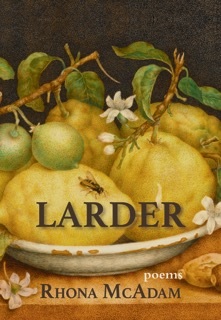
In her latest collection, Rhona McAdam navigates the dark places of human movement through the earth and the exquisite intricacies lingering in backyard gardens and farmlands populated by insects and pollinators, all the while returning to the body, to the tune of staccato beats and the newly discovered symmetries within the human heart.
“…A beautiful, filling collection, Larder is a set of poems to read at the change of the seasons, to appreciate alongside a good meal, and to remind yourself of the beauty in everything, even the things you may not appreciate before opening McAdam’s collection….”
Rhona McAdam is a writer, poet, editor, and Registered Holistic Nutritionist with a Master’s in Food Culture from Italy and a deep-rooted passion for ecology and urban agriculture. Her work spans corporate and technical writing to poetry and creative nonfiction, often exploring the vital links between what we eat and how we live. Based in Victoria, BC, and available via Zoom, Rhona is always open to new writing commissions, readings, or workshops on nutrition and the culinary arts.