-
Nose Diving
Read Full Post: Nose DivingI’ve yet to get my hands on a copy of Harold McGee‘s latest book, Nose Dive: A Field Guide to the World’s Smells, but I revere his classic work, On Food and Cooking: The Science and Lore of the Kitchen. And was delighted to catch his talk at last summer’s Oxford Symposium on Food & Cookery... That conference truly was one of the highlights of my year. A sincere thank you to pandemic lockdown which made it possible to attend, and even greater thanks to the Symposium organizers who demonstrated, with deceptive ease, how to run a warm and friendly event, attended by hundreds of food lovers from all points of the compass.
Since then, Symposiasts have been attending Kitchen Table discussions on many and various topics. Today’s theme was Smells Nasty and Nice: How they guide us in the kitchen and at the table. McGee was in conversation with food writer Fuschia Dunlop, and around 200 of us gathered round our Zoom screens to hear what they had to say, filling the Chat with the observations, quotes, questions, recommendations and the same passionately informed and good-natured banter that featured in the Symposium.
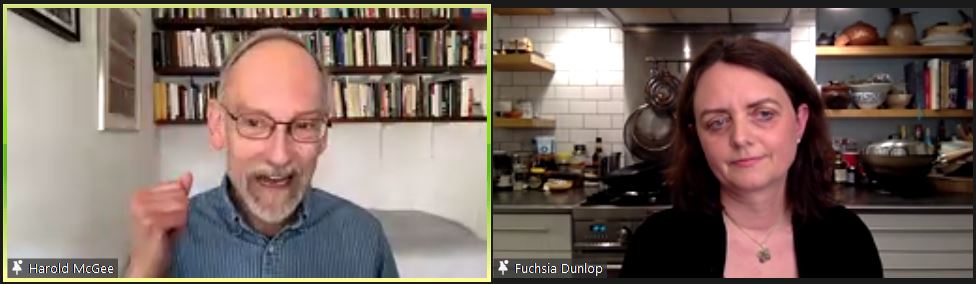
McGee enchanted us with language: the “osmocosm” is probably going to be our favourite word for a while.. encompassing geology, biology, human culture: the idea that where you live provides its own aromatic microspace. The smell of eucalyptus in San Francisco.. volcanic emissions in Hawaii.. the smell of the sea, and underlying notes of cedar used to welcome me off the plane when I’d return to Victoria.
Anosmia was a popular topic, since loss of smell (and taste) is so often a symptom of COVID-19 infection, but it can also signal other viral infections, and the sense of smell declines with age. McGee said he’d experienced anosmia a couple of times – including one bout while writing this book! – and that it greatly affected how he ate and cooked, and lived, since he stopped going out for meals as there was little point if he couldn’t taste the food.
Some smells are culturally defined – Dunlop, an expert in Chinese cuisine, described the concept of a ‘fishy’ smell in raw meat (Xīng wèi according to google translate), which is dealt with by specific preparation methods. though smell receptors are to some extent genetically determined, many smells are also contextual: such as a foul odour that followed Dunlop around town, before she realized she was carrying cheese bought earlier from Neal’s Yard Dairy (surely one of the most aromatic establishments in London). Foul became fair as she anticipated the meal to come.
A question about why out of season tomatoes don’t smell or taste of anything, and whether aroma is tied to nutrition, elicited what I am sure is a greatly simplified answer: aroma molecules in plant materials like fruits and grains are made in the course of making other molecules in the plants. Plants have limited resources in making those molecules, so having time to ripen fully will optimize the taste, texture, aroma and nutritional qualities (vitamin A in the case of the tomato). A particularly strong aroma may in fact occur at the expense of other aspects, like taste and nutrition. Growing a fruit (such as a commercial tomato) as fast and heavy as possible, pumped up with water, means all molecular pathways are being depleted, in which case a lack of scent will correlate with lack of nutrients.
Molecules are really McGee’s bread and butter. The book includes a number of tables, he said, that show molecular correlations between otherwise different foods, e.g. cucumbers and oysters. These tables show what chemists have uncovered that explain why two foods have similar aroma notes (but different intensities. A 2.5 year old Parmigiano-Reggiano cheese develops an aroma like pineapple – why those resonances exist is why the book came about. Even toxic chemicals, which in larger quantities warn us off eating a food, can, in tiny amounts in the background, add an enjoyable flavour; for example notes of ammonia are present in ripe camembert, but in over-ripe camembert the ammonia overwhelms – so if the chemicals are excessive, we know to avoid the food.
The book covers far more than cooking, but cooking came up a lot in the discussion, like the idea that cooks monitor their dishes through smell (this one does it by sound!) – a kind of aromatic index of the transformation from raw to cooked. But, said McGee, really most of us start at the beginning, a quality test: we sniff anything we start cooking with – nuts (so often rancid), meats, dairy – to see what shape it’s in before they start.
-
Poetry Among the Seeds
Read Full Post: Poetry Among the SeedsOur BC Virtual Seedy Saturday poetry lineup is out. Eleven BC poets will be featured among the talks that make up the three days of the event.
Some months ago, when the idea for a virtual event was mooted, I was talking to Carla Hick, one of the organizers from Farm Folk City Folk. She said they were open to all kinds of ideas, and the word “poetry” crossed her lips. I jumped on that and offered to organize something.
I conferred with a couple of people – Yvonne Blomer, who’s well connected in the Island poetry community; and then Nancy Holmes, who teaches at UBC-Okanagan in Kelowna and knows many of the mainland and BC Interior poets.
It was Nancy who put her finger on the key issue: a regular poetry reading would not do, as our audience was not a literary one, but made up of farmers and gardeners whose focus is seeds, plants and the products of horti- and agriculture. She suggested something more multimedia. “Why not poetry videos?” she mused. Inwardly I cringed – learn another thing? Would there be enough BC poets writing around our subjects and comfortable with the technology?
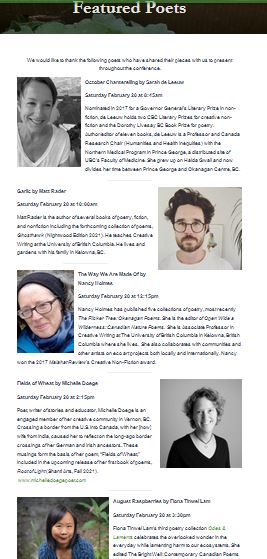
Turns out there were! Farm Folk City Folk reckoned we’d have room for 10 videos, scattered through the weekend’s program rather than posted as one long piece. In the end we’ve got 11 poets represented, and here they are, with the names of their pieces and the date/timing in the program:
Sarah de Leeuw – October Chanterelling – Sat Feb 20, 8:45am
Matt Rader – Garlic – Sat Feb 20, 10am
Nancy Holmes – The Way We Are Made Of – Sat Feb 20, 12:15pm
Michelle Doege – Fields of Wheat – Sat Feb 20, 2:15pm
Fiona Tinwei Lam – August Raspberries – Sat Feb 20, 3:30pm
Yvonne Blomer – Rhubarb, Death in a Garden – Sun Feb 21, 8:45am
Renée Sarojini Saklikar – Grandmother’s Instruction, Sun Feb 21, 10:05am
Shelley Leedahl – Sometimes – Sun Feb 21, 11:15am
John Barton Malus Pumila – Sun Feb 21, 12:30pm
Rhona McAdam! – Wild Bees – Sun Feb 21, 1:45pm
Cornelia Hoogland – Seaweed, Sun Feb 21, 3:45pmAll the poets used their own poems and created new videos for this program, so check ’em out! Registration for the weekend is only $5 (or more if you want to donate towards a share that goes to the organizing nonprofits). See you there!
-
Seedy Saturday, Pandemic Style
Read Full Post: Seedy Saturday, Pandemic Style
I’m back online after a long absence! It seems right to pick up the thread here with news of this year’s Seedy Saturday.
Autumn is the time gardeners and farmers are starting to pore over seed catalogs, and community organizers are normally well into booking venues and speakers and seed vendors for that fine Canadian tradition known as Seedy Saturday.
But back in the fall of 2020, infection numbers were starting their winter ascent, and we were beginning to hunker down for more isolation after a carefully sociable summer. So the folks from Vancouver’s Farm Folk City Folk took the bit between their teeth and invited regional Seedy Saturday organizers into a series of brainstorming meetings to see if we wanted to put all our seeds in one provincial basket.
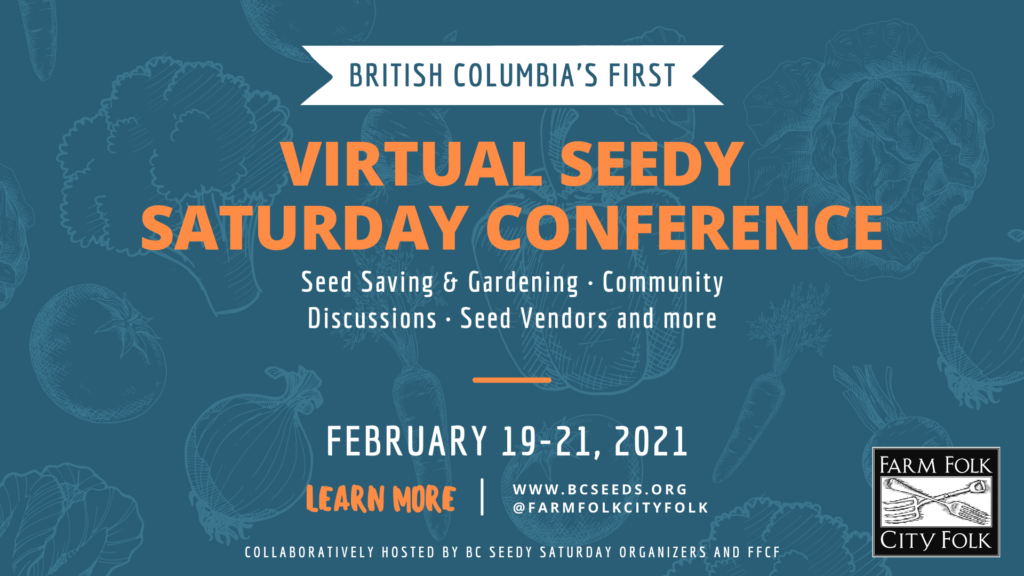
The consensus was a resounding YES. And FFCF has done a remarkable job of engaging seedy folk from around British Columbia to prepare a rich and fertile schedule for BC’s Virtual Seedy Saturday from Feb 19-21.
The nonprofit groups who organize local Seedy Saturday events in ‘normal’ times have lost this valuable source of income, and FFCF is sharing whatever profit may ensue with those groups. One of them, with which I’ve long been associated, is Haliburton Community Organic Farm.
Hali’s contribution is a talk by Kristen Miskelly of Saanich Native Plants, one of the longtime farm lessees on Hali’s land. She’ll be speaking on ‘Native Seed For Gardening and Restoration’.
I’ve also been working with Kelowna poet Nancy Holmes to coax poetry videos from BC poets. We approached those we thought would have a passion for seeds, gardens or similar, and our harvest will be scattered through the program. More on all this in upcoming posts!
Latest Posts
- Writers at Word!
- Sublime and Twisted Readings coming up!
- Sublime
- Good weather for reading
- The world, the world
- Sublime launch!
Aldeburgh Poetry Festival Barny Haughton BBC BC poets Berkswell blackberries Black Stilt Bologna book launch Borough Market Carlo Petrini Catalonia Cyrus Todiwala dairy Daunt's Books Dijon Edinburgh Fanny Bay Feast of Fields Food and Morality food history food journalism Jenna Butler lardo Malahat Review Michael Pollan Okanagan olive oil tasting olive trees Omnivore's Dilemma Our Food Our Future Oxford Parmigiano-Reggiano Planet Earth Poetry poetry poetry readings Poetry videos prosciutto salumi Sean O'Brien Suffolk ticks Wendy Morton Wired Writing Yvonne Blomer
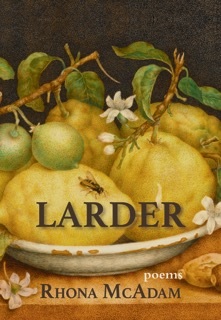
In her latest collection, Rhona McAdam navigates the dark places of human movement through the earth and the exquisite intricacies lingering in backyard gardens and farmlands populated by insects and pollinators, all the while returning to the body, to the tune of staccato beats and the newly discovered symmetries within the human heart.
“…A beautiful, filling collection, Larder is a set of poems to read at the change of the seasons, to appreciate alongside a good meal, and to remind yourself of the beauty in everything, even the things you may not appreciate before opening McAdam’s collection….”
Rhona McAdam is a writer, poet, editor, and Registered Holistic Nutritionist with a Master’s in Food Culture from Italy and a deep-rooted passion for ecology and urban agriculture. Her work spans corporate and technical writing to poetry and creative nonfiction, often exploring the vital links between what we eat and how we live. Based in Victoria, BC, and available via Zoom, Rhona is always open to new writing commissions, readings, or workshops on nutrition and the culinary arts.