-
News from the colony

We’re into the end of the middle of the first week of the writers’ and artists’ colony at St Peter’s and time is flexing its mean muscle as we brace ourselves for the first of two change-over weekends where some of us leave and some more of us arrive and we roll along together a while longer.
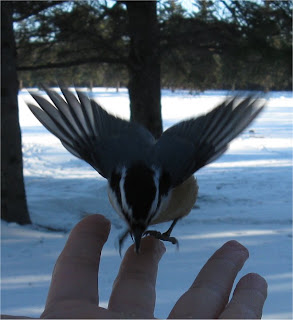
The birds have welcomed us back, the nuthatches being bolder now than the chickadees, and demonstrating an irksome singlemindedness where the menu is concerned. After one round of feeding I had run out of peanut pieces and had only a few sunflower seeds to offer; when nuthatch saw these it picked them up and threw them off my hand onto the ground and gave me a few gentle pecks on the fingers to record displeasure before flying off to have a public hissy fit in the trees. I don’t know what names I was called but they were certainly not nuthatch endearments.
Other wildlife encountered included a pair of poets and a nature writer, in the library, with a reading. Three books were launched before our eyes: Mari-Lou Rowley‘s Suicide Psalms;
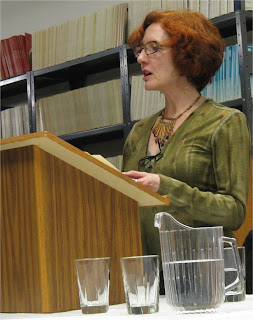
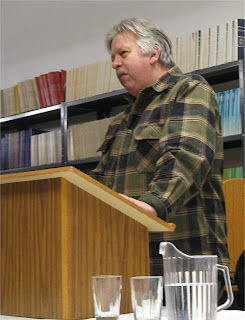
and Candace Savage‘s Bees: Nature’s Little Wonders.
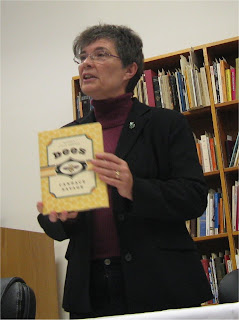
It was an excellent reading all round, with offerings of intensity, hilarity and curiosity. The Bee book in particular was a treasure: absolutely gorgeous design and offering a fascinating trail of poetry, myth and research about honeybees.
-
Valentines wishes
GE Free BC reports that our biggest sugar processing company, Rogers/Lantic, the last GM-Free sugar beet processing company in North America, is about to decide if they will accept GM sugar beet this growing season. This sugar beet has been genetically modified to resist Monsanto’s herbicide Roundup. Because sugar beets are wind-pollinated, there is a huge risk of cross-pollination between GM and conventional varieties, as well as related crops such as organic chard and table beets.
And as always, of course, there’s the overriding safety concern about genetically-modified plants intended for human consumption, which is that we simply don’t know enough about the long-term health risks of eating such foods. To paraphrase what I heard one seed grower say about it, do we really have the right to perform this kind of science experiment on our grandchildren?
It is suggested, therefore, that you send a special valentine to Rogers/Lantic’s CEO, Edward Makin, asking that he keep our sugar GE free.
Another sweet thought this week might include sending a submission to a new publication, Food & Sex (a new independent quarterly that explores the history, nature and culture of food and sex) from The Bouwerie, “a collective of visual linguists, wayfaring wordsmiths, agricultural artists, and culinary arbiters” who also bring you the very useful Eat Well Guide, a fun search tool to keep you sustainably nourished in Canada and the U.S.
-
Cholesterol numbers, and howd’ya like them eggs
Greetings from Saskatchewan where the weather is bright and not too cold for walks among the chickadees and nuthatches who have, we flatter ourselves to suppose, been waiting for us and our pockets full of peanuts since last winter’s colony.
A little while ago I was having one of my food-obsessed conversations with someone and struggled to remember something I’d read about cholesterol in Gina Mallet‘s Last Chance to Eat: The Fate of Taste in a Fast Food World. I tracked it down in her chapter on The Imperilled Egg.
Dr [Donald J.] McNamara explained that [in 1968] a group of food scientists got together and thrashed out the idea of setting a safe cholesterol standard. Some thought the whole idea unnecessary, but others were adamant. So the debate went back and forth and finally a compromise was reached. The average human intake of cholesterol is 580 mg (per litre of blood) a day, so let’s just halve that. Make it 300 mg. ‘There’s not one bit of scientific evaluation in that number,’ Dr McNamara added.
This was amazing to me; I’ve heard and read a lot about the egg debate but never seen the fundamental RDA numbers contested so simply. She continues, “Cholesterol is created by the way the body processes food, not by foods like eggs that contain cholesterol… So, overnight as it were, and on the basis of an arbitrary calculation the egg was in trouble, deep trouble.”
(Of course the source of your eggs is a whole other question. As with anything we consume, we need to be aware of what our food was fed on. Eggs from battery chickens – fed on Omega-6 rich grains – will not be as nutritionally sound as from pasture or organically fed free-run chickens who can glean nutrients from varied sources and live healthier lives.)
Cholesterol – and the case of the imperilled egg – is only one of those areas where we’ve been battered by contradictory scientific opinions till we’re not sure which way is up anymore. Mallet affirms the anti-nutritionism position for which Michael Pollan has been slammed by, of course, food scientists:
People today are blasé about food science because they have been frightened into changing their diets so many times only to be told later that the scientists were wrong. For years, people believed in food science and obediently ate fibre to stave off colon cancer. Then, suddenly, they were told fibre makes no difference. Margarine was briskly touted as an excellent, healthy substitute for butter, cheaper too: and even though margarine has a disagreeable taste and ruins any dish it is cooked with, people obediently used it, thinking they were lengthening their life span. Now, of course, margarine is ringed with red flags as a trans fat, the deadliest of fats.


Latest Posts
- Sublime
- Good weather for reading
- The world, the world
- Sublime launch!
- Planet Earth Poetry – Readings by Volunteers, Victoria 2026
- Poetry at the Goldfinch
Aldeburgh Poetry Festival Barny Haughton BBC BC poets Berkswell blackberries Black Stilt Bologna book launch Borough Market Carlo Petrini Catalonia Cyrus Todiwala dairy Daunt's Books Dijon Edinburgh Fanny Bay Feast of Fields Food and Morality food history food journalism Jenna Butler lardo Malahat Review Michael Pollan Okanagan olive oil tasting olive trees Omnivore's Dilemma Our Food Our Future Oxford Parmigiano-Reggiano Planet Earth Poetry poetry poetry readings Poetry videos prosciutto salumi Sean O'Brien Suffolk ticks Wendy Morton Wired Writing Yvonne Blomer
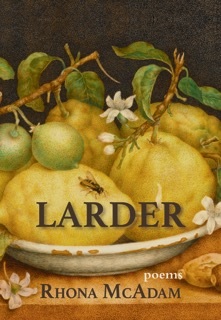
In her latest collection, Rhona McAdam navigates the dark places of human movement through the earth and the exquisite intricacies lingering in backyard gardens and farmlands populated by insects and pollinators, all the while returning to the body, to the tune of staccato beats and the newly discovered symmetries within the human heart.
“…A beautiful, filling collection, Larder is a set of poems to read at the change of the seasons, to appreciate alongside a good meal, and to remind yourself of the beauty in everything, even the things you may not appreciate before opening McAdam’s collection….”
Rhona McAdam is a writer, poet, editor, and Registered Holistic Nutritionist with a Master’s in Food Culture from Italy and a deep-rooted passion for ecology and urban agriculture. Her work spans corporate and technical writing to poetry and creative nonfiction, often exploring the vital links between what we eat and how we live. Based in Victoria, BC, and available via Zoom, Rhona is always open to new writing commissions, readings, or workshops on nutrition and the culinary arts.