-
Sustainability on land and sea
Glad to see Red Fish Blue Fish get some more media attention. They produce some excellent grub from their tiny home in a green-roofed shipping container in Victoria’s Inner Harbour.
Had a note from BCSEA giving some follow-up NotStupid suggestions for positive actions following last week’s screening of The Age of Stupid. They are local to BC but I offer them in case they inspire thought for elsewhere. Here they are:
A. Five Political Actions
1. Sign BCSEA’s online petition to Let LiveSmart Live — to be presented in the BC Legislature as soon as possible. Sign the petition now. We know there’s a desire among many people within government to get the program renewed, but we must apply pressure.
2. Send an email to Prime Minister Stephen Harper, urging him to stop messing around with our children’s future and make a serious commitment before the Copenhagen Conference to reduce Canada’s GHGs by 25% below 1990 by 2020, as Japan has done. pm@pm.gc.ca
3. Send a similar email to Michael Ignatieff, leader of the Liberal Party. Ignatieff.M@parl.gc.ca
4. Attend the free lunchtime lecture on Friday, October 2, Greening the Future? Climate Change, Energy Systems, and Sustainability with UVic’s Dr. Kara Shaw . Call 250-472-4747 to register (Lecture Code: ASDS240 2009F E02)
5. Plan to join the October 24th International Day of Climate Action, starting in Centennial Square at 12 Noon. At the time of writing, 1528 actions are being organized in 125 countries. See 350.org and 350.org/Victoria. This day brings an amazing opportunity for us all to work together. If you can’t make Centennial Square, create your own event, however small.B. Three Personal Actions
1. If you are not already a member of the BC Sustainable Energy Association, please consider becoming one. Members not only allow BCSEA to put on events like The Age of Stupid, but they’re the driving force behind our projects too. Join now!
2. If you do not already receive EcoNews, Victoria’s monthly environmental newsletter, click here to receive it. And check out the EcoNews monthly Green Diary.
3. Adopt your local MP or MLA, and become their personal climate solutions email service, sending them regular stories that make you concerned or hopeful.C. Five Household Actions to Reduce your Carbon Footprint
1. Get your home energy-audited, and invest in measures to save energy (EcoEnergy grants available).
2. Take advantage of special homeowner grants – still available for a limited time – to install a solar hot water system. See BCSEA’s SolarBC website for details.
3. Grow your own food, and buy more locally grown organic food. Start eating a more vegetarian diet. There are lots of courses at the Greater Victoria Compost Education Centre and elsewhere.
4. Dust off your bicycle, or buy a new or a second hand one. Join the Greater Victoria Cycling Coalition, and work with them to push for more cycling paths and lanes.
5. Think about ride-sharing for regular trips to work, school, sports, choir, or church. Consider selling your car and joining the Victoria Car Share Cooperative.The poetry part of this blog is about to make a return as I set off for Banff to work on my food poems for a couple of weeks. See you over the mountains!
-
End of summer Hali-days; Farm Food Freedom
It was my last Wednesday work party at Haliburton yesterday, which we spent harvesting tomatoes (growing very interesting shapes!)
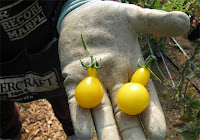
and weeding the squash patch which was full of mustard weed and smartweed in flower and seed. Meanwhile the farmers are gearing up for squash season and the Halloween extravaganza: pumpkin carving (for which they are not using certified organic pumpkins, I believe, though some of the farm’s produce will be turned into food to munch on during the events) and composting party, held in conjunction with the Compost Education Centre. The Sunbird farmers as always have an aesthetically superior arrangement

though the Terralicious greenhouse also sports a nice line of pumpkins
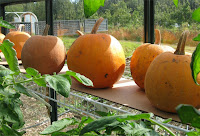
and some beautiful squashes indoors as well.
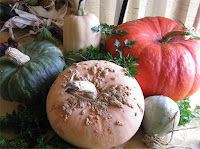
The best finale – in addition to seeing the well-named everbearing raspberries still on the farmstand – was taking home the last watermelon! Not a great example of the variety since it’s missing its stars, it’s an heirloom Moon & Stars – thought to be the oldest watermelon.

An amusing account came through on the COG listserv, about a recent Farm Food Freedom dinner to raise awareness and funds for the campaign against mindless government restrictions on farming (affecting meat and milk and eggs etc.), which featured a quiz that people could attempt, with questions such as the following:
1. Which of the below items are illegal in British Columbia? Put an X by the illegal activity.
1. Selling a rifle from your home.
2. Selling food with measurable pesticide residues from your home.
3. Selling an organic freezer turkey from your home.2. Which of the animals below are illegal to own in the town of Sechelt?
1. A pair of pit bull terriers.
2. A Rotweiller/mastiff cross.
3. A lamb.3. Things that cannot be legally purchased in Canada – Cross out the illegal item.
1. Fireworks.
2. Bullets.
3. Red Fife Wheat seed.4. Farmers must now submit recipes and completed laboratory test results of all cooked foods to Health Departments before selling them at the Farmers Market. This new move apparently protects our health. Circle the items that the Health Departments are not concerned with as an ingredient.
1. Pesticides.
2. Herbicides.
3. Fungicides.
4. All of the above.5. The vast majority of food borne illnesses result from errors at:
1. Unregulated farms.
2. Farmers Markets without Health approval.
3. Government licensed food processing plants.6. How many cases of food borne disease per annum have been attributed to eating un-inspected meat? Circle it.
1. Over 50
2. Over 100
3. None7. Which of the fines below apply to farmers proven to be selling farms meats from their homes? Circle it.
1. $500 – $800.
2. $1000 – $3000
3. $25,000 – $50,0008. Which of these items was confiscated by inspectors from a Canadian Seedy Saturday as an illegal product? Put a dark line through it.
1. GM beet seeds.
2. Roundup ready canola seed.
3. Small Yukon gold potatoes.9. Which of these common farm practises are illegal? Cross it out.
1. Using large tractors with un-tuned engines for small jobs.
2. Applying excessive nitrogen fertilizers that destroy soil.
3. Selling fresh eggs in a clean container at an un-refrigerated farm stand.10. Put a big X by the item that you can only purchase on the black market.
1. A 26 oz bottle of Vodka on a long weekend.
2. A case of Player’s Light from a corner store.
3. A jar of milk fresh from the cow.And yes, the correct answer number is the same all the way through. A good way I thought to make some serious points about local food supply and irrational government restraints on meat, milk and egg farmgate sales. If you’d like to join the freedom fighters, you can find print-your-own stickers and bumper stickers on Farm Food Freedom or under “Be Subversive” at Edible Landscapes.
-
GM day – hello US GM beet ban – goodbye organic corn?
Excellent news this morning about sugar beets south of the border: a federal court ruling that the US government illegally approved genetically modified sugar beets, on the grounds that they cross-pollinate easily, making it impossible for those who wish to grow non-GM beets to continue doing so.
Which begs the question about the approval of SmartStax GM corn: one might question the approval of a wind-pollinated member of the grass family in countries where the only GM labelling permitted is that of its negative: certified organic food cannot contain genetically modified ingredients.
Monsanto/Dow Chemical’s SmartStax GM corn was approved in the US and Canada in what I hope is record speed (I would hate to think this is the turnaround for all product approvals).
It took the EPA and the CFIA about a month to approve the stuff, from the time Monsanto submitted its documents on June 16 until the official registration July 20, which rather suggests they didn’t bother overmuch with doing their own messy safety checks or independent evaluation of environmental risks, preferring to accept Monsanto’s research. Is such haste normal? If it’s not, it appears to mark some new dodge on Monsanto’s part, that they have figured out how to outmaneuvre those pesky regulations.
Approval in Canada was announced the same day as in the US; I’m told it’s normally just a matter of rubber-stamping such products once they’ve been approved in the US. Canada certainly hasn’t demonstrated much interest in reining in the environmental or health risks of GM in the past: look at the trade pickle we ended up in recently with contaminated flax seed. Health Canada has a lovely flow chart that shows the steps required, officially, to assure our safety, but it’s hard to match all these steps to the approval of SmartStax. Here’s a full list of the GM products we already have on our tables here. So far, SmartStax doesn’t appear on the list.
Whether our legislators will attend to US court rulings, or somehow maintain that our winds don’t blow the same as theirs is another question. As is whether Canada will respect the very similar US court judgement that ruled GM alfalfa posed undue risks of cross-pollination to farmers who didn’t want to grow it, resulting in a nationwide ban in the States.
Meantime, GM sugar beets have been planted in Canada for the first time this year; your sugarbowl will certainly contain some GM sugar if you buy Rogers sugar. Vote with your dollars, folks.


Latest Posts
- Sublime
- Good weather for reading
- The world, the world
- Sublime launch!
- Planet Earth Poetry – Readings by Volunteers, Victoria 2026
- Poetry at the Goldfinch
Aldeburgh Poetry Festival Barny Haughton BBC BC poets Berkswell blackberries Black Stilt Bologna book launch Borough Market Carlo Petrini Catalonia Cyrus Todiwala dairy Daunt's Books Dijon Edinburgh Fanny Bay Feast of Fields Food and Morality food history food journalism Jenna Butler lardo Malahat Review Michael Pollan Okanagan olive oil tasting olive trees Omnivore's Dilemma Our Food Our Future Oxford Parmigiano-Reggiano Planet Earth Poetry poetry poetry readings Poetry videos prosciutto salumi Sean O'Brien Suffolk ticks Wendy Morton Wired Writing Yvonne Blomer
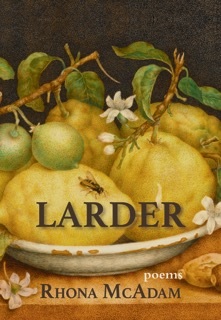
In her latest collection, Rhona McAdam navigates the dark places of human movement through the earth and the exquisite intricacies lingering in backyard gardens and farmlands populated by insects and pollinators, all the while returning to the body, to the tune of staccato beats and the newly discovered symmetries within the human heart.
“…A beautiful, filling collection, Larder is a set of poems to read at the change of the seasons, to appreciate alongside a good meal, and to remind yourself of the beauty in everything, even the things you may not appreciate before opening McAdam’s collection….”
Rhona McAdam is a writer, poet, editor, and Registered Holistic Nutritionist with a Master’s in Food Culture from Italy and a deep-rooted passion for ecology and urban agriculture. Her work spans corporate and technical writing to poetry and creative nonfiction, often exploring the vital links between what we eat and how we live. Based in Victoria, BC, and available via Zoom, Rhona is always open to new writing commissions, readings, or workshops on nutrition and the culinary arts.